Reviews and occasional notes on classical music
"Music, both vocall and instrumental, so good, so delectable, so rare, so admirable, so super excellent, that it did even ravish and stupifie all those strangers that never heard the like." - Thomas Coryat, after hearing 3 hours of music at the Scuola di San Rocco in Venice, 1608.
Showing posts with label Duke Ellington. Show all posts
Thursday, May 10, 2018
An important concert finally on CD
Duke Ellington in Coventry, 1966
The February 21, 1966 concert of the Duke Ellington Orchestra at Coventry Cathedral was a big deal. "It’s one of the most satisfying things I’ve ever done,” said Duke in an interview with TV Times, “...and the most important. It’s a personal statement. It’s a personal statement about belief." The concert has been very well documented with photographs from both the rehearsal and the concert itself. Here's a shot by Bill Wagg:
As well, the 55 minute television broadcast from ABC Midlands, first shown in April 1966, has apparently been re-shown recently on ITV in Britain, though I haven't yet found it on DVD or streaming video. Now, finally, we have this great-sounding CD from Storyville, due on June 8, 2018. Storyville knows its Duke; they have more than 100 Ellington titles in their catalogue. Their restoration engineers also have demonstrated that they can make the most out of pretty much any source material, and this disc ends up sounding pretty decent. The band is on top form; here is the lineup:
The orchestra added English vocalists for the concert, soloist George Webb and the Cliff Adam Singers, and they're very fine in their numbers. The band of course misses Billy Strayhorn, who died in May of the following year, but Duke's piano solos are first class and very moving. There's so much expression here; some of that comes of course from his deeply-held spiritual beliefs, but I expect he's already beginning to mourn the loss of his great collaborator.
Here's a lovely story about a 14-year old boy & his jazz-loving father listening in on Duke's rehearsal at the Cathedral.
Wednesday, April 5, 2017
The real Duke underneath
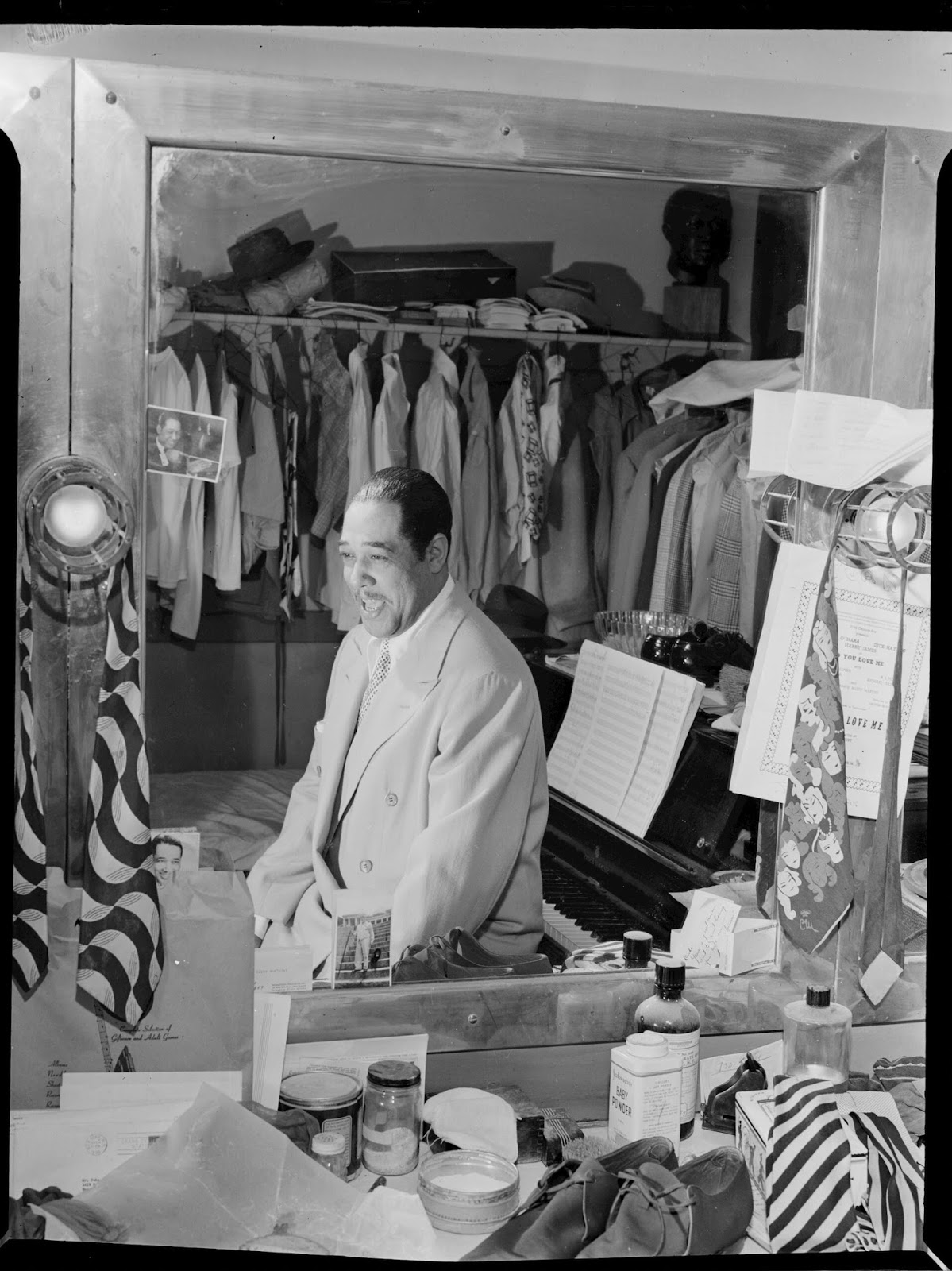
From the beginning Duke Ellington had style and a strong sense of himself; as a child, according to Terry Teachout's excellent biography A Life of Duke Ellington, he "carried himself like a prince of the realm." Once he became Duke, with his own band, everything was subsumed by elegance and refinement; nearly every description of his ensemble includes the words "style" and "sophistication". This is apparent in the famous picture William P. Gottlieb took of Duke in his dressing room at The Paramount in New York in September 1946.
![]() |
| Library of Congress |
Here's his first take of Billy Strayhorn's lovely Lotus Blossom:
Ellington has said that Billy Strayhorn loved to listen to him play Lotus Blossom; it's the last track on ...And His Mother Called Him Bill, Ellington's 1967 memorial for Strayhorn, who died that year. The emotional impact of that track is astonishing. This album is full of such personal items; My Mother, My Father and Love is one, which looks back on a largely happy childhood and deep, deep feelings of family and connection and love. There are more extroverted songs from the 1972 concert as well, with contributions from band singers Anita Moore and Tony Watkins. Storyville has filled out the album with four songs by Ellington's band from a 1969 concert in Holland. This project has given us a glimpse, underneath the surface elegance, of a great artist and a great (though, of course, flawed) person.
Tuesday, January 3, 2017
Duke Ellington's patriotic pitch
In 1945 the American Treasury Department arranged with Duke Ellington to broadcast a series of one-hour musical radio programs promoting American Savings Bonds. This long-running series from Storyville Records is up to vol. 21 of a total of 24 releases. It's a format that served everyone well. I'm sure the War Bonds people were pleased with the response, the Duke had a regular gig for 18 months in 1945 and '46 to present his musicians from venues around the U.S., and even James C. Petrillo, the President of the American Federation of Musicians, gets regular mentions, following the labour issues of the early 1940s.
Storyville has bundled two radio programs into each 2-CD album, with added material from the archives. This one has sets from The Million Dollar Theatre in Los Angeles, July 6, 1946 and the Orpheum Theatre in San Diego, July 27, 1946: plus music from the El Patio Ballroom in Denver, July 14, 1942 and the Trianon Ballroom, South Gate, California, May 2, 1942. The introductory track from volume 20 in the series will give you an idea of the material included:
The musicians in the orchestra are, of course, legendary. Featured on this album are saxophonists Johnny Hodges and Ben Webster, with Ray Nance on trumpet, and vocalists Kay Davis and Al Hibbler. The broadcast sound is very good, and with all of the announcements (but otherwise no commercials) this makes for a fascinating two hours of listening. I don't know that I'd want to listen to 24 of these, but I am looking forward to volume 22.
Here's Duke Ellington in his dressing room at the Paramount Theater, New York, ca. Sept. 1946, in one of William P. Gottlieb's great photos (all of which are available at the Library of Congress' website.) Ellington's style and sophistication are evident throughout his War Bond appeals; he's such an effective pitchman for this important cause.
Monday, March 14, 2016
Elegant Duke
"The three greatest composers who ever lived are Bach, Delius and Duke Ellington. Unfortunately Bach is dead, and Delius is very ill, but we are happy to have with us today The Duke."This must have seemed an extravagant claim when it was made by Percy Grainger in 1932, when Duke Ellington and his orchestra played for a class Grainger was teaching at New York University. Grainger was an early jazz afficionado. "There never was a popular music so classical," he once said. Grainger thought that Ellington's music "had a harmonic language similar to Delius." If the statement about Bach and Delius sounds odd today it would be more for its mention of Delius, whose star has faded a bit in the past years, but it's perhaps less outrageous today to rate Ellington so highly than it was then.
From Milan-based pianist Luigi Palombi comes this excellent new disc of piano works written by Ellington, presented as if it were a disc of Ravel or Faure. It begins with Ellington's first composition, the jaunty Soda Fountain Rag he wrote in the summer of 1914 (when he was working as an actual soda jerk). This is a straight-ahead presentation, though there's no lack of style, even elegance, in Palombi's playing. It's less brittle than Ellington's own solo piano playing, often considerably slower, and with less rubato. You know what Ellington (might have) said to Grainger: "It don't mean a thing if it ain't got some rubato." If you compare Palombi's version of the great ragtime Swampy River written in 1928, Ellington's version could have come from the poolroom, while Palombi sounds like he's wearing a tuxedo while playing at a Duke Ellington Tribute. Not to say this isn't a lovely performance; it has energy and verve, but without the full measure of authenticity. The piano sound is excellent; miles ahead of any of the surviving recordings of Ellington's own piano playing.
Here's The Duke, by the way, in a nice performance of his beautiful song Melancholia:
This is from a great two-CD album called Duke Ellington at the Piano that I came across on Spotify. Unfortunately the Palombi CD isn't up on Spotify yet. His version of Melancholia has a dreamy surface, but none of the depths plumbed by the Duke.
The best part of the Palombi disc is the Second Suite from Ellington's great Sacred Concerts. The three songs - The Lord's Prayer, Meditation, and New World - represent a high point in Ellington's late period when he came closest to writing music as strongly devotional and inspirational as Bach.
This disc will be released on March 25, 2016 on Amazon.
Sunday, November 1, 2015
A Personal Testament from a Fine Guitarist
From May 22, 2014:
I'm a big fan of guitarist Jason Vieaux, especially his recordings of South American composers and Bach. His new CD is really outstanding, so much more than just a collection of encore pieces. In his fine liner notes Vieaux shows a personal connection to each piece. He explains how particular composers and performers have helped him perfect his own art as a guitarist. My favourite pieces in this collection include Tom Jobim's Felicidade arranged by Roland Dyens, the Ponce version of the classic Mexican tune Por Ti Mi Corazon, and Vieaux's own arrangement of Duke Ellington's In a Sentimental Mood. The Ellington piece is cleverly designed for solo guitar, and Vieaux provides the proper amount of swing as well as the requisite elegance. I enjoyed listening to this track along with Duke's own recordings while I read Terry Teachout's excellent new biography Duke: A Life of Duke Ellington.
Subscribe to:
Posts (Atom)