Reviews and occasional notes on classical music
"Music, both vocall and instrumental, so good, so delectable, so rare, so admirable, so super excellent, that it did even ravish and stupifie all those strangers that never heard the like." - Thomas Coryat, after hearing 3 hours of music at the Scuola di San Rocco in Venice, 1608.
Monday, October 26, 2026
Think of England
Wednesday, July 13, 2022
Haydn Symphonies "Les Jeux et Les Plaisirs"
"All camp objects, and persons, contain a large element of artifice. Nothing in nature can be campy."
Wednesday, February 2, 2022
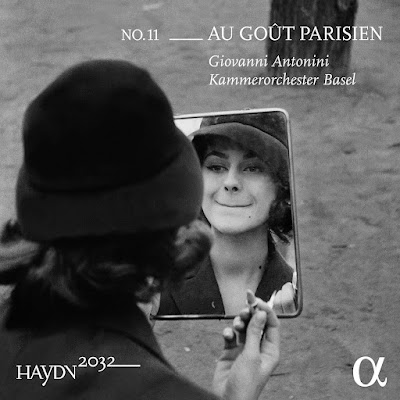
Great Haydn Symphonies "Au Goût Parisien"
Haydn: Symphonies 2, 24, 82, 87
Though the Basel orchestra is considerably larger than Il Giardino Armonico - the string complement is ten Violin I, seven Violin II, five Viola, three Double Bass - this is a nimble group that Antonioni takes through the twists and turns of Haydn's music as if he were driving a Ferrari. I've always loved the six Paris Symphonies commissioned by the Chevalier de Saint-Georges in 1788; two are included here. Number 82 is subtitled "L'Ours", for the comical, slightly grumpy features of its finale, complete with the drone of a folk instrument, perhaps a kind of bagpipe. Though it doesn't come with a cute title, Symphony 87 is a perfect mature Haydn symphony, an on-ramp for the Beethoven Symphony Freeway to come. The 24th Symphony is from 1764, a period when Haydn brought a bit of mystery and drama to the gallant symphonies of the time. It's bracketed by two stone-cold masterpieces - number 22, "The Philospher", and number 26, "Lamentatione" - but number 24 has its own positive qualities. I find it at once unsettling and exciting. There's something a little bit dangerous in this performance!
The Paris connection for Symphony 24 is that it was performed there - to great acclaim - in 1773. The 2nd Symphony, written in the late 1750s, was actually published in Paris in 1764. At under 10 minutes, it's the shortest of his symphonies, but there's plenty of incident packed in here. It's slight in stature, but not in style; the Little Symphony That Could.
Antonini brings great energy to all four symphonies here - great and small. Though this series doesn't replace my all-time choice for the complete Haydn symphonies, Adam Fischer's version on 37 CDs with the Austro-Hungarian Haydn Orchestra, I'm beginning to see that we now have a very close challenger, not quite a third of the way to 2032.
Each of the Haydn 2032 releases features a Magnum photographer in the album liner booklet, and this time it's the turn of the great Elliot Erwitt, a great choice considering the theme: "Au Goût Parisien". He took so many great photos of the City of Light; I'll post one here that he took in 1989; for some reason it isn't included in the booklet.
Tuesday, October 17, 2017
A promising new direction for Haydn 2032
Haydn: Symphonies 19, 80 and 81; Kraus: Symphony in C minor
Giovanni Antonini shifts gears with this fifth issue of his wonderful Haydn 2032 recordings, in the lead-up to the Haydn Tri-Centennial. This is a great series; volume 3 was my top release from last year. Instead of the marvellous Il Giardino Armonico, he now directs the Kammerorchester Basel, which will also get the call in volumes 6 and 7. What's the word on this new reliever from the bullpen?
It's very good news indeed. Though both play on original instruments, the Basel orchestra is considerably larger than Il Giardino, 6:6:5:3:2 in the strings versus 4:4:2:2:2. But though there's a fuller, richer, sound that's more appropriate for Haydn's Symphonies 80 and 81 from the mid-1780s, this is a very tight band that gives Antonini all the grace and lightness that Haydn still requires. I know these symphonies very well; my default version of Haydn's Symphonies is Adam Fischer's set with the Austro-Hungarian Haydn Orchestra, and the Basel musicians come close to this high standard. Stripped down to a smaller ensemble for the slight but charming (and fun) Symphony 19, we here have the same nimbleness of Il Giardino with all of expressiveness.
Haydn is great (great? - he's super-great!), but the star of the show here is Joseph Martin Kraus, an exact contemporary of Mozart, and a composer not too terribly far off in quality from the two great classical composers of the period. His Symphony in C minor is an outright work of genius. I slightly prefer this version over the very good Concerto Köln recording from 1992; the new recording is as theatrical, but its cooler temperature shows off its classical bones better.
A final note, once again, on Alpha's fabulous presentation for this series. The notes (in three languages) are excellent, and the featured photographs by a Magnum artist, in this case Stewart Franklin, are especially apposite. I await volume six with the Kraus Symphony set on repeat....
This disc is due to be released on November 3, 2017.
Saturday, March 4, 2017
An arrest of attention
"I think that art has something to do with an arrest of attention in the midst of distraction."The superb Haydn 2032 project of Giovanni Antonini and Il Giardino Armonico continues with "Il Distratto", the 4th volume on the way to the complete Haydn symphonies in their historical context by the year 2032. The project has three sterling characteristics which place it at the very top of similar ongoing series by other groups: the highest musical standards (style, precision, musicality); a significant scholarly/intellectual component; and top quality presentation and marketing. I included the third volume, "Solo e Pensoso", in my Top 10 Discs of 2016. This new disc will surely end up in my 2017 list.
- Saul Bellow, Paris Review, 1966
The disc takes its title from Haydn's 60th Symphony of 1774, which is actually a symphonic suite taken from the composer's incidental music for a revival of Le Distrait by Jean-François Regnard. This is perhaps the pinnacle of the musical joke genre, though closer to J.S. Bach than P.D.Q. Bach. It's clever and knowing, way over on the proper side of the Seinfeld-Hee Haw humour continuum. Haydn has some interesting things to say, I think, about an issue that began to be discussed for the first time in human history in the 18th century: the problem of distraction. According to sociologist Frank Furedi, the idea of distraction being a social evil relates to threats to moral authority, rather than to any new technologies or structural social changes. The Enlightenment, of course, was chock full of those threats, and there was plenty more to come in 1774. Furedi quotes the Scottish political economist William Playfair, who stated that "the inattention of the nobility to their duty was one cause of the revolution". Haydn actually quotes his own subtle challenge to moral authority, his Farewell Symphony of 1772 in this work. Much of the distraction is played for laughs, but it also provides Haydn with the opportunity to produce some arresting sounds, some that sound far, far ahead of their time. Haydn was the absolute master of building a life in which he had completely free range to exercise his artistic vision, without the compromises forced on poor Mozart or the angst that Beethoven suffered because of his own transitional social position.
Giovanni Antonini has found a perfect foil for Il Distratto in the mini-opera Il Maestro di Cappella, by Domenico Cimarosa. This is another self-aware piece that seems shockingly modern, with an orchestra that acts up, turning into one of the characters in the comedy. It reminded me of Raymond Queneau's 1968 novel The Flight of Icarus, whose main character acts up in much the same way as Cimarosa's orchestra.
In the other two Haydn symphonies included here, no. 12 and 70, there are hints of extra-musical connections. In his excellent liner notes Antonini posits that "In the ascending direction of tre soggetti of the fugal finale [of no. 70], we can glimpse a favourable omen for the erection of the new Esterhaza opera house at the laying of its founding stone - the occasion on which the symphony was first performed." So consider Haydn a proto-Oulipian, in his use of constrained musical composition to create novel forms and structures. It looks forward to the moderns, yes, but back as well to J.S. Bach's mathematical games that weave through so much of his music. The astounding thing about this music is that as clever as the games are, the final result is so artistically sound, and so often arrestingly beautiful.
Sunday, January 1, 2017
Telemann's surprises
Wednesday, August 10, 2016
Illuminating Haydn
The Haydn 2032 project picks up steam in this third release from Alpha Classics, "Solo e Pensoso". It takes its title from sonnet XXXV from Petrarch’s Il Canzioniere that was set by Haydn in 1798:
Alone and deep in thought, through the loneliest fields"Alone and deep in thought" is not how we think of the lively and above all social music making of the Baroque period, so this is an important milestone on the way to the solitary-genius composer whose epitome was Mozart, and in a heroic and Romantic form, Beethoven. But we're not used to thinking of Haydn in these terms at all. Putting Haydn's dramatic but still pensive setting at the centre of this new project, and presenting it in such as stylish way, with the musicians of his superb band Il Giardino Armonico and soprano Francesca Aspromonte, Giovanni Antonini once again makes us look at Haydn in a new way.
I tread with slow and sluggish steps,
and keep my eyes watchful, intent on flight
wherever a human footprint appears in the sand.
This time around the program is all-Haydn, though a Mozart aria from 1789, Vado, ma dove?
KV 583, featured in the 2015 concert programs for this project but didn't make it onto the disc. The three symphonies, #4 completed in 1760, #42 of 1771, and #64 from 1773, are given context by Haydn's Petrarch setting and another work from the stage, the overture to L’Isola Disabitata from 1779. Thus we have music from Haydn's early, middle and late periods, but Antonini has something much more sophisticated in mind than a mere chronological approach. Rather, he is following threads from the vast tapestry of Haydn's symphonic output to illustrate his theme.
Symphony #42, which begins the program, has an arresting combination of operatic incident and a more abstracted and wistful counterpoint. In tone if not always in musical style this seems quite close to Mozart. This is even more true of the great Symphony #64, with the mysterious "missing cadences" of its eccentric Largo and possibly contemporary nickname Tempora mutantur (the beginning of a Latin tag that goes "Times change, and we change with them: how so? Mankind gets worse with time.") One theory is that this music was part of a lost project of Haydn's to provide incidental music for Shakespeare's Hamlet. We're a long way from the Papa Haydn stereotype here! Symphony #4, which ends the program, is a surprisingly cultivated and refined work for its time, with its ghostly middle Andante not giving up a sense of muted melancholy in the more dramatic, but still, in the end, contemplative and thoughtful finale.
The marketing of Haydn 2032 is world-class. Go to the Solo e Ponsoso portion of the project website for the full deal, including amazing photos by Bruno Barbey and superb analysis by musicologist Christian Moritz-Bauer. There's even a Haydn 2032 shop planned for the future. But none of this matters if the music isn't special, and to my mind it certainly is. In fact, these are ground-breaking performances, In #64 there's an immediacy and presence that clearly outshines Christopher Hogwood's version with the Academy of Ancient Music. Even the version of the Austro-Hungarian Haydn Orchestra under Adam Fischer, my reference standard for Haydn, seems less nimble and expressive. I'm so pleased with what I've heard so far from Haydn 2032, and look forward to the long journey to Haydn's Tricentennial.
.jpg)