Reviews and occasional notes on classical music

Reviews and occasional notes on classical music

"Music, both vocall and instrumental, so good, so delectable, so rare, so admirable, so super excellent, that it did even ravish and stupifie all those strangers that never heard the like." - Thomas Coryat, after hearing 3 hours of music at the Scuola di San Rocco in Venice, 1608.

Showing posts with label Alpha. Show all posts

Friday, May 16, 2025

Vital reinventions of early music

Electric Fields: Music by Hildegarde von Bingen, Barbara Strozzi, Francesca Caccini, Bryce Dessner & David Chalmin

The Audio CD and streaming versions of this Alpha disc are now available. I'm reviewing the 180 gram double-LP version of this release, which is due to be released on June 6, 2025.

Photo by Umberto Nicoletti

Electric Fields is a project of this good-looking crew: soprano Barbara Hannigan, composer and electronics performer David Chalmin, and the duo-pianists Katia and Marielle Labèque. It's based on the music and texts of the remarkable medieval polymath Hildegarde von Bingen, as well as music by two women composers of the early Baroque: Barbara Strozzi and Francesca Caccini. This music becomes the raw material for improvisations of the team, as well as original compositions by Chalmin and Bryce Dessner.

These are more than mere pastiches; they're serious 21st century reinterpretations of early music. Though there's an immersive feel to all the music here, especially with the warm sound of vinyl, this project is not built in the studio, but rather through live performances. That gives a vital pulse to the music, with even a hint of swing in the improvised pieces. Of course Barbara Hannigan is thoroughly familiar with Historically Informed Practice when it comes to the music of Strozzi and Caccini, so we're on solid ground when it comes to reinterpretation in a new idiom.

Hildegard of Bingen, Symphonia Harmonie Celestium Revelationum", published in modern facsimile by Alamire

You have to be of a certain age to look at this score of Hildegarde von Bingen and think immediately of IBM punch cards, but that was my first response. Hildegarde wrote this music some 850 years ago, so there's an element of translation involved in any performance. With the lack of any performance tradition in the intervening centuries, Hildegarde is a strong candidate for a true reinvention in modern times. Besides her skills as a musician, she had an interest in scientific analysis and even cryptography. There are two pieces on this album - by Bryce Dessner and David Chalmin - that use Hildegarde's "Lingua ignota", her invented language. The intellectual curiosity of this one-of-a-kind 12th century woman lives on in these two tracks, but one can also say that something of her spirit has also survived.

It's Heitor Villa-Lobos's modern reinvention of Bach in the mid-20th century that I kept coming back to when I listened to this music. Villa's Bachianas Brasileiras reinvents Bach's music in the light of Brazil's popular music traditions, of the Amerindians of the Amazon and the urban choros musicians of Rio de Janeiro. Like the Bachianas, Electric Fields is a vital hybrid of old and new, erudite and popular.

It's all grist for the mill:
  • The Labeque sisters' recordings of Mozart, Schubert, Gershwin, Philip Glass, Moondog and many others;
  • Bryce Dessner's contemporary classical compositions and collaborations with people like Sufjan Stevens and Nico Muhly, as well as his experience in the rock group The National
  • Barbara Hannigan's operatic singing, especially in the Baroque repertoire, and her move to become an important conductor, with wonderful recordings of Nono, Messiaen, Berg, Ligeti and others;
  • David Chalmin's production work in jazz and classical music, his electronic composition and live electronic performance, as well as his collaborations with the Labeque sisters.
There seem to be no barriers for these wonderful musicians. They've produced an album that will reward multiple listens and close study, but which is also just there in its particular groove, inspiring wonder.

Tuesday, March 25, 2025

The Certain and Uncertain Symphony


 Molécule - Symphonie no. 1, "Quantique"

"This symphony is an imaginary and symbolic representation made up of probabilities, intuitions, certainties and uncertainties. It is an artistic adventure charged with encounters, openness, benevolence and learning; its cardinal point is love for sound and its vibrations."
- Romain De La Haye-Serafini, aka Molécule

"All the good music has already been written by people with wigs and stuff."
- Frank Zappa 

This fascinating new symphony by the electronic musician Molécule was made in remarkable way. The composer attended rehearsals of the Orchestre National de Lille over a period of two years, recording everything: 

"... the sliding of strings, harmony, the cracking of instruments, silences, melodies, musicians’ breaths, the inaudible frequencies of a double bass... I wasn’t looking for perfect notes, but for a collection of sounds that would give me enough material to start composing."

This gave Molécule his sound palette. He took those sounds, manipulated them, and then recombined them into the standard four-movement symphonic format we all know and love. After he had created his soundscape, it was transcribed by Sinan Asiyan into standard orchestral notation, and played by the 83 musicians of the orchestra, led by its conductor Alexandre Bloch.

Molécule's earlier works involved a more adventurous sound recording stage; he gathered sounds in Arctic Greenland, and at the legendary huge waves of Nazaré in Portugal. But as he says in this video, the project with the Lille orchestra had its own artistic risks:


Molécule's sound-gathering is the most interesting and innovative part of both his earlier work and the Symphonie project. It might be analogous to Bartok or Villa-Lobos's ethnomusical forays into the Hungarian countryside and the Amazon rainforest. Meanwhile, the classical sound collage has been a staple of post World War II avant garde music: Mauricio Kagel's Ludwig Van, from 1969, is a good example:


But as cool as the process is, the proof of this particular pudding is in the music itself. There are certainly some impressive moments in the finished works, and I was swept up in some peak passages throughout. The problem with this kind of pastiche is also its strength: the best-sounding bits are the least original. There are plenty of modernist clichés and avant garde clichés and movie soundtrack clichés in this work. But of course, the parts that sound the most like John Williams or Howard Shore also sound like those composers' (acknowledged) forebears: Gustav Holst and Richard Wagner and Richard Strauss. Though Molécule actually samples particular works - for example, Debussy's La Mer and Holst's The Planets in Mouvement II, No. 3: 335 398 400 - most of the source material has been massaged so that only echoes of the original music can be heard.

Symphonie no. 1, in the end, can stand on its own as a success of outstanding process and workmanlike structure. Listen for yourself:


Saturday, March 22, 2025

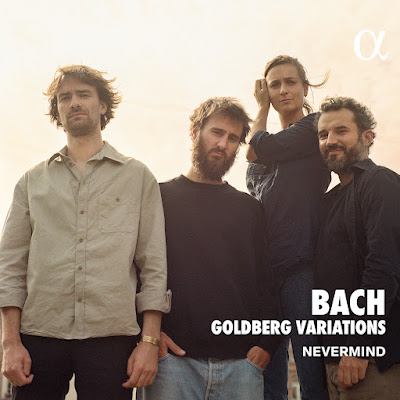
A rich new Goldberg Variations


 Nevermind - Bach Goldberg Variations

If your idea of diversity in the Goldberg Variations universe is to occasionally swap out the 1955 and 1981 recordings of Glenn Gould, you might want to expand your horizons and listen to this new arrangement of Bach's perennial best-seller, by the talented young musicians of Nevermind: Anna Besson, transverse flute; Louis Creac'h, violin; Robin Pharo, viola da gamba; and Jean Rondeau, harpsichord and organ.

You'll find the sounds of Nevermind's four instruments, in various combinations, throughout Bach's works: his sonatas for violin, for viola da gamba, and for flute, and in passages from the Passions and Cantatas. The Paris Quartets of Telemann and Les Nations by François Couperin are among the other models used in this transcription.

The spell that the Goldberg Variations weaves seems to mess with one's internal clock. I can never believe that so much happens in the 38 minutes of Glenn Gould's first version, or that even his more measured 1981 recording is still only 51 minutes. To be sure, Gould isn't generous with repeats, but there is still a feeling of time standing still in many of the variations (and in the 1981 version, of the Aria itself). Here we have the opposite effect; instead of time slowing down, there seems to be a disconnect at the end of the Aria da Capo. Surely, that hasn't been 100 minutes (over two CDs, if you're still listening on physical media)! One is carried along by the internal engine of the music, its logic, and by the often dramatic, even operatic, effect of the instrumental timbres. In his notes to his 1955 recording, Gould called this "... music which observes neither end nor beginning, music with neither real climax nor real resolution." We may have ended up where we began (time being, as we learned from True Detective, a flat circle), but what a rich experience it was!

Listening to the Goldberg Variations in a special performance on the piano or harpsichord can feel like a singular communication with the performer and the composer. This, though, is a more communal experience, not only with the four musicians, but with Bach's European network of performance practices and the traditions of music-making from the 18th century until today. For me, though, it was still a private experience that touched me deeply.

This is a journey well worth taking!

The cover photo is by Clement Vayssieres.


Sunday, May 14, 2023

The complex being of 'Woman'


Maria Mater Meretrix: music for voice and violin by Holst, Crumb, Dufay, Martin, Kurtag, Hildegarde von Bingen & more
 

"This is the theme of this album, Maria Mater Meretrix – a study of the three classical female phenomenologies into which, since time immemorial, the (un-female!) eye and ear have divided up the complex being of ‘Woman’: as Saint, Mother, and Whore."

Thematic albums like this new disc from soprano Anna Prohaska and violinist/conductor Patricia Kopatchinskaja, with the Camerata Bern, have recently become more popular in the classical music sphere. Back in 2016, Patricia Kopatchinskaja released a marvellous album around the theme of "Death and the Maiden"; in my review I called it an "illuminating, moving project." We have another such winner here.

The quote at the top of this review is from a fascinating essay by Christine Lemke-Matwey. She highlights the Virgin Mary - and Mary Magdalene - references in the huge range of music included here: from early works by Hildegard von Bingen, Walther von der Vogelweide and Tomas Luis de la Victoria to 20th century music by Frank Martin, Gyorgy Kurtag and Gustav Holst. Clever arrangements, by Michi Wiancko and Wolfgang Katschner, are included with original chamber and orchestral works. The resulting common sound-world allows one to truly appreciate the common themes in this incredibly diverse music. This album rewards close and careful - and repeat - listens. I feel like I learned more each time I sat down with this music.

I'm reading Adam Gopnik's new book The Real Work: On the Mystery of Meaning, and I feel this passage applies here:

"We find meaning in one thing by enlarging the area of reference, making it not more precise but less, by a horizontal leap relating it to something larger. Meanings expand as our contexts expand. Art only becomes articulate within a history..."

The wonderful cover photo of Prohaska and Kopatchinskaja is by Marco Borggreve. There are two equally fine shots of each of them inside the cover.


Wednesday, July 13, 2022

Haydn Symphonies "Les Jeux et Les Plaisirs"


Under the direction of Giovanni Antonini, the Kammerorchester Basel performs three middle-period Haydn Symphonies - numbers 61, 66 and 69 - with a special bonus for the youngsters out there. This is the 12th release in the wonderful Haydn 2032 series from Alpha; only 10 more years of these records until the project is complete and we can break out the cake with 300 candles for Papa Haydn!

This is a fun disc from start to finish. To be sure, in these symphonies Joseph Haydn makes use of the common tropes of the international galant style, but he always puts his own stamp on his symphonies. At this point in his career Haydn does not stray far from the galant schemata, but he conceals within them a complex and cunningly wrought art that seems effortless.

Giovanni Antonini is taking the long view of this immense series of symphonies; he has planned each album's program with care, taking into account the long arc of a great musical career as well as each hour and twenty minute segment. He's plucked three joyful works from 1775-76 to contrast with the more dramatic and erudite group in the 11th disc (which I reviewed here). The sense of fun is palpable in these performances; Antonini and his band are obviously enjoying playing this music, & that's immediately communicated to the listener.

Joseph Haydn's younger brother Michael has written a small kitsch masterpiece in his Toy Symphony, and it receives a spirited performance here. There are parts written for various toy instruments, from trumpet, drum and triangle to ratchet, quail, organ hens and cuckoo. The result is a splendid noise:


I was curious about the bird sounds, so I ran the symphony through the Merlin Bird ID app from The Cornell Lab of Ornithology. I was pleased to see that there was no fooling the Merlin algorithm; it heard no actual birds. As Susan Sontag says in her "Notes on Camp", 
"All camp objects, and persons, contain a large element of artifice. Nothing in nature can be campy."


As with every disc in the Haydn 2032 series, this release is matched with a Magnum photographer; in this case it's the fabulous Spanish photographer Cristina García Rodero. I was thrilled to see these photos, since I only knew her black and white pictures (which are stunning). A number included here are from García Rodero's 2020 exhibition "Holi, the celebration of love".  Holi is an Indian festival of colour, where young people throw colored powders to desire love, fortune and vitality, while they dance and sing in the streets and temples. What a follow-up to a lifetime of amazing black and white photography!


Wednesday, February 2, 2022

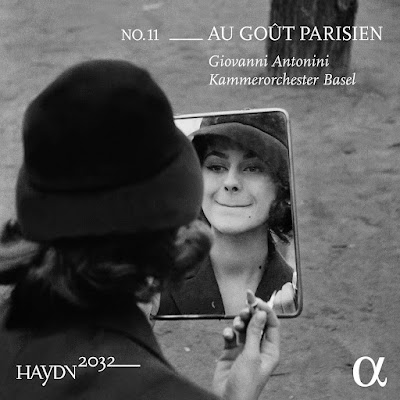
Great Haydn Symphonies "Au Goût Parisien"


Haydn: Symphonies 2, 24, 82, 87

Alpha's Haydn 2032 project continues with this album, the 11th release in the series. In about half the recordings Giovanni Antonini conducts his ensemble Il Giardino Armonico, but here he returns to the Kammerorchester Basel for four Haydn Symphonies with a Parisian connection: 2, 24, 82 and 87. 

Though the Basel orchestra is considerably larger than Il Giardino Armonico - the string complement is ten Violin I, seven Violin II, five Viola, three Double Bass - this is a nimble group that Antonioni takes through the twists and turns of Haydn's music as if he were driving a Ferrari. I've always loved the six Paris Symphonies commissioned by the Chevalier de Saint-Georges in 1788; two are included here. Number 82 is subtitled "L'Ours", for the comical, slightly grumpy features of its finale, complete with the drone of a folk instrument, perhaps a kind of bagpipe. Though it doesn't come with a cute title, Symphony 87 is a perfect mature Haydn symphony, an on-ramp for the Beethoven Symphony Freeway to come. The 24th Symphony is from 1764, a period when Haydn brought a bit of mystery and drama to the gallant symphonies of the time. It's bracketed by two stone-cold masterpieces - number 22, "The Philospher", and number 26, "Lamentatione" - but number 24 has its own positive qualities. I find it at once unsettling and exciting. There's something a little bit dangerous in this performance!

The Paris connection for Symphony 24 is that it was performed there - to great acclaim - in 1773. The 2nd Symphony, written in the late 1750s, was actually published in Paris in 1764. At under 10 minutes, it's the shortest of his symphonies, but there's plenty of incident packed in here. It's slight in stature, but not in style; the Little Symphony That Could.

Antonini brings great energy to all four symphonies here - great and small. Though this series doesn't replace my all-time choice for the complete Haydn symphonies, Adam Fischer's version on 37 CDs with the Austro-Hungarian Haydn Orchestra, I'm beginning to see that we now have a very close challenger, not quite a third of the way to 2032. 

Each of the Haydn 2032 releases features a Magnum photographer in the album liner booklet, and this time it's the turn of the great Elliot Erwitt, a great choice considering the theme: "Au Goût Parisien". He took so many great photos of the City of Light; I'll post one here that he took in 1989; for some reason it isn't included in the booklet.


Saturday, November 11, 2017

Bright and bouncy


Handel: Messiah, 1754 version

Hervé Niquet has opted to record the 1754 version of Messiah, which has five soloists rather than four. I know this version well because of the now classic 1991 recording by Christopher Hogwood and the Academy of Ancient Music, which featured the divine Emma Kirkby. We had that on cassette, so it was the soundtrack (along with Yogi Yorgesson's I Yust Go Nuts at Christmas - the kids were little!) for many a holiday trip in Alberta's cold Decembers.

However, that's not the key to this new version by Le Concert Spirituel under the direction of Hervé Niquet. Rather, it's his statement that "I’ve opted here for an operatic interpretation, taking its cue from the drama inherent in this account of the life of Christ." Niquet plays up the drama throughout, and he has the players and singers to follow through on all of his concepts. I think nearly every idea is at least plausible. It's a brisk run-through; listen to the swinging Sinfonia:


But this is about more than just tempo. Niquet's version is positively bouncy; if it were in the Hundred Acre Wood it would be Tigger. As far as I'm concerned that's great; I've heard too many Eeyore Messiahs.

E.H. Shepard. Tiggers can't climb trees

Tuesday, October 17, 2017

A promising new direction for Haydn 2032


Haydn: Symphonies 19, 80 and 81; Kraus: Symphony in C minor

Giovanni Antonini shifts gears with this fifth issue of his wonderful Haydn 2032 recordings, in the lead-up to the Haydn Tri-Centennial. This is a great series; volume 3 was my top release from last year. Instead of the marvellous Il Giardino Armonico, he now directs the Kammerorchester Basel, which will also get the call in volumes 6 and 7. What's the word on this new reliever from the bullpen?

It's very good news indeed. Though both play on original instruments, the Basel orchestra is considerably larger than Il Giardino, 6:6:5:3:2 in the strings versus 4:4:2:2:2. But though there's a fuller, richer, sound that's more appropriate for Haydn's Symphonies 80 and 81 from the mid-1780s, this is a very tight band that gives Antonini all the grace and lightness that Haydn still requires. I know these symphonies very well; my default version of Haydn's Symphonies is Adam Fischer's set with the Austro-Hungarian Haydn Orchestra, and the Basel musicians come close to this high standard. Stripped down to a smaller ensemble for the slight but charming (and fun) Symphony 19, we here have the same nimbleness of Il Giardino with all of expressiveness.

Haydn is great (great? - he's super-great!), but the star of the show here is Joseph Martin Kraus, an exact contemporary of Mozart, and a composer not too terribly far off in quality from the two great classical composers of the period. His Symphony in C minor is an outright work of genius. I slightly prefer this version over the very good Concerto Köln recording from 1992; the new recording is as theatrical, but its cooler temperature shows off its classical bones better.

A final note, once again, on Alpha's fabulous presentation for this series. The notes (in three languages) are excellent, and the featured photographs by a Magnum artist, in this case Stewart Franklin, are especially apposite. I await volume six with the Kraus Symphony set on repeat....

This disc is due to be released on November 3, 2017.

Wednesday, October 11, 2017

More than just a mood elevator


Il Violoncello del Cardinale: Cello sonatas by Boni, Amadei, Haym, Perroni, Costanzi, Bononcini, Lulier

In the 1950s & 60s there was a radio show from WNYC called "DeKoven Presents", which focussed on the music of the Baroque, or rather the pre-classical music that DeKoven called Barococo. I listened to DeKoven (it was always just DeKoven: "no sir or mister") in the late 60s and early 70s on CKUA, the great radio station at 580 kc. in Edmonton. The reason I'm reminiscing here is that while DeKoven was way ahead of the curve in appreciating early music, he did have an oddity, which Brendan Gill points out in his New Yorker profile from 1962: "He wants his programs to [be] anti-soporific so he plays only those parts of compositions that go very fast." I knew at the time this was a mis-step, and as early music has evolved over the decades I'm absolutely sure that the musical genius in this period comes from the entire range rather than just the peppy, and that it serves as much more than just a mood elevator.

I was reminded of this when I listened to this disc of Cello Sonatas from the marvellous Marco Ceccato and his Accademia Ottoboni. There is so much dignity and gravity and serious thought in much of this music. This Grave movement from Giuseppe Maria Perroni's Cello Sonata no. 1 is a good example.


So much of this music is like this, lots of it of the same high calibre. But lest you think there's only slow arrows in this bow, you can also find more spirited music. DeKoven himself would have enjoyed this tiny theatrical, folk-inspired Allegro assai by Nicola Haym. I wonder if he'd have rated it OTW (out of this world), OTG (out of this galaxy), or even the sublime OTC (out of this cosmos)?

Sunday, August 6, 2017

More Rembrandt than Hals


Dvorak: Piano Quartets no. 1, op. 23, and no. 2, op. 87

The Busch Trio received very positive reviews for the first disc in their projected complete Dvorak chamber music with piano series, a piano trio disc released on Alpha Classics in 2016. Now comes a recording of less familiar but still quite marvellous Dvorak: his two piano quartets. Miguel da Silva, the violist from the Ysaÿe Quartet, fits in very well with his younger colleagues. The youthful first quartet could have perhaps used a somewhat lighter touch, but the mature second work, a true masterpiece, is a great fit for the dark, Brahmsian way these musicians have of playing Dvorak. Torn between the bucolic and the cosmopolitan, Dvorak puts his somewhat protean music out there, and musicians have the lovely opportunity of filling in much of their own emotional content. In this instance we have a pretty sophisticated, dramatic interpretation more in the style of a brooding Rembrandt than Frans Hals celebrating life's pleasures. Even with perhaps too much light and shade, I enjoyed this interpretation a great deal.

This disc will be released on September 22, 2017.

Monday, June 19, 2017

Knowing interpretations of appealing music


C.P.E. Bach, Sonatas for Violin & Fortepiano

One of the common dynamics in a wide range of arts is the dialectic between the rational and the expressive, classic and romantic, Apollo and Dionysus. This is where C.P.E. Bach lives, looking at once back to his father's example of cosmic order and ahead to the confusing affective eruption that would later be termed Sturm und Drang (Storm and Drive, or Storm and Stress). To call these expressive Sonatas Romantic is to overstate the case, but their expressiveness is undeniable. They are also tuneful in an original way, full of erudite cleverness that gives both the listener and player much pleasure. I can't imagine a more effective presentation of this music: Amandine Beyer's violin is the emoting actor, while Edna Stern's fortepiano provides the lightest of commentary to go with her solid support. They play this music with style and grace, and aren't afraid to milk the sentimental moments when the composer lets his classic mask slip artfully to the side. At the same time their interpretation is knowing; Beyer and Stern know when to give the music its full expressive force, and when to pass on the composer's winks. This is an outstanding release that I've listened to a great deal in the past weeks, and which I plan to explore further.

These aren't new recordings, but from 2005, from a Zig Zag Territoires disc.

Saturday, March 25, 2017

A fascinating reboot from Versailles


Every year, beginning in early December, I enjoy listening to as many versions of Handel's Messiah as I can: from rambling, romantic traditional versions to HIP re-enactments. I especially love hearing the version Mozart prepared in 1789, which adds trombones and clarinets, but more importantly brings a new sensibility to bear on this great music, which was first performed in 1741. Something very similar is at play here: in 1770 three composers, Antoine Dauvergne, François Rebel and Bernard de Bury, were commissioned to update the classic Lully opera Persée, originally written in 1682 for the inauguration of the new opera house at Versailles. It's presented by Le concert Spirituel under Herve Niquet in a beautiful package from Alpha Classics, who are fast becoming my favourite label.

The late 18th century didn't have the same regard for historical accuracy that has become the norm in the 21st, and the French musical establishment had been monkeying around with the great scores of the 17th century long before this project. This is a much more thorough reboot of Lully than the Mozart Messiah, and it's the source of much pleasure for the open-minded. Of the three new composers I know Dauvergne the best; I had an LP of his short comic opera Les Trouquers many years ago that I loved. The other two I was unaware of (once I realized that the Rebel I know is the father Jean-Féry and not the son François). All three do their thing with freedom, adding flutes and bassoons, clarinets and horns, and writing a fair amount of new music. Here's the original overture by Lully, played by the present band, Le Concert Spirituel under Herve Niquet:


and the new Overture by Dauvergne:


A new sound for a new Opera House! We have the torso of Lully's opera left, along with a general feeling of stateliness, grandeur and shameless flattery towards royalty. In all, this is a fun package with a scrupulously researched back story for those who want to delve into the music historical aspects. It's so beautifully played and sung that I have no hesitation in recommending it.

Sunday, March 5, 2017

HIP folk-inspired music from the Celtic lands


I've always loved Scottish and Irish music, most especially since a fabulous trip to Edinburgh and Islay last fall. So I was pleased to come across this new disc from a favourite group, Les Basses Reunies under Bruno Cocset, from a favourite record company, Alpha. The music is by a favourite Italian composer with strong connections to the British Isles and Ireland, Francisco Geminiani, along with a variety of Scottish and Irish composers. The one I know best is the blind harper Turlough O’Carolan, who has a real gift for melody. This is a fabulous collection all around; the players seem to have a strong feeling for the folk traditions of the Celtic lands as well as a state-of-the-art understanding of Historically Informed Practices in Baroque music. Though the dominant mood is sadness - is there a Scots or Irish equivalent to Brazil's saudade? - there's no lack of variety in textures and tempos, with a variety of both solo instruments (viola, tenor violin, various viols) and continuo (harpsichord, organ and harp) matched to particular songs. Pour yourself an Old Bushmills or a wee dram of Laphroaig, open up your Ossian, and listen.

Here's the trailer for the new disc, due to be release March 24, 2017.

Saturday, March 4, 2017

An arrest of attention


"I think that art has something to do with an arrest of attention in the midst of distraction."
- Saul Bellow, Paris Review, 1966
The superb Haydn 2032 project of Giovanni Antonini and Il Giardino Armonico continues with "Il Distratto", the 4th volume on the way to the complete Haydn symphonies in their historical context by the year 2032. The project has three sterling characteristics which place it at the very top of similar ongoing series by other groups: the highest musical standards (style, precision, musicality); a significant scholarly/intellectual component; and top quality presentation and marketing. I included the third volume, "Solo e Pensoso", in my Top 10 Discs of 2016. This new disc will surely end up in my 2017 list.

The disc takes its title from Haydn's 60th Symphony of 1774, which is actually a symphonic suite taken from the composer's incidental music for a revival of Le Distrait by Jean-François Regnard. This is perhaps the pinnacle of the musical joke genre, though closer to J.S. Bach than P.D.Q. Bach. It's clever and knowing, way over on the proper side of the Seinfeld-Hee Haw humour continuum. Haydn has some interesting things to say, I think, about an issue that began to be discussed for the first time in human history in the 18th century: the problem of distraction. According to sociologist Frank Furedi, the idea of distraction being a social evil relates to threats to moral authority, rather than to any new technologies or structural social changes. The Enlightenment, of course, was chock full of those threats, and there was plenty more to come in 1774. Furedi quotes the Scottish political economist William Playfair, who stated that "the inattention of the nobility to their duty was one cause of the revolution". Haydn actually quotes his own subtle challenge to moral authority, his Farewell Symphony of 1772 in this work. Much of the distraction is played for laughs, but it also provides Haydn with the opportunity to produce some arresting sounds, some that sound far, far ahead of their time. Haydn was the absolute master of building a life in which he had completely free range to exercise his artistic vision, without the compromises forced on poor Mozart or the angst that Beethoven suffered because of his own transitional social position.

Giovanni Antonini has found a perfect foil for Il Distratto in the mini-opera Il Maestro di Cappella, by Domenico Cimarosa. This is another self-aware piece that seems shockingly modern, with an orchestra that acts up, turning into one of the characters in the comedy. It reminded me of Raymond Queneau's 1968 novel The Flight of Icarus, whose main character acts up in much the same way as Cimarosa's orchestra.

In the other two Haydn symphonies included here, no. 12 and 70, there are hints of extra-musical connections. In his excellent liner notes Antonini posits that "In the ascending direction of tre soggetti of the fugal finale [of no. 70], we can glimpse a favourable omen for the erection of the new Esterhaza opera house at the laying of its founding stone - the occasion on which the symphony was first performed." So consider Haydn a proto-Oulipian, in his use of constrained musical composition to create novel forms and structures. It looks forward to the moderns, yes, but back as well to J.S. Bach's mathematical games that weave through so much of his music. The astounding thing about this music is that as clever as the games are, the final result is so artistically sound, and so often arrestingly beautiful.


Thursday, February 16, 2017

Not making history


The rationale of the Resound Beethoven project is about what a wine expert would call terroir; it's a historical reconstruction of the original venue for important premieres of orchestral works from the composer's lifetime. I've bought in to the concept to some extent, though I preferred the theatrical Egmont Music of volume 3 to the much more demanding 3rd Symphony in volume 4. For the 9th Symphony the original venue is no longer in place, so we hear instead a recording from the Redoutensaal at Hofburg Vienna, where the second performance took place on May 23, 1824. But this is in a sense moot, since because of his deafness Beethoven would have heard this music in a completely different venue: his head. All bets are off, I think. When we think of a Platonic Ideal of the 9th Symphony living in Beethoven's head, how this music sounded in a long-ago venue seems less important. Instead, we can imagine a direct line from Beethoven's head through his score and nearly two hundred years of performance traditions to the mind and imagination and musical skills of a conductor and a group of musicians. The music on this disc has some plusses, most especially in a rather good slow movement, which combines a child-like simplicity with subtle atmospheric effects. But the rest of the work sounds very square compared with the powerful rhythmic thrust - I want to say swing - of Toscanini. It seems very rustic when we put it next to Karajan's polish and cool elegance. And it's lacking entirely in the glimpses of the other world that Solti brings, especially when Jessye Norman sings. The sense of place looms large in certain famous performances of the 9th Symphony, none more momentous and historic than the Christmas Day 1989 Leonard Bernstein concert with an augmented Bavarian Radio Symphony Orchestra, as the Berlin Wall came down. There Bernstein and his musicians made history, but only because the spirit of the time lifted them up and inspired them. But without a more compelling and engaging performance no venue will make a big difference.

This disc will be released on March 24, 2017.

Sunday, January 1, 2017

Telemann's surprises


We'll be hearing a lot of Telemann in 2017, the 250th anniversary of the great composer's death. I doubt, though, that many discs will be as well-planned and stylishly performed as this splendid release from Alpha Classics, with Giovanni Antonini leading Il Giardino Armonico, and playing recorder and chalumeau.

Antonini raises the curtain with a clever little Prelude for solo recorder by Jacques-Martin Hotteterre. Telemann's Suite in A Minor is quite well known, but this is a performance to take special note of. Antonini is in a groove throughout both as a soloist and conductor, providing a high level of virtuosity, but never missing out on Telemann's many expressive possibilities. Some of the other works are a bit more obscure, but there are many gems to be uncovered here. Most astonishing is the Grave movement from a Quartet for 2 chalumeaux (early clarinets), violin and continuo. This is a kind of salon piece with the slightest hints of Eastern European folk music and even tango, a very sexy number! 

Here is the entire Quartet; the Grave movement begins at 6:10. Also, listen for the mock heroics in the finale; Telemann is having fun here! And the musicians are as well.


The whole disc is full of moments like this. I am astonished by the endless surprises Telemann gives us. He has lived in Bach's shadow for a very long time; perhaps 2017 will be his year in the sun.

Here is the fifth movement from Telemann's Suite in A Minor, entitled Réjouissance (Rejoicing). We can indeed rejoice in such invention by Telemann, and such virtuosity by Antonini and his fellow musicians.

Monday, October 17, 2016

Illuminating, moving musical project


This new disc from Patricia Kopatchinskaja, the leader of the conductor-less Saint Paul Chamber Orchestra, is part of the new classical music recording trend of publishing projects built around a music-historical or conceptual theme. In the old days a record company would likely put out Schubert's Death and the Maiden Quartet on an LP coupled with the Trout Quintet, or another popular "named" quartet by another composer. The idea of wrapping a recording around a defining idea bigger than just "recital" or "concert" wasn't often on the radar in the LP era. This was perhaps because of format limitations: each 20-25 minute side happened to fit a chamber music work, or half of a romantic symphony, and the format pointed to a certain kind of conventional content.


This is different. Kopatchinskaja takes the idea of "Death and the Maiden", which began as a poem by Matthias Claudius, set as a song by Schubert in 1817, and makes it the basis of a fascinating 70 minutes of music. By the time Schubert wrote his String Quartet, which uses the song's great melody as the theme of its Andante second movement, he was facing death during a major health crisis in 1824. The various musical sources brought in for this project, from medieval chant to the avant garde, all speak to this consciousness of what is coming. Then each source, from widely varying musical beginnings, is adapted for a common platform, the string orchestra. The Schubert arrangements are by Kopatchinskaja herself. Pieces by Dowland, Kurtag, Gesualdo, Normiger and an anonymous Byzantine chant provide historical and emotional context for Schubert's masterwork. This is an illuminating, moving project.

This Alpha Classics disc will be released on October 28, 2016.

Wednesday, October 5, 2016

Clean and Stylish, but Static Beethoven


Last May I raved about the 3rd volume in the Resound Beethoven series, where Martin Haselbock and the Orchester Wiener Akademie performed the Egmont music and the Consecration of the House Overture in the hall in which the music had been premiered. With the latest volume the stakes have risen, though. I consider the Eroica Symphony the greatest symphony ever written, and there are a string of performances that I worship: Klemperer, Walter, Szell, Karajan, Giuilini in the big-band group, and Bruggen and Harnoncourt on the HIP side. How do Haselbock and his Vienna group compare, forgetting for a moment their completely apposite venue (the Eroica Saal at the Palais Lobkowitz)?

Listen to this great live performance with the Orchestra of the 18th Century conducted by Frans Bruggen:


It's clear that Haselbock doesn't bring anything close to that excitement from the beginning. Furthermore, Tom Service praises both Bruggen and Otto Klemperer for "the cumulative momentum that builds from the first bar to the last" in the ground-breaking 1st Movement. I don't feel the momentum, which I think really does explain why these Klemperer and Bruggen move me so much. Thanks for that explanation, Tom! Haselbock turns in a clean, stylish performance, but it's curiously static. I'm still impressed with the concept of hearing Beethoven's music in the space in which it was first heard, and the contrast between the Symphony and the Septet on the 2nd disc does help to define the acoustic space. But music of this greatness really requires something special when it comes to interpretation.

Saturday, August 20, 2016

Style, authenticity and tradition


In his especially perceptive liner notes to this new Busch Trio Dvorak disc from Alpha, Jan Smaczny talks about the composer being pulled by two opposite forces: the folkloric music of Bohemia and the Austro-German style of Brahms and his circle. This dynamic of nationalism versus trans-national style can be seen in many other composers: Villa-Lobos, for example, navigated between the modernism of Paris and the particularly Brazilian melding of folkoric traditions. Similarly, Aaron Copland's music saw Americana struggling with that same Parisian style, and Vaughan Williams was in the middle of a tug-of-war between Ravel and English Folk Song. But whether acknowledging Brahms' musical mentorship and personal friendship, or harking back to his roots, Dvorak was always authentic, and his music speaks in his own voice. The young musicians of the Busch Trio have caught that voice in the manner of a great actor creating a historic figure, with technical assurance and style.


They also are playing in the tradition of a great musician, their namesake Adolf Busch. This is about more than just the fact that violinist Mathieu van Bellen plays Adolf Busch’s own 1783 Guadagnini violin; rather the group has the same lean and brilliant way of attacking the great music of 19th century Europe.


From the liner notes:


Wednesday, August 10, 2016

Illuminating Haydn


The Haydn 2032 project picks up steam in this third release from Alpha Classics, "Solo e Pensoso". It takes its title from sonnet XXXV from Petrarch’s Il Canzioniere that was set by Haydn in 1798:
Alone and deep in thought, through the loneliest fields
I tread with slow and sluggish steps,
and keep my eyes watchful, intent on flight
wherever a human footprint appears in the sand.
"Alone and deep in thought" is not how we think of the lively and above all social music making of the Baroque period, so this is an important milestone on the way to the solitary-genius composer whose epitome was Mozart, and in a heroic and Romantic form, Beethoven. But we're not used to thinking of Haydn in these terms at all. Putting Haydn's dramatic but still pensive setting at the centre of this new project, and presenting it in such as stylish way, with the musicians of his superb band Il Giardino Armonico and soprano Francesca Aspromonte, Giovanni Antonini once again makes us look at Haydn in a new way.


This time around the program is all-Haydn, though a Mozart aria from 1789, Vado, ma dove?
KV 583, featured in the 2015 concert programs for this project but didn't make it onto the disc. The three symphonies, #4 completed in 1760, #42 of 1771, and #64 from 1773, are given context by Haydn's Petrarch setting and another work from the stage, the overture to L’Isola Disabitata from 1779. Thus we have music from Haydn's early, middle and late periods, but Antonini has something much more sophisticated in mind than a mere chronological approach. Rather, he is following threads from the vast tapestry of Haydn's symphonic output to illustrate his theme.

Symphony #42, which begins the program, has an arresting combination of operatic incident and a more abstracted and wistful counterpoint. In tone if not always in musical style this seems quite close to Mozart. This is even more true of the great Symphony #64, with the mysterious "missing cadences" of its eccentric Largo and possibly contemporary nickname Tempora mutantur (the beginning of a Latin tag that goes "Times change, and we change with them: how so? Mankind gets worse with time.") One theory is that this music was part of a lost project of Haydn's to provide incidental music for Shakespeare's Hamlet. We're a long way from the Papa Haydn stereotype here! Symphony #4, which ends the program, is a surprisingly cultivated and refined work for its time, with its ghostly middle Andante not giving up a sense of muted melancholy in the more dramatic, but still, in the end, contemplative and thoughtful finale.

The marketing of Haydn 2032 is world-class. Go to the Solo e Ponsoso portion of the project website for the full deal, including amazing photos by Bruno Barbey and superb analysis by musicologist Christian Moritz-Bauer. There's even a Haydn 2032 shop planned for the future. But none of this matters if the music isn't special, and to my mind it certainly is. In fact, these are ground-breaking performances,  In #64 there's an immediacy and presence that clearly outshines Christopher Hogwood's version with the Academy of Ancient Music. Even the version of the Austro-Hungarian Haydn Orchestra under Adam Fischer, my reference standard for Haydn, seems less nimble and expressive. I'm so pleased with what I've heard so far from Haydn 2032, and look forward to the long journey to Haydn's Tricentennial.