Reviews and occasional notes on classical music

Reviews and occasional notes on classical music

"Music, both vocall and instrumental, so good, so delectable, so rare, so admirable, so super excellent, that it did even ravish and stupifie all those strangers that never heard the like." - Thomas Coryat, after hearing 3 hours of music at the Scuola di San Rocco in Venice, 1608.

Showing posts with label Opus Arte. Show all posts

Thursday, August 3, 2017

Gorgeous bits without dramatic purpose


Liam Scarlett's Frankenstein, which premiered in May of 2016, contains a very fine 90-minute narrative ballet buried within a 2 hour and ten minute story that somehow is both over the top and un-dramatic. It has marvellous scenes that feature three outstanding dancers: Federico Bonelli as Victor Frankenstein, Laura Moerera as his love Elizabeth, and Steven McRae as The Creature. Unfortunately Scarlett has swallowed and regurgitated whole chapters worth of exposition from Mary Shelley's novel about minor characters that obscure the main action, and more importantly take away from Shelley's themes of nature, science and the purpose of knowledge. Two scenes stood out for me: the first was a lovely dance of awakening love in the First Act between Victor and Elizabeth, which reminded me of the great Dancing in the Dark scene in The Band Wagon with Cyd Charisse and Fred Astaire. The second is the terrifying dance between Elizabeth and The Creature at the end of Act 3, and the coda with The Creature's dance with his creator. This is uncomfortable to watch, but highly original and theatrical in the best way, and at a high level.

Lowell Liebermann's music has been called cinematic, and at its best recalls some very good film composers. But narrative ballet is closer to silent cinema than modern talkies, so the music keeps churning away whether there's a reason to be there or not. That puts some significant strain on the score, and weakens its impact. Similarly, John MacFarlane's sets and costumes are quite gorgeous, but can't keep one's interest above water during long scenes with minor characters dancing, as beautifully as they all dance. The three principal dancers have great careers ahead of them, but Liam Scarlett needs to stick with short-form abstract dance, or begin a dramatic apprenticeship with a competent theatrical director.

Friday, October 14, 2016

A modern masterpiece brought to post-modern life


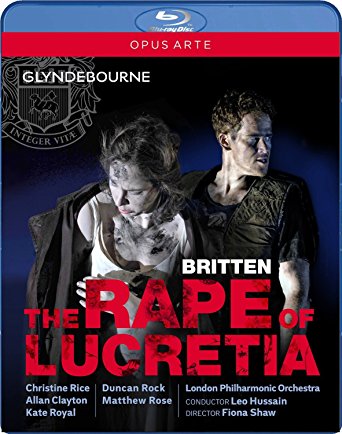
This new Opus Arte Blu-ray disc of last year's Glyndbourne production of Britten's The Rape of Lucretia is a very welcome record of the highly praised opera directed by Fiona Shaw. Shaw's concept adds new layers to the cleverly designed original concept of Britten and his librettist Ronald Duncan. There's an intended pun there, since the Male and Female Choruses act as if they were post-war British archaeologists uncovering the tragic story of Lucretia and her rape by Tarquinius, prince of Rome. We dig into the story through layers of dirt, and the set and lighting and costume design all focus our attention on Britten's perennial theme, the corruption of innocence. 

I watched this with the equally sordid American election swirling in the background, which seemed pertinent in a way, but unfortunate in others. There's lots in the story as told by Shaw that's vile, but it also has dignity and gravitas, and the violence of the central act is never gratuitous. That's helped immensely by the amazing acting and singing of the cast, and especially Christine Rice as Lucretia and Duncan Rock as Tarquinius. Musically as well we have the best possible players - thirteen musicians from the London Philharmonic Orchestra and their leader, Leo Hussain - who, as Fiona Shaw herself says, "have [the work] in their fingers, in their bodies." The HD sound and picture are outstanding; much more impressive than a video clip can put across. This is a modern masterpiece brought to post-modern life.


Friday, July 29, 2016

The best Henry V for the home theatre


The last three plays in Shakespeare's Tetralogy, Henry IV, parts I & II, and Henry V, are a bit like a Three Card Monte game. Who are we watching for? Pay close attention to Sir John Falstaff. How could we not, when he was played so superbly by Antony Sher in the first two plays? I was bowled over by this performance, and by Sher's amazing book The Year of the Fat Knight which chronicles his role. But pay too much attention to Falstaff and you'll miss the amazing character arc of Prince Hal becoming King Henry, who is marvellously portrayed by the another superb actor and comedian, Alex Hassell. Watch King Henry, as he builds his character and leadership skills, coming to a climax in the great St. Crispin Day speech. What a character; what a fine performance! But wait - where is Sir John?

Alas, he's gone, leaving a Sir John-shaped hole and some very good memories. Shakespeare has let the Falstaff card fall from the table. But in this presentation of Henry V director Gregory Doran and his awesome cast work hard to fill that hole and move the action across to France and world events. Bardolph is back, played again by Joshua Richards, as is Pistol (Antony Byrne), along with Mistress Quickly (Sarah Parks, who replaces Paola Dionisotti), and they all get some room, away from Falstaff's shadow, to build comic rhythms and gain long and loud laughs from an appreciative Stratford-upon-Avon audience. Again, the talented actors in Doran's troupe often take multiple roles, and the stagecraft is of the highest order all around. The stage is set, to coin a phrase, for the patriotism and heroics on, or rather, just a bit to the side of, the battlefield. All this, plus Opus Arte's fine HD sound and picture and excellent video direction, makes this the best available Henry V for your home theatre.

Wednesday, December 30, 2015

Impressive staging and presentation of a master-work


Karol Szymanowski’s opera Król Roger (King Roger) was written in the period 1918-1924, and received its premiere performance in Warsaw in 1926. The work is a skillful blend of psychological, political and religious themes, but it’s a personal testament as well. In this complex master-work of the operatic stage the composer presents lifelong philosophical musings, and his own sexual longings, in an idealized Mediterranean setting common to northern European artists since Goethe and Schumann.

The opera is full of multicultural references and effects, with an unusually broad range of influences apparent in its libretto (by the composer and his cousin Jarosław Iwaszkiewicz) and the music itself. Some that occur to me, or have been suggested in my reading, are Oscar Wilde, Walter Pater and Thomas Mann on the literary side; Stravinsky’s early ballets and Wagner’s Tristan and Parsifal on the musical side; and Euripedes’ Bacchantes (Szymanowski’s explicit model) and Shakespeare’s Hamlet, The Tempest and King Lear on the dramatic side. The over-arching philosophical structure comes, of course, from Nietschze’s dichotomy between the reasonable Apollonian and the instinctive Dionysian natures of humans and Gods. Finally, the religious ecosystem of the opera is a syncretistic mixture of Eastern Mystery rites, ancient and Byzantine Greek and ancient and Catholic Roman faiths, with Muslim influences from the Sicilian locale. As Pater put it in Marius the Epicurean, “A blending of all the religions of the ancient world had been accomplished.”

All of this might come crashing down in an eclectic heap were it not for Szymanowski’s extraordinarily cogent libretto and his arresting sound world and musical development. Even then, there are lots of ways a production of King Roger could founder, from problems with the cast, chorus, orchestra, production conception or stage design. Luckily, all of those components are top drawer in this excellent recent Royal Opera House Covent Garden production headed by Director Kasper Holten.

The principals are especially good. Kim Begley is very effective as Roger’s advisor, part Tom Hagen consigliere, part Sigmund Freud therapist. Georgia Jarman is always sexy as the Queen, though often slightly demented, and she’s great in Roxana’s big second act aria - the most sensuous 20th century music for soprano until Villa-Lobos’s 5th Bachianas Brasileiras. Salmir Pirgu is a delightful Shepherd, coming on full-charismatic guru, then pulling back as a detached, cynical con-man. In the final scene he channels the Commendatore from Don Giovanni, calling the protagonist to a different kind of end:
I'm calling you to an endless journey,
to a joyous dance!
To me! To me!
I'm calling you!
As the dramaturg John Lloyd Davies points out in his excellent liner note essay, the work is very much about the titular character, and this production of King Roger is blessed with the gifted singer and actor Mariusz Kwiecień, who presented a similarly tortured main character in the Royal Opera’s superb recent production of Don Giovanni (another collaboration with Holten.) Every bit of the King’s doubts and enthusiasms, his longings and hesitations, is projected on Kwiecień’s face or through his voice. The entire production is exceptional, from Holten’s concept to the stage and lighting design and choreography. The singing (and acting) of the chorus is strong, as is the playing of the Royal Opera House Orchestra under Antonio Pappano. The Opus Arte presentation makes full use of the audio and visual capabilities of Blu ray and includes fascinating special features, most interestingly an audio commentary by Holten and Pappano. This is a demonstration disc in so many ways, and most importantly a demonstration of the enduring dramatic and intellectual power of opera.

Wednesday, November 11, 2015

Shear vulgarity


My favourite thing about ‘Eurotrash’ opera productions - radically political and elaborately trendy remixes of 18th and 19th century works that began life with breastplates, horned helmets, well-fed singers and real-life trees on-stage - is the YouTube comments that accompany the trailers. One complained about the ‘shear vulgarity’ of a new production (which I extravagantly praised) of Rameau’s Les Indes Galantes. This new Tannhauser will surely bring its own tsunami of outrage, but then outrage is nothing new when it comes to a work Wagner wrote with controversy in mind.

The culture wars have always been with us, and Wagner trolled the comfortable bourgeoisie with the best of them. The bait was always taken, though the biggest splash at the 1861 Paris premiere came from the Jockey Club, who objected to the ballet occurring at the beginning of the opera, rather than after the interval when their members usually arrived. Baudelaire saw Wagner’s not-too-well-hidden meaning right away, saying “…barbarity always has to have its place in the drama of love, and sensual enjoyment has to lead, by a satanic logic, to the delights of crime.” If the composer could see what’s happening at his sacred Festspielhaus in the 21st century of course he’d himself be shocked, but surely he would have been pleased by the strong response. This is, after all, an opera about sex.

I always like to go with the flow with these kind of spectacles. I tend to be open to experimental dramaturgy, and I like what’s happening here in that regard. Sebastien Baumgarten’s production, which centres around Joep van Lieshout’s imposing industrial installation, is focussed on Tannhauser as experiment. To go with this, though, musical standards must be high, and the singing especially needs to be strong. This production passes that bar easily, with outstanding singing and acting from Michelle Breedt as Venus, Camilla Nylund as Elisabeth, and especially Torsten Kerl as Tannhauser. Conductor Axel Kober provides more than capable support with the Bayreuth Festival Orchestra & Chorus, and the entire experience is communicated with excellent sound, video, lighting and camera work.

So bottom line: I’m shocked just a bit, titillated just a bit, impressed a lot.

Salacious note: People buying this DVD without reading the comments (Caveat emptor!) might not realize what they're getting. Look at that cover above! Here's the good stuff: enjoy!


Monday, November 2, 2015

A comic masterpiece, with tragic relief

From March 19, 2015:


Watching the superb new BluRay version of this Royal Shakespeare Company production of the two parts of Henry IV, I thought of a quote by the late Terry Pratchett: “You can’t build a plot out of jokes. You need tragic relief.” Shakespeare balances the tragic and the comic, the historical and the situational, perfectly and deftly in the first part, if a tiny bit less so in the second. Comedy is the key ingredient, but strategic doses of tragic relief move the history along and make us care for the characters. Shakespeare creates a great figure in Sir John Falstaff, and presents him in the round, literally and figuratively. Antony Sher’s portrayal is outstanding: comic, and often hilarious (rather than Elizabethan clown/jester “funny”), but also sometimes cruel, and a figure in the end of deep sadness and regret.

The true measure of this production’s success, though, is in the integration of both parts of Henry IV’s story through the most amazing cast, who all work together to present Director Gregory Doran’s (and Shakespeare’s) vision. Many cast members take multiple roles, and actors portraying noblemen might show up in the next scene as carriers or soldiers. Trevor White, outstanding as Hotspur in Part I, plays the small but key role of Lord Mowbray in II. Antony Byrne impresses as the Earl of Worcester in I, and actually get three roles in II: Rumour, a Porter, and an outrageous Pistol. Nia Gwynne is touching and sad as Lady Mortimer in the first part, and plays a hilarious and sad Doll Tearsheet in the second. This is an ensemble play in the best sense.

The plays as history present the passing of the crown from Henry IV, usurper and uneasy king, to his son, the wastrel Prince Hal who becomes Henry V. Jasper Britton is an impressive King: distracted by guilt, deathly ill, and never easy in his role. His son begins as callow as can be, and only starts his journey to true Kingship by the end of the second part. Alex Hassell retains a bit of the upper-class twit through most of both plays, with glimpses of greatness on the battlefield in Part I, and with his dying father in Part II. Henry V will have his apotheosis in his own play, and I’d love to see Hassell continue this role in that play. Meanwhile, there are plenty of sparks between Hassell and White as Hal and Hotspur have their thoroughly dramatic final confrontation at the Battle of Shrewsbury at the end of Part I. The stage fighting here is absolutely amazing, turning up the tension to a fever pitch, accelerating the action to its inevitable end.

The presentation on BluRay from Live from Stratford upon Avon is really special. The camera always seems placed just where it needs to be, whether adding sweep to a battle scene, or focussing without moving on the back of Falstaff’s head as he is rejected and humiliated by his once-friend, the new King. When the King passes and Antony Sher slowly turns to the camera, tears streaming down his face, we witness a great theatrical moment. These two discs are full of those moments. Through the magic of HD video and sound we feel that we're right there in Stratford watching.

A Towering Don Giovanni on Blu-ray

From December 2, 2014:


Everything about the new Blu-ray disc of the early 2014 Royal Opera production of Don Giovanni is of the highest quality. Director Kasper Holten’s conception of the opera as psycho-drama is well-served by Es Devlin’s design, by the singing and acting chops of the cast, and by the stylish playing of the Royal Opera House orchestra under the direction of Nicola Luisotti. First and foremost is, of course, Marius Kwiecien as the Don. His strengths as a singer are only surpassed by his acting ability. From Don Giovanni’s initial swagger to the torments of the finale Kwiecien commands the stage (and the camera) with a huge range from violent intimidation to the subtlest portrayal of his internal insecurities. It’s a majestic performance that matches the finest work of the greatest stage or screen actors I can think of.

To this superman/monster Mozart adds humanity with a great cast of supporting characters. Alex Esposito is an outstanding Leporello, bringing comedy and pathos in equal measure. Both Malin Bystrom as Donna Anna and Veronique Gens as Donna Elvira are amazing singers, but also fine actresses who create rounded characters rather than merely wronged and vengeful stock figures.

Blu-ray is the perfect medium for Mozart’s drama, which is oddly intimate, even claustrophobic, while it deals with the widest range of human emotion and supernatural forces.