Reviews and occasional notes on classical music

Reviews and occasional notes on classical music

"Music, both vocall and instrumental, so good, so delectable, so rare, so admirable, so super excellent, that it did even ravish and stupifie all those strangers that never heard the like." - Thomas Coryat, after hearing 3 hours of music at the Scuola di San Rocco in Venice, 1608.

Showing posts with label Pentatone. Show all posts

Friday, January 13, 2023

Fresh and Vital Bach and Pärt


Bach: Violin Concertos; Pärt: Fratres, Spiegel Im Spiegel

"The slow movement from Bach’s A Minor Concerto was the reason that, at the age of four, I knew I wanted to play the violin for the rest of my life. Of course, I had no idea at the time what that would really mean — but I was so overwhelmed by the beauty and depth of Bach’s music that there was no question for me: I simply had to become a musician!"

Playing the Guarneri del Gesù ‘Sainton’ violin from 1744, Arabella Steinbacher provides a luscious sound, rich and full, that focuses one's attention completely, almost ignoring the to-and-fro of the orchestral and solo parts, and even of the beautiful melodies that Bach provides. It's remarkable how an instrument made that long ago could be used to play music that's three centuries old and sound so fresh and alive. I've long been a fan of Steinbacher's; I've raved about her playing in a wide variety of repertoire: Bartok, Brahms, and Hindemith and Britten. Here she plays two Bach Violin Concertos: in E major and A minor, and a Bach Concerto for Two Violins in D minor, with another fine violinist, Christian Kontz. Once again Pentatone provides fine accompaniment: the agile and stylish Stuttgarter Kammerorchester.

J. S. Bach's manuscript score of the violin part for
the slow movement of his A minor Concerto

Two Arvo Pärt pieces bookend the three Bach concertos. His Fratres comes in many versions; this one, for violin, string orchestra and percussion, is from 1992. This is a suitable prelude to the meat of the programme: hushed and reverential, but in the end as dramatic a curtain raiser as a Rossini overture. The final piece, Spiegel im Spiegel, in its original 1978 version for violin and piano, acts as a kind of valedictory encore. Once again, Arabella Steinbacher has a fine partner, in pianist Peter von Wienhardt.

The wonderful photo of Steinbacher on the album cover is by Co Merz.

This album will be released on February 10, 2023.

Sunday, January 12, 2020

Handel: dramatic and refined


Handel: Concerti grossi op. 6, no. 7-12

This is the second of three Handel albums from the Akademie für Alte Musik Berlin under Bernhard Forck. I loved the first, which included the Concerti grossi op. 6, no. 1-6, and very much look forward to the op. 3 album, hopefully coming soon, which will complete the set. This is a group that has Handel figured out like Van Gogh figured out sunflowers; these marvellous concertos have never sounded better. They've hewn to a middle road between refinement (the Academy of Ancient Music under Andrew Manze) and full-out drama (Il Giardino Armonico under Giovanni Antonini). The latter had always been my preferred version, but I find myself more inclined to choose this new release for my Desert Island Handel.

This fine portrait of the Akademie für Alte Musik Berlin by Uwe Arens shows the full richness and joy you can expect from these Handel discs from Pentatone.


This album will be released on January 17, 2020.

Tuesday, December 17, 2019

Fresh Beethoven takes from a fine conductor


Beethoven: Symphonies 5 & 7

All right, 2020 is indeed the Beethoven Year, marking the 250th anniversary of the composer's birth. But I wasn't planning on turning Music For Several Instruments into an all-Beethoven blog. We'll see how things go in January, but in the meantime I'm really enjoying listening to the Big Guy as we see out the year and the decade: the Late String Quartets from The Brodsky Quartet, the superb complete Piano Sonatas by Igor Levit, and now this fine new disc of Symphonies from the NDR Radiophilharmonie under Andrew Manze.

Back in 2010 Manze talked with Michael Cookson about his transition from conducting while playing the violin in Baroque repertoire, where he made his early reputation:
But there comes a point with the repertoire when you cannot do that anymore. For me the point came with Beethoven and so to go any further meant I had to put the violin down and conduct. I was always interested in a wide repertoire, not everything, but a wide repertoire.
A decade later, Manze is settled in with the superb NDR Radiophilharmonie, and he's indeed exploring a wider repertoire: most notably the Mendelssohn symphonies in a marvellous series for Pentatone. In this new recording of two of Beethoven's greatest symphonies you can almost hear the pre-figured Mendelssohn echoing in the background. Manze is driving the two-way street between the Classic and Romantic here, proving once again Jorge Luis Borges' axiom: "Every writer creates his own precursors. His work modifies our conception of the past, as it will modify the future." This doesn't mean that Manze adds Romantic excrescences to Beethoven, any more than he transfers anything more than a feeling of lightness and an extemporaneous freshness from the early music with which he was once almost exclusively connected. The Fifth Symphony has plenty of drama, but light and dark have equal weight in the great slow movement. One has the feeling that Manze is leading his fine instrumentalists through Beethoven's score without any special agenda of his own; hence his fresh takes sound organic rather than contrived.

Peter Ackroyd, in his marvellous book Albion: The Origins of the English Imagination, sees this point of view as something typically British:
What manner of imagination is this? It is one that eschews purity of function for elaboration of form, that strays continually into anecdote and detail, that distrusts massiveness of conception or intent, that avoids 'depth' of feeling or profundity of argument in favour of artifice and rhetorical display.
Manze's Beethoven, I would argue, is firmly in this British tradition of pattern and elaborate decoration, and thus outside the 'profound' tradition of Beethoven conductors, German especially (Furtwangler, Klemperer, Karajan). But as Hugo von Hofmannsthal once said, "Depth must be hidden. Where? On the surface." The fact that Manze is leading a German orchestra down this different path - not radically different, but different nevertheless - shows the close bond he has built with his NDR players since he took over the band just over five years ago. One looks forward to more Beethoven from the same source, as well as more varied repertoire in the future. Which repertoire? Surprise us, Maestro!

This disc will be released on January 10, 2020.

Sunday, June 9, 2019

Inspiration recorded


Handel: Concerti grossi op. 6, no. 1-6

After a disappointing recent Handel album from another Berlin band, it's great to have this new disc, with the promise of two more real soon, from the Akademie für Alte Musik Berlin, under Bernhard Forck. This is some of the greatest music of the 18th century: on the same level as Bach's Brandenburgs and Vivaldi's best concertos, and it's performed in as stylish and musical way possible. Forck highlights the myriad felicities that Handel has woven into these six concertos, but without interrupting the rushing mountain streams of the fast movements, or the stately court dances of the slow ones.

Handel wrote the first six Concerti Grossi published as op. 6 in just over two weeks, from September 29 to October 15, 1739 (the final six were completed before Hallowe'en). You can hear the rush of inspiration in these works in a way that few pieces of music can match. I think of Mozart's piano concertos from the spring of 1785, and Schubert's composition of Winterreise in February and October of 1827. Handel's orchestral music sounds robust when it's played like this, but I've heard more than a few versions of both op. 3 and op. 6 that were crippled by poor musical choices or stylistic axe-grinding, on both sides of the Historically Informed Practices divide. Bernhard Forck and his very fine Berlin musicians, supported by Pentatone's fine engineers, let Handel's inspiration flow unimpeded.

This disc will be released on July 19, 2019.

Friday, April 12, 2019

The International Style in 18th Century Music


Jet Set!: works by Abel, Reichardt, Zelter, Mozart, Storace and Paisiello

From 14th century Gothic cathedrals to early 20th century skyscrapers, there have been International Styles in the arts, as the nobility and then multi-national corporations vied for the best artists, architects and composers from around the world, who influenced each other and created new styles through cross-fertilization. Simon Murphy's latest theme album tells the story of 18th century musicians as if they were from the mid-20th century Golden Age of Travel: "classical glitterati" going to the musical capitals of Europe to show off their wares.


This is stylish programme design and very clever marketing, but it would mean nothing without top-class musical values, and we have that here in spades. First of all, the music itself, full of rarities, and even a number of recording premieres, is of very high quality. Sure, the aria from Mozart's Marriage of Figaro does stand out a bit, but the symphonies, concertos and arias here are always interesting and occasionally quite brilliant. And Murphy manages the transitions from the 18th century to the 21st, with various stops in the 20th century along the way, with verve, panache, and finely modulated levels of style. A simply wonderful time!

Wednesday, January 16, 2019

High above, on a better star


Heimweh: Schubert Lieder

From Pentatone Classics comes this very special package, with an amazing cover photo by Julia Wesely, the profound musical concept and an arresting liner notes essay by Anna Lucia Richter, and the gorgeous music making of Richter, pianist Gerold Huber and clarinettist Matthias Schorn. Not to forget the greatest song-writer in history, Franz Schubert, a brilliant curator of poetry and the ultimate melder of words and music.

"We are torn between nostalgia for the familiar and an urge for the foreign and strange," says Carson McCullers. "As often as not, we are homesick most for the places we have never known." The German words for these two feelings are Heimweh, a kind of homesickness, and Hinausweh, or wanderlust. Schubert, a master of the emotional landscape as much as the musical one, weaves strands of both throughout his songs, and Richter has gathered some of the best for this project. We begin with the heartbreaking simplicity of An den Mond, D. 259, a Goethe setting from 1815. In her liner notes Doris Blaich calls Heimweh, D. 456, from the following year, "one long musical sigh." The lyrics, by Theodor Hell, are a special expression of nostalgic feelings.
Often, in quiet, solitary hours,
I have experienced a feeling,
inexplicable, marvellous,
like a yearning for the far distance,
high above, on a better star,
like a soft presentiment.
Schubert turns the emotional level way up in the late Totengräbers Heimwehe, D. 842, a setting of Jakob Nikolaus from 1825. In this song "The stars vanish – My eyes close in death," an unflinching look into the abyss!

The programme ends with Der Hirt auf dem Felsen, D. 965, a melding of two poems by Wilhelm Müller and Karl August Varnhagen, written in October 1828. This concert aria shifts the spotlight from the relatively intimate lieder to something which points to a more theatrical future, which alas was not to be. The song was published posthumously, after the composer died that November.
My sweetheart lives so far from me,
Therefore, I long so to be with her
Over there.
Music wouldn't be the same without this yearning, from the lonesome cowboy to the saudade of Fado and Tom Jobim, from singin' the blues to Judy Garland's yearning for home in The Wizard of Oz. This album is a distinguished addition to the genre.


This disc will be released on February 1, 2019.

Thursday, September 27, 2018

Fresh and lively Schubert


Now that Historically Informed Practices are closer to the mainstream of classical music one is less likely to come across a surprisingly different performance, even of early 19th century works, but here we are with a completely re-thought album of Schubert's symphonies. René Jacobs and the B'Rock Orchestra present the freshest and most lively Schubert I've heard in a long time; the cobwebs are gone, the light is let in, and one can hear the most interesting musical connections to different genres of operatic, orchestral and popular music, and especially to the carnival traditions of Vienna. Jacobs provides a long essay that breaks down each movement in the two symphonies, the First from 1813, and the Sixth from 1817-18. Reading it is like watching an expert restorer of Old Master paintings. He shows more than musicological expertise, though; he makes a convincing case for presenting the finale of the Sixth Symphony as Schubert's musical depiction of a procession from the Carnival.

Rudoph Ackermann. Characters in the Grand Fancy Ball Given by the British Ambassador Sir Henry Wellesley
at Vienna, at the Conclusion of the Carnival 1826
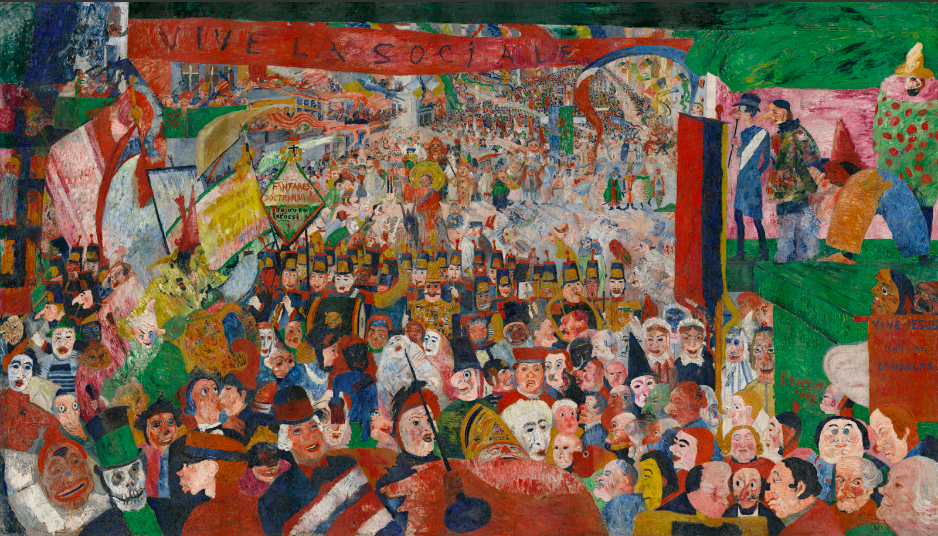
In an extraordinary passage, Jacobs illustrates the music by referring to a great painting, now in the J. Paul Getty Museum, by the Belgian James Ensor (René Jacobs and the B'Rock Orchestra hail from Ghent):
James Ensor’s monumental 1888 painting ‘The Entry of Christ into Brussels’ comes very close to the “meaning” of this final movement as I see it: Christ, although placed at the centre of the huge picture, is a small, lonely, sad figure, almost drowning in a sea of ugly masks and guises. It’s carnival time, and the little Christ is Ensor himself... I wonder if behind the many exuberant notes of this movement, a small, lonely and sad Franz Schubert is hiding.


All the musical and cultural insights into this music are impressive indeed. That along with the outstanding performance of the players of the B'Rock Orchestra makes this a special release indeed.

This album will be released on November 2, 2018.

Tuesday, July 24, 2018

Transcendence, transfiguration & redemption


The new Pentatone album of music from Vienna by Alisa Weilerstein, her first as Artistic Partner of the Trondheim Soloists, comes from a place of profoundly mixed feelings:
Schoenberg fled Vienna in 1934, four years before my grandparents escaped. So, as a young artist, nowhere in my imagination was the possibility of duality and contradiction made more manifest than in the history of that city. A culture that gave birth to some of the greatest achievements in the artform that I had chosen to pursue could, in the same breath, harbor sentiments and sanction behavior antithetical to music’s transcendent promise. 
This ambivalence is a common theme when writing about Vienna since the 1930s, by Jewish writers, or indeed anyone who has been paying attention to the often sordid political and social life of this great intellectual centre, once an Imperial capital.  In "Thomas Bernhard, Karl Kraus, and Other Vienna-Hating Viennese", a fascinating article in the Paris Review, Matt Levin counts down a list of many great thinkers and artists - Robert Musil, Elias Canetti, Sigmund Freud, Ludwig Wittgenstein, Arthur Schnitzler, and more - and concludes, "...in some way, they all seemed to despise the city in at least equal measure to their affection."

For the last twelve years of his life Joseph Haydn lived in Gumpendorf, then a village on the outskirts of Vienna. After his many years away from the mainstream at Esterházy, he really wanted to be closer to the centre of the musical world, and that meant, in turn, Paris, London and Vienna. Alisa Weilerstein has a chance here to show off her considerable chops as a cellist in the two cello concertos that are undeniably by Haydn. But it's also Weilerstein as a conductor who shapes this music in the context of her thought-provoking program (a program that's beautifully laid out in a superb, long liner-notes essay by Mark Berry). We have here a picture of 18th century Vienna, one of civilized life before multiple revolutions brought down the power structures that had built the Austro-Hungarian Empire. But this is more than the usual nostalgic sentimental kitsch so common in Vienna, since Weilerstein brings out both Haydn's earthy humour and the folkloric musical roots of his music. Weilerstein and the players of the Trondheim Soloists have already developed a superb partnership in this repertoire, which also bodes well for future projects.

There's a huge gap between Haydn's Vienna and Arnold Schoenberg's Vienna, but in our post-modern world even the Second Vienna School can take on the same kind of nostalgic sheen that drapes pre-WWI society, of a different sort, certainly, but just as sentimental in its own way.  Vienna has been called "an essential cockpit of modernism", but that revolution, which once seemed so close to our time, begins to recede into distant memories as we move into our new century.  In his 1943 transcription of the 1899 original Schoenberg loses chamber music textures but gains in emotional intensity, assuming a very good performance, which we certainly get here. I always thought the famous Karajan recording from 1974 was way over the top, but this definitely isn't. Though it also packs an emotional punch, Weilerstein's version is responsible in the way that Karajan's version wasn't, clear-eyed about the beauty of the music but also the horrors into which Vienna would descend.

What a thoughtful and impressively musical disc this is!

This recording will be released on August 24, 2018.

Monday, March 5, 2018

Deeply moving and profound


Paul Hindemith: Symphonic Metamorphosis, Nobilissima Visione, Konzertmuzik "Boston Sinfonie"

I've been listening to way more Paul Hindemith in the past couple of years. Some outstanding recent discs are driving this, but I went back to the composer himself conducting the Berlin Philharmonic in the 1950s,  from the 3 CD set from Deutsche Grammophon, to take a closer look at his orchestral music. What I heard there impressed me greatly, and surprised me more than a little. This is almost all really stellar music, and the old recordings still have the power to move one as much as all but the greatest composers of the 20th century.

Now comes this new disc, just released, from Marek Janowski and the WDR Symphony Orchestra. This raises the bar even more, and not just with the improved sonics (to be sure, the old DGG recordings sounded better than one would expect). There's even more excitement and energy here, more warmth in Hindemith's reflective moments. This music isn't only "orchestral showpiece" level, as sparkly as it can be. This is at times deeply moving and profound. I highly recommend this excellent Pentatone release.

Sunday, September 10, 2017

Dynamic music in exile


Benjamin Britten & Paul Hindemith: Violin Concertos

It's looking like Paul Hindemith's reputation might have turned a corner; there have been some really first-class releases of his music in the last few years.  I've recently reviewed the Amar Quartet's excellent Complete String Quartets on Naxos and another fine album of chamber music with clarinet from Brilliant Classics. Slightly older, but quite spectacular, was an outstanding all-Hindemith disc from Midori and Christoph Eschenbach. Now we have a fine new recording of the Hindemith Violin Concerto from Arabella Steinbacher and the Berlin Radio Symphony Orchestra under Vladimir Jurowski. It's coupled with an equally beautifully-played Britten Concerto.

These two works were both written in 1939, when each of these composers was in exile from his native land; Britten in America and Hindemith in Switzerland, and later America as well. "Only the misfortune of exile," says Stefan Zweig, "can provide the in-depth understanding and the overview into the realities of the world." There's some nostalgic sadness in each work, as there was in Zweig's own work about exile, The World of Yesterday, written in Brazil in the early 1940s. But, typically of both composers, this music is very much forward-looking, dynamic and really rather optimistic. Steinbacher plays with verve and great virtuosity, while Jurowski and his musicians provide the requisite big sound for these two 19th century-style concertos, the dramatic and lively Britten, and the lyrical, stirring Hindemith. Very highly recommended.


This album will be released on October 20, 2017.

Monday, August 1, 2016

Bach the Terminal Point


Heitor Villa-Lobos called Bach "...a kind of universal folkloric source, rich and profound."  He mined a particularly rich Bachian vein throughout his career, as have so many other composers, including Mozart, Chopin, Debussy.  "Study Bach," said Brahms, "there you will find everything."  One way to pay back this influence is to write music in homage: Villa's Bachianas Brasileiras, Stokowski's orchestral adaptations of preludes and fugues, Shostakovich's great Preludes and Fugues for piano, Penderecki's St. Luke Passion. There are hundreds, thousands, of others.

For this project Matt Haimovitz commissioned six composers - Philip Glass, Du Yun, Vijay Iyer, Roberto Sierra, David Sanford, and Luna Pearl Woolf - to write music for solo cello that would naturally lead into six different movements from the Solo Suites. In a process that Bach the every-day professional musician would have found familiar, these commissions interrupted the composers' current work - on Glass's opera Appomattox and Woolf's opera Better Gods - or started a back-and-forth collaboration between composer and performer, as happened between Haimovitz and Iyer. The composers' ideas encouraged Haimovitz to explore new techniques: microtonality in the music of Du Yun, the jazz bassist's repertoire of pizzicato and a different forms of scordatura with David Sanford, and an exploration of the five-string cello piccolo in the work of his partner Luna Pearl Woolf. He uses a variety of bows - Baroque and modern - throughout. None of this trial-and-error and technical innovation gets in the way of the music; it all sounds completely natural and organic. There is similarly no jarring transition between the new music and Bach, which is a tribute to the composers, the performer, and genius of Bach himself.

As with all the best encounters between artists, the more each composer focusses on Bach the more personal the music becomes. Haimovitz is demonstrating in these commissions and his superb Bach performances the truth of Borges' statement in his essay Kafka and His Precursors: "The fact is that every writer creates his own precursors. His work modifies our conception of the past, as it will modify the future."


"Bach is a terminal point," Albert Schweitzer once said. "Nothing comes from him; everything merely leads up to him." So all music in homage to Bach is really a kind of overture.

The Pentatone CD will be released September 9, 2016.


Monday, November 2, 2015

Super Super Audio

From October 1, 2015:


I came late to multi-channel Super Audio recordings, but even with my modest audio setup, I’ve really come to appreciate the extra dimensions it brings as I listen to new CDs, DVDs and Blu-ray discs of classical music. The expansive, dramatic Dvorak Cello Concerto is the perfect piece to show off Super Audio, and this new Pentatone disc immerses one in a concert hall setting with a strong orchestra and a superb cellist. Johannes Moser’s playing is vivid, tender and tragic, but with strong support from conductor Jakub Hrusa, he keeps this often emotional music from veering into melodrama. The Lalo Concerto isn’t at the same high level as the Dvorak, which is very much a tough act to follow. Since the work has such a different sound world, though, it is here a real joy to listen to. The German-Canadian Moser seems to have a special feeling for French music, as he made clear with his very first recording, of Saint-Saens’ music for cello and orchestra. This is very highly recommended.

Here is a very cool video promoting the project:

Saturday, October 31, 2015

An Outstanding Brahms Program,

From June 28, 2011:


Every competent performance of a Brahms violin sonata will have in it something of interest: each phrase is perfect and inevitable, but somehow at the same time constantly surprising and evocative. Great performances will always be emotional but not sentimental, and classically balanced but not dry or academic.

There's an old Gaelic proverb that says "When the cup is fullest it is most difficult to carry." Brahms has filled the cups to the very brim in his three violin sonatas, and the challenge to violin and piano partners who would carry them is daunting. This new disc from Arabella Steinbacher and Robert Kulek is as accomplished as any recent CD in this repertoire.

I'm a big fan of Steinbacher's tone, and her technical capabilities are obvious. Kulek provides more than simple accompaniment; he's an equal partner in this challenging music. This is outstanding musicianship, with the artists' egos subjugated to the logic of the music. Pentatone has provided stunning sound in this 2010 Dutch recording. The multi-channel super audio format is perfect for presenting both the drama and the intimacy of Brahms' chamber music.

Not every disc of the Violin Sonatas finds room for the Scherzo that Brahms contributed to the FAE Sonata, along with Albert Dietrich and Robert Schumann. This is no mere filler, but an accomplished work by the 20-year-old composer. It's a splendid encore to an outstanding program of masterpieces for violin and piano.

Eavesdropping on something special

From November 2, 2010:


Fans of recorded music have always talked about the sense of being more or less in a concert hall, listening to music as real as a live concert. The sound from this disc is so vivid and lifelike that I had a more privileged, intimate feeling. I could imagine that I was present at the recording, one of a handful of hangers-on allowed to sit in Geneva's lovely Victoria Hall while the recording took place, experiencing the creation of something special.

I don't have the high-end system or the high-end ears of a true audiophile, but this feeling of the musicians' presence enhanced my enjoyment more than I thought it could. The outstanding quality of Arabella Steinbacher's performance of these two pieces (the second of which tops my list of the greatest 20th century violin concertos) was just as apparent to me when I listened to the MP3s on my iPhone, as was the musicality Marek Janowski brought out from the Suisse Romand Orchestra. But this Hybrid Multichannel Super Audio CD is at the intersection of the highest levels of creation, interpretation, and technology. Watch for this disc to show up on many "Best Of" lists to come!