Reviews and occasional notes on classical music

Reviews and occasional notes on classical music

"Music, both vocall and instrumental, so good, so delectable, so rare, so admirable, so super excellent, that it did even ravish and stupifie all those strangers that never heard the like." - Thomas Coryat, after hearing 3 hours of music at the Scuola di San Rocco in Venice, 1608.

Showing posts with label Beethoven. Show all posts

Sunday, April 9, 2023

Splendid, authentic, joyful chamber music


In the world of Charles Schulz's Peanuts, it's not Schroeder who's most like Beethoven, but the fussbudget Lucy. Beethoven had a lot to moan about in his difficult life, but even when things went well, there was always something to complain about. 


His Septet of 1799, scored for clarinet, horn, bassoon, violin, viola, cello and double bass, was a big hit, a very big hit. This irked the composer, since he felt that the serenade-like work was far eclipsed by his more important works, which at the time included his First Symphony, his first two Piano Concertos, his op. 18 String Quartets and a fair number of Piano Sonatas, including the Pathétique. I think what upset him most about the success of the Septet, a work of great charm and considerable ingenuity, was that it represented what he considered an obsolete role for the composer. Even today we connect the serenade with musicians playing on demand, often in the open air, for aristocrats. In this ancien regime scenario the be-wigged composer beating time is little more than a servant providing entertainment for courtiers.

In a controversial essay in the New York Times, Martin Scorsese posited that "cinema is an art form that brings you the unexpected. In superhero movies, nothing is at risk." Beethoven's Septet was a kind of Marvel Movie for the musical consumer of the turn of the 19th century, a safe source of entertainment that didn't tax the brain or emotions too much. Everything that Beethoven truly valued in his own music, as well as the music of others, was based on a much more radical and unsafe point of view. 

I know the Wigmore Soloists from their very fine 2021 recording of an undisputed masterpiece, Schubert's Octet. Here they navigate the tricky line between popular and erudite music, and come up with the perfect compromise. Their Septet is, quite properly, not treated as the Eroica, but neither is it tossed off with little regard for its true merits. The result is, I think, as fine a Beethoven Septet as I've heard.

Franz Berwald's Septet seems like the perfect pairing for Beethoven's Septet, since it was written in 1828, the year after Beethoven's death. But this is, I believe, only the second time the two works have appeared together on one disc; the other was in a 2017 CD from the Uppsala Chamber Soloists. That was a well-played recording, especially the Berwald, but it's completely outmatched by the new Wigmore Soloists disc. Everything about this new BIS recording is perfectly judged, from the splendid, authentic, joyful performance to the always impeccable BIS engineering, and the fine liner notes by  Philip Borg-Wheeler. Very highly recommended.

Friday, February 17, 2023

Legendary audiophile Beethoven from Minnesota

Beethoven: Leonore Overtures, Fidelio Overture, The Ruins of Athens

Terry Pratchett, whose aphorisms are on the same level as those of Mark Twain and Oscar Wilde, once said, "Opera happens because a large number of things amazingly fail to go wrong." Beethoven's orchestral music is so dramatic, but he only managed to write a single opera, and for that he came up with four different overtures, in a remarkable display of compositional dithering. What failed to fail to go wrong in Beethoven's operatic career?

First of all, Fidelio is a remarkable work, though Beethoven laboured mightily to complete it in a version he felt good about, creating lots of hard feelings along the way. It's not as if Beethoven's compositional career has any dead spots in it. If he didn't write a great deal of vocal music, he obviously made up for that with instrumental, chamber, orchestral and sacred music at the highest level. So here's the first answer: he was busy writing other kinds of music.

Secondly, there's a difference between dramatic music and theatrical music. Opera is a collaborative art, and Beethoven is the least likely person to succeed in working with others. It's maybe only because we have Mozart's example at hand that we think Beethoven should have produced other operas besides Fidelio. It wouldn't be until Wagner that someone as self-centered as Beethoven succeeded in creating both quantity and quality in his operas. But Wagner is perhaps sui generis, and besides, he had Beethoven as a musical model.

Listening to the three Overtures to Leonore, I thought about those DVD "deleted scenes" commentaries, where movie directors explain why scenes were cut. When he moves from the 2nd to the 3rd Overture, Beethoven tightens up his material and jettisons everything that doesn't move things along. This isn't to save time, but to allow him to introduce a very dramatic recapitulation (the two pieces are virtually the same length - around 14:20 - on this recording). In any case, with the Leonore Overtures we have three splendid concert works that refer to the dramatic feeling of Fidelio, without in any way becoming a potpourri of themes or "opera without words".

In 1980 Vox released a 3 LP VoxBox set of Beethoven's orchestral music for the stage played by the Minnesota Orchestra, conducted by Stanislaw Skrowaczewski. This was one of the projects produced and engineered by Marc Aubort and Joanna Nickrenz of Elite Recordings, who made some of the most impressive sounding classical discs ever. We finally have one of those LPs - comprising the 3 Leonore Overtures, the Fidelio Overture, and the Overture and some incidental pieces from The Ruins of Athens - available on CD, transferred in 192 kHz, 24 bit High Definition sound, from the original analogue tapes.


Though I don't call myself an audiophile, I certainly appreciate the lifelike orchestral sound presented in this project. And I definitely think that this is Beethoven playing of the highest order. In Leonore 2 and 3, Skrowaczewski has his musicians hitting on all cylinders; he takes things at a feverish pace at times, sure that his fine musicians can follow. I've focused on those two works, but the others on this disc are wonderful as well. There are a couple of bonus tracks that are really fun: the Turkish March and March and Chorus "Schmückt die Altäre" from The Ruins of Athens. The latter features the choir of the Bach Society of Minnesota.

This is orchestral virtuosity of the highest order. I look forward to more of these splendid Vox Audiophile recordings in the near future.

This album will be released on March 24, 2023. 

Thursday, May 13, 2021

Urgent, passionate, transcendent piano music


"Something about this music just seemed to make sense now, when so little else did."

It's fitting, I think, that I come back to reviewing music on this blog after my annus horribilis, when my wife died of Ovarian cancer and I had a major accident, all during the terrible pandemic that we're slowly emerging from. Pianist Andrew Von Oeyen's year was a challenging but productive one, resulting in a shift in his musical priorities, and it brings us a quite remarkable album of music by Bach and Beethoven.

Von Oeyen came to Bach, or perhaps more accurately, Bach came to Von Oeyen, during enforced leisure, with touring, public performance and normal recording activities on hold:
While I had studied many of his keyboard works, I almost never performed them; I was not a specialist. Yet his music was calling, and with a newfound liberty of time to explore repertoire without professional deadlines, I decided to bury my troubles in his contrapuntal canon.
That this was a kind of Saul in Tarsus moment for the pianist is clear from his taught and concentrated performance of the Overture in the French Style, BWV 831. This is just the opposite of the dry Bach that still holds sway over some pianists; Von Oeyen plays with urgency and passion. He comes through these emotions to a calm centre, though he doesn't quite reach the same Olympian serenity of that most urgent and passionate of all pianists, Glenn Gould. Still, this is a superb version of this great work that seems better each time I listen to it.

Von Oeyen's Beethoven is equally stormy, and just as convincing. He found that "the directness, virility, determination, and sheer willpower of Beethoven... aligned with my own growing resolve to transcend this trial." This is Von Oeyen shaking his fist at COVID as Beethoven famously shook his at Fate. The Appassionata Sonata, op. 57, is the perfect work to demonstrate how one person can fight the good fight against the Universe, though of course it also takes enormous control, and self-control, to keep it from sounding melodramatic and histrionic. The slighter Sonata Quasi Una Fantasia, op. 27 no. 1 is pitched at a lower temperature, and to his credit, Von Oeyen doesn't push too hard and destroy the still somewhat naively pre-Romantic feeling of this wonderful piece. This is beautifully balanced, and beautifully played.

Von Oeyen ends a wonderful programme with two Bach arrangements by that great Beethoven pianist, Wilhelm Kempff. I've always thought of Kempff as my Beethoven pianist, since I first heard Beethoven's sonatas played by him. Kempff brings loads of sentiment to these pieces, and in turn Von Oeyen plays both with simple dignity and a feeling of transcendence. Perhaps there is some light ahead.


To be released June 11, 2021.


Sunday, March 29, 2020

Fear and Admiration


Beethoven: Symphony no. 5

Watch this amazing video of MusicAeterna playing Beethoven's Fifth Symphony under the direction of Teodor Currentzis. With the Sasha Waltz Dance Company & Guests at Radialsystem Berlin, January 2016.


The same mystery, drama and physical movement which inspired Currentzis' interpretation of this amazing music remains in this new recording, to be released four years later. Only now there is even more of each of those components, and it results in one of the most exciting new Beethoven recordings I've heard this century.


Robert Schumann's comments on the Fifth Symphony are especially a propos in this case:
No matter how frequently heard, whether at home or in the concert hall, this symphony invariably wields its power over people of every age like those great phenomena of nature that fill us with fear and admiration at all times, no matter how frequently we may experience them.
Currentzis' high energy level, his brisk tempi, and his pointed dynamics might seem to some exaggerated, but I was completely swept along and swept away, almost, but not completely, against my better judgment. Yes, he's faster than a speeding Toscanini, more powerful than a Von Karajan locomotive, he leaps over tall buildings Klemperer walks around.

I recognize my own tendency to enthusiastically embrace shiny new things, and occasionally I come back with sober second thoughts. Let's see how this works out for me!

This album will be released on May 8, 2020

Wednesday, March 11, 2020

Perfectly judged performances


Beethoven: Piano Trios op. 1 no. 3 and op. 70 no. 2

The three piano trios that Beethoven published as opus 1, and especially the third in C minor, constituted an announcement to the wide world that a new composer was about to enter into the top echelon in Vienna, the musical centre of Europe at the time. It's astounding that this obscure young man from Bonn, without connections, should be interacting with Joseph Haydn, the world's most famous composer, and having his new music premiered two years later at the home of Prince Lichnowsky. I'm not sure which disparity was more pronounced: the social distance between this impoverished newcomer and the one-percent Viennese aristocracy, or the professional gap between a freelancer with barely any gigs on his resumé and Europe's top musical superstar at the peak of his powers. Perhaps this social mobility came about because of the recent revolutionary events in France, though I'm sure at least as much was due to Beethoven's outsize talent and his pure strength of will - chutzpah in a word.

When Haydn, shocked by the new sounds of the C minor Piano Trio, advised Beethoven to abandon the work, the young composer was devastated. His pride hurt, he put the criticism down to Haydn's jealousy. Thus did Beethoven's relationship with his true musical father enter its full Oedipal stage. Haydn's relationship with his other protégé, Mozart, had always been cordial, though Mozart, of course, had his own fraught relationship with his own musical, and actual, father. So from now on it would be this: Beethoven against the world!

I'm impressed with the way the London-based Sitkovetsky Trio give us some idea of just how new the C minor trio might have sounded to those who heard it for the first time at Prince Lichnowsky's musical gathering, without leaning in too hard towards the revolutionary, after the fact as it were. I've heard some groups anachronistically make too much of a meal of this work. While Haydn and Mozart had recently overhauled the piano trio, freeing it from its salon music roots, this was still within a rather narrow, civilized band. If one considers this relatively sedate landscape, then Beethoven's dramatic effects and new harmonic and rhythmic devices can sound a bit disconcerting, even considering the two centuries of musical innovation to come.


The Sitkovetsky Trio usher us into a completely different soundscape with their performance of the second Piano Trio of Beethoven's op. 70 set, from 1809, the period of the Second Symphony. Gone is the chip on his shoulder. We know that life was no easier for the composer, in spite of some significant successes, but the quiet confidence and grace of the first movement is perhaps a sign of maturity.  Haydn died on May 31st of that year; perhaps this work, in a genre that Franz Joseph had truly made his own, is a tribute to Beethoven's true musical father.

Tucked away between these two works is a little gem that Beethoven wrote in 1812, the Allegretto, WoO. 39. This may be a simple piece, designed for the ten-year-old Maximiliane Brentano, the daughter of a friend of Beethoven's, but the degree of difficulty to bring about such a perfect result is very, very high. Here again is evidence of the sensitivity and musicality of the Sitkovetsky Trio. This entire program is remarkable, and bodes well for future volumes.


Monday, February 3, 2020

Music of unbridled joy for #Beethoven250


Beethoven: The Complete Piano Concertos

"The sonatas were pursuits of inner truth, the symphonies pursuits of the highest qualities in humanity, the piano concertos pursuits of unbridled joy." In a heartfelt essay in the liner booklet, Stewart Goodyear notes that he waited to record the Beethoven Piano Concertos: "... it had to be at a time when I felt that I knew deeply what universal joy and delight felt like." This joy and delight is clear to hear in this 3-disc album with the BBC National Orchestra of Wales under Andrew Constantine, from Orchid Classics.

When we think about joy and Beethoven, it's Friedrich Schiller's Ode to Joy that comes to mind:
Joy, beautiful spark of Divinity,
Daughter of Elysium,
We enter, drunk with fire,
Heavenly One, thy sanctuary!
Schiller's poem was published in 1785, and revised in 1808. In between, Beethoven wrote the first four of his piano concertos; the fifth was begun in 1809. Beethoven's own apotheosis of joy came, of course, with the Schiller setting in the last movement of his Ninth Symphony in 1822/24. But I love Stewart Goodyear's characterization of this wonderful music as being in some way essentially joyful. It's the serious, grumpy stereotype of Beethoven himself that Goodyear is fighting here. Unlucky in love, navigating family difficulties, grappling with political disasters that seem as dire as our own today, experiencing the vagaries of the "gig economy" as one of the very first freelance composers, and stricken with deafness in this very period; we can feel for Beethoven today. We can even imagine a black cloud hanging over his head. Especially with the late sonatas and string quartets to come, we look to Beethoven for spiritual and aesthetic resolutions to his own pain and suffering. "The idea that happiness could have a share in beauty would be too much of a good thing",  Walter Benjamin once said. But listen to the music, especially in these performances, and you'll hear incredible verve and passion, as Beethoven reaps the harvest of his own "pursuit of happiness" in his art, if not in his personal life. Perhaps it was the Mozartian model - Beethoven's 3rd Concerto in C minor owes so much to Mozart's C minor Concerto K. 491 - that helped Beethoven get over his own hump on his way to happiness.

These are special performances by this team assembled by Orchid Classics: the assured and stylish playing of the BBC National Orchestra Wales shows that conductor Andrew Constantine and this fine Canadian pianist (why are there so many fine Canadian pianists, by the way?) are on the same page. I look forward to listening to these discs in regular rotation during this Beethoven Year, along with the amazing set from Richard Goode & Ivan Fischer, the equally fine recordings of Mitsuko Uchida & Kurt Sanderling, and, of course, the Wilhelm Kempff & Ferdinand Leitner set which was my first experience of this marvellous music.


This album will be released on March 13, 2020

Saturday, January 4, 2020

Quirky joy from a revolutionary pianist


Friedrich Gulda: Piano Concertos by Mozart, Beethoven & Strauss

In October 1950 the 20-year-old Friedrich Gulda made his Carnegie Hall debut, to significant acclaim. Six years later he was playing at another iconic New York venue, The Birdland, with a high-powered sextet put together especially for Gulda by producer John Hammond. I'm especially interested in how Gulda managed his two parallel music strands - classical and jazz - throughout his career. I'm listening, then, for any jazz influences in these piano concertos by Mozart, Beethoven, Haydn and Richard Strauss, recorded by Südwestrundfunk from 1959-63.

Gulda has sympathetic conductors with fine orchestras here. Joseph Keilberth conducts the Stuttgart RSO in Mozart's great K. 491 Concerto. Hans Muller-Kray leads the same orchestra in one of Gulda's signature pieces, the Beethoven 4th Concerto. Muller-Kray conducts the same orchestra in the Haydn and Richard Strauss works. Finally, Hans Rosbaud conducts the South West German Radio Symphony Orchestra, Baden-Baden in Mozart's K. 449 and 488 Concertos, two of my favourites. SWR's remastering of their original tapes is exemplary; these are very lifelike recordings.

And the influence of jazz on Gulda's classical music? It's a cool coincidence that I recently reviewed another 1959 recording by Gulda: his Beethoven Cello Sonatas with Pierre Fournier. I note in my review that Gulda largely plays it more or less straight, even more so than Wilhelm Kempff, who also recorded Beethoven with Fournier. Gulda is rather more relaxed in some of the concertos here, but he's still paying these great composers the compliment of respecting their scores. Remember that this was a time when Mozart concertos were sometimes played with sickly sentimentality and dubious ritardandos. But it's Gulda's surprising cadenzas that stand out as great examples of dramatic improv. It's instructive that some of the most interesting Mozart piano concertos of today are played by Jean-Efflam Bavouzet, who often plays Gulda's cadenzas. In a review of a recent release from Bavouzet's great Manchester series I say "Gulda lurks behind these, and other, concertos in the Mozart series; there is the same spirit of quirky joy here. I couldn't possibly give much higher praise." It's not jazz harmonies or rhythms, or anything more than a certain "swinging" feeling now and then, that informs Gulda's playing here, but a perpetual feeling that he is discovering something new in the music that surprises him as much as it does us. This happens in Gulda's classical music recordings as much, or even more, than in his jazz.

I'm a big fan of SWRmusic's historic re-issues, based on the really interesting musicians they've recorded, their meticulous re-mastering, and their excellent documentation. Classical music on the radio has a grand tradition, and German regional radio has been a real leader over the years. I look forward to more like this.

This album will be released on February 14, 2020.

Tuesday, December 17, 2019

Fresh Beethoven takes from a fine conductor


Beethoven: Symphonies 5 & 7

All right, 2020 is indeed the Beethoven Year, marking the 250th anniversary of the composer's birth. But I wasn't planning on turning Music For Several Instruments into an all-Beethoven blog. We'll see how things go in January, but in the meantime I'm really enjoying listening to the Big Guy as we see out the year and the decade: the Late String Quartets from The Brodsky Quartet, the superb complete Piano Sonatas by Igor Levit, and now this fine new disc of Symphonies from the NDR Radiophilharmonie under Andrew Manze.

Back in 2010 Manze talked with Michael Cookson about his transition from conducting while playing the violin in Baroque repertoire, where he made his early reputation:
But there comes a point with the repertoire when you cannot do that anymore. For me the point came with Beethoven and so to go any further meant I had to put the violin down and conduct. I was always interested in a wide repertoire, not everything, but a wide repertoire.
A decade later, Manze is settled in with the superb NDR Radiophilharmonie, and he's indeed exploring a wider repertoire: most notably the Mendelssohn symphonies in a marvellous series for Pentatone. In this new recording of two of Beethoven's greatest symphonies you can almost hear the pre-figured Mendelssohn echoing in the background. Manze is driving the two-way street between the Classic and Romantic here, proving once again Jorge Luis Borges' axiom: "Every writer creates his own precursors. His work modifies our conception of the past, as it will modify the future." This doesn't mean that Manze adds Romantic excrescences to Beethoven, any more than he transfers anything more than a feeling of lightness and an extemporaneous freshness from the early music with which he was once almost exclusively connected. The Fifth Symphony has plenty of drama, but light and dark have equal weight in the great slow movement. One has the feeling that Manze is leading his fine instrumentalists through Beethoven's score without any special agenda of his own; hence his fresh takes sound organic rather than contrived.

Peter Ackroyd, in his marvellous book Albion: The Origins of the English Imagination, sees this point of view as something typically British:
What manner of imagination is this? It is one that eschews purity of function for elaboration of form, that strays continually into anecdote and detail, that distrusts massiveness of conception or intent, that avoids 'depth' of feeling or profundity of argument in favour of artifice and rhetorical display.
Manze's Beethoven, I would argue, is firmly in this British tradition of pattern and elaborate decoration, and thus outside the 'profound' tradition of Beethoven conductors, German especially (Furtwangler, Klemperer, Karajan). But as Hugo von Hofmannsthal once said, "Depth must be hidden. Where? On the surface." The fact that Manze is leading a German orchestra down this different path - not radically different, but different nevertheless - shows the close bond he has built with his NDR players since he took over the band just over five years ago. One looks forward to more Beethoven from the same source, as well as more varied repertoire in the future. Which repertoire? Surprise us, Maestro!

This disc will be released on January 10, 2020.

Friday, December 13, 2019

Transparent, pure and crystalline


Beethoven: Late String Quartets
Slowly, slowly, the melody unfolded itself. The archaic Lydian harmonies hung on the air. It was an unimpassioned music, transparent, pure and crystalline, like a tropical sea, an Alpine lake. Water on water, calm sliding over calm; the according of level horizons and waveless expanses, a counterpoint of serenities. And everything clear and bright; no mists, no vague twilights. It was the calm of still and rapturous contemplation, not of drowsiness or sleep. It was the serenity of a convalescent who wakes from fever and finds himself born again into a realm of beauty. But the fever was 'the fever called living' and the rebirth was not into this world; the beauty was unearthly, convalescent serenity was the peace of God. The interweaving of Lydian melodies was heaven.
 - Aldous Huxley, on the third movement of Beethoven's String Quartet op. 132, in his novel Point Counter Point
2020, the Beethoven Year commemorating the 250th anniversary of his birth, begins at the very apex of the composer's music, his late string quartets, played by the very fine Brodsky Quartet. This is a group that has often put together innovative programs on disc and in live performance, but here we have just the works themselves, albeit with a most substantial bonus, the 11th String Quartet, op. 95, from Beethoven's middle period. In a 1989 Gramophone review of Beethoven Quartet cycles, Robert Layton once talked about the late quartets as "the Alpine heights of the repertory which few traverse unscathed." He felt that technical finesse and superficial beauty that had pushed recordings of earlier Beethoven works forward might prove as impediments in the interpretation of these great works crafted within the composer's total deafness. Layton quotes Basil Lam, who said "in the last quartets Beethoven is as indifferent to communication as he is to self-expression." In space, no one can hear you scream.

These performances tread a middle ground between the more mystical interpretations of the Lindsay or Végh Quartets and the solid (but by no means stolid) German tradition of the Amadeus Quartet, whose early 1960s LPs were my first exposure (along with Huxley's novel) to this music. Though Beethoven had long left behind the musical tropes and attitudes of the 18th century Enlightenment, there is a residual classical feeling in much of this music, which the Brodsky performance often underlines. As Huxley says, "no mists, no vague twilights." There are no radical differences between the music on these three discs and a hypothetical average of the spectacular run of great recordings of late Beethoven quartets, from the early Busch and Hollywood sets to the Quartetto Italiano, the Cleveland and Melos Quartets. Paradoxically, this approach points most decidedly to the absolutely radical nature of Beethoven's music itself. In the rarefied air of Beethoven's music of the mid-1820s, everything has changed.

This album will be released on January 3, 2020.

Tuesday, December 3, 2019

Beethoven from The Original Odd Couple


Beethoven: Complete Works for Cello and Piano

Pierre Fournier is, for me, the Beethoven cellist. I first heard this music - two early sonatas, two late, and one in between, with three delightful sets of variations - on Deutsche Grammophon LPs with Fournier and Wilhelm Kempff, from the mid-1960s. But I didn't know this earlier Fournier set, also from DGG, recorded in 1959 with one of my favourite pianists, Friedrich Gulda. The elegant Fournier, who in his mid-50s was at his peak, forms a true musical bond with an unlikely partner, the brash 29-year-old piano iconoclast from Vienna. In these recordings Gulda actually plays it rather straight, by his standards. Indeed, a Gramophone reviewer says in a 1993 review, "... it is Kempff who sounds as if he might have one foot in the jazz camp." But though Gulda doesn't act out in this high-profile gig, it certainly doesn't mean there are any deficiencies in his Beethoven playing. Just the opposite: he and Fournier make a great team, with Fournier's lovely tone and Gulda's perfectly judged contribution, not too bold, not too reticent, and definitely not too eccentric.

It's only been a few years since I've developed a real taste for historic re-issues. I really appreciate the work that Urania has done in bringing great music like this back into general circulation. They may not provide the highest level of documentation, in the style of Somm Recordings, but their re-mastering is solid, and, most importantly for me, their repertoire and artist choices are often first-rate. This release is especially recommended.

A note on the Urania cover: the Milan-based artist Gianmario Masala re-mixes his landscape photographs to add a patina of history and mystery. This is well-chosen to match the drama of Beethoven and the performance by Fournier & Gulda.


Wednesday, October 30, 2019

A spiritual performance without sentimentality


Beethoven: Symphony no. 9

Those of you who follow my reviews know that my favourite large recording project is BIS's series of Bach Cantatas with the Bach Collegium Japan, under Masaaki Suzuki. With this great enterprise all wrapped up, it's been fascinating to follow these fine musicians as they move on to other composers. A recent recording of the Missa Solemnis showed us that Suzuki was a very fine Beethoven interpreter. It's been exciting to listen closely to this new recording of Beethoven's 9th Symphony.

In 2015 Maestro Suzuki conducted the Bergen Philharmonic Orchestra in Beethoven's 9th Symphony. This is an impressive performance indeed, but on his home ground, with his own instrumental and choral forces, he has turned up the energy, without sacrificing any nuance. I see that the Bergen performance featured the same very fine soprano from the Japanese recording, Ann-Helen Moen. The rest of the vocal soloists, from both Bergen and Japan, are outstanding.  As well, I sense some subtle interpretation differences in the four years between these performance. Suzuki has a more reverent attitude in the slow movement, while Beethoven's more boisterous passages are almost completely unbridled. This is, as I would expect, a 9th Symphony full of spiritual feeling, but completely without sentimentality.

Symfoni nr. 9 (Beethoven) - Bergen Filharmoniske Orkester from Bergen Filharmoniske Orkester on Vimeo.


Thursday, September 19, 2019

A great musical partnership


The Complete Beethoven Sonatas for Violin & Piano; Sonatas by Fauré, Franck & Debussy

Here are more classic Beethoven recordings to lead us into the Big Beethoven Year of 2020, the 250th Anniversary of his birthday, on December 17, 1770. The Beethoven sonatas are studio recordings from 1958 and 1961, and it would be hard to find a better-matched duo for this repertoire. When Zino Francescatti and Robert Casadesus swap the lead and support roles at the beginning of the Spring Sonata, op. 24, you're hearing a marvellous musical partnership unfold.


The keynote here is freshness. Though the temperature is rather low, as likely to be measured as fiery, the two musicians always sound spontaneous, and even, when the music allows, joyous.  I was always convinced by their decisions, and swept along by the music. And what lovely music this is! Perhaps the violin sonatas aren't as serious and profound as the string quartet cycle, but my goodness, there are so many felicities in melody and rhythm, and such inventive conversations between the instruments. When you have two such impressive musicians as Francescatti and Casadesus, so intelligent, so sensitive, so lively, you can be sure you're hearing this music as the composer intended.

The three Beethoven CDs sound exceptional, as one would expect, since Holger Siedler, who did the remastering, had fine source tapes to work with. The fourth disc is much more of a mixed bag, sound-wise, though the music and the performances are wonderful. These sonatas by Fauré, Franck and Debussy are live recordings from 1947 to 1956. The bonus disc is much more than just an encore; it makes a perfect album even more impressive!


Tuesday, September 17, 2019

Beethoven for the Big Year


Beethoven: Complete Piano Sonatas

Next year Beethoven fans around the world will be celebrating the 250th Anniversary of the composers birth, on December 16, 1770 (or the 17th; Charles Schulz makes reference here to the uncertainty about the actual date).


I'm planning a full year of merrymaking in 2020, but it never hurts to get a good head-start for this, and here we have a marvellous project to get the festivities rolling. Igor Levit's complete Beethoven Piano Sonatas are full-blown masterpieces of the art of performance and recording. In the three op. 2 sonatas Levit sets the perfect tone. The 25-year-old composer is attempting to make his first piano sonatas much grander than his models, mainly Haydn, and he worked hard to present his music in a completely assured way. And surprisingly he very nearly succeeds. There's a certain coltish awkwardness in these early sonatas, though, that Levit underlines in an appealing way. The Adagio of the 1st Sonata is charming, but also more than a bit sentimental, and Levit is engaging as he shows Beethoven, not for the last time, exposing very personal feelings, in this and all the storm and stress of these works. This

Sony released the late sonatas (op. 101 to op. 111) back in 2013, when Levit was only 25 himself. These are astonishingly performances, so far removed from any youthful callowness, or any lack of nuance or indeed the spiritual component of these great works of art. With their complete context in place - all 27 sonatas written before 1816 - these five sonatas seem even more impressive as part of the complete set.

It's hard to believe that the Beethoven Bicentennial was 50 years ago. In 1970 I began my serious introduction to classical music, with the DGG set of 85 LPs arriving in the mail, 5 discs every month, via Time-Life. The great Wilhelm Kempff played the piano sonatas; it was the perfect way to listen closely to this music for the first time.


I was, and am today, completely won over by Kempff's measured approach and a deeply humanistic feeling that seems very much to be a fellow-feeling with Beethoven himself. Igor Levit seems to be very much there in Kempff's court, along, perhaps, with Alfred Brendel in between. The many times I've listened to Levit's Beethoven in the past month is just a start; I'm sure I'll be listening just as carefully, and appreciating his artistry, throughout the Big Year, and beyond.

Monday, April 22, 2019

A thought-provoking & satisfying first album


Can Çakmur: piano music by Beethoven/Liszt, Haydn, Schubert, Say, Sasaki, Bartok

After the artificial rigours of the international piano competition world, Can Çakmur (who won in Glasgow in 2017, and in Hamamatsu in 2018) now has a chance to build an interesting, exciting programme for his first recording. His opener is an inspired choice: Franz Liszt's arrangement of Beethoven's song Adelaïde, an arresting piece that alternates between sentiment and all-out flash. Of course we want virtuosity in this situation, and it's here in spades, but in the long-term we're on the look-out for musical intelligence, style and staying power. On the evidence of this album we should be listening to the Ankara-born pianist for a very long time.

Çakmur plays Schubert's E-flat major Sonata D. 568, from 1817 when he was only 20, with wit and delicacy. He doesn't add any anachronistic darkness to the slow movement - the bulk of the composer's agonies are years ahead at this point - but lets the simple sad post-adolescent clouds drift through in their quiet way. The more sophisticated and brilliant F minor Variations by Haydn seem at first deceptively slight, but they are the centrepiece of the album; this is a profound work that Çakmur gives a suitable gravitas and quiet dignity. Fazil Say's Black Earth adapts a folk song by Turkish minstrel Aşık Veysel, complete with the sound of the lute-like instrument the bağlama, approximated by pressing on the piano strings while playing notes on the keyboard. This is an arresting piece that combines piano technique and folklore in an appealing way. Çakmur stays in the world of imitative folk music with Bartok's percussive Out of Doors, and brings his first album to a moving conclusion with Fuyuhiko Sasaki's Sacrifice. This is a complex work with references to Christian theology, to the 2011 Great East Japan Earthquake, to Bach's St. Matthew Passion, and to Andrei Tarkovsky's final film, The Sacrifice, from 1986. What a thought-provoking and satisfying first album!


Tuesday, September 11, 2018

Re-saddling the warhorse


Mozart Symphony 25; Beethoven Symphony 5; Brahms German Requiem

Musical warhorses have a big advantage over similar works in the visual arts. What can you do with the Mona Lisa, except draw a moustache on it? But an inspired performance has the potential to completely change the way one thinks about the works you know are great, but have heard too many times. Listening to Otto Klemperer and the Philharmonia Orchestra in the third movement of Beethoven's Fifth Symphony in this recording from the Edinburgh Festival in 1958 is like seeing a scene from an ordinary Hollywood mystery, but re-shot by Alfred Hitchcock. The suspense is intense, and the transition to the Finale is breath-taking. And then things really take off! In the words of Richard Osborne, from the fine liner notes, "From the entry of the trombones in the finale to the work’s incandescent close, this is a performance that genuinely gathers itself to greatness."

Marcel Duchamp, Mona Lisa parody "LHOOQ", 1919

Something similar happens in this recording of the Brahms German Requiem with Klemperer conducting the BBC Symphony Orchestra in a recording from London in 1955. With two very fine soloists - soprano Elfride Trötschel and baritone Hans Wilbrink - and the superb BBC Chorus led by Leslie Woodgate, this version approaches or even surpasses Klemperer's landmark 1961 recording with the Philharmonia Chorus and Orchestra, Elisabeth Schwarzkopf and Dietrich Fischer-Dieskau.

Though Klemperer's Beethoven and Brahms LPs were at the front of the LP bins when I was first buying classical music in the early 1970s, it wasn't until the CD era that I began to really pay attention to him. So my admiration for him as perhaps the greatest of all conductors feels unmixed with too much nostalgia for the glory days of my youth. It seems only natural and obvious, and this new release from the wonderful ICA Classics label is just one more piece of evidence.

This two-disc set will be released on October 5, 2018.

Friday, July 27, 2018

Profound music from a teenage prodigy


Martha Argerich: The Successful Beginning: Ravel, Bartok, Chopin, Liszt, Prokoviev, Brahms, Schumann, Beethoven, Mozart

A new bunch of important historic recordings is being released by Profil's Edition Günter Hänssler on August 19, 2018, including a promising David Barenboim release, which I'll be reviewing soon. But I'm most excited about this 4-CD set of music by a talented teenager from Buenos Aires, Martha Argerich. Argerich shot to worldwide fame when she won the International Chopin Piano Competition in Warsaw in 1965, at age 24. But she was already a star-in-the-making when most of these recordings were made in 1960 and 1961, having won both the Geneva International Music Competition and the Ferruccio Busoni International Competition in 1957, at 16 years of age.

As a pupil of Friedrich Gulda - Argerich went to Vienna in 1955 to study with him - one would expect something special from her Mozart, but the performances of two great middle-period sonatas are quite astounding. The first movement of the A minor sonata K. 310 begins briskly, but Argerich soon draws back a curtain to show the composer working out dramatic themes that will soon blossom into The Abduction from the Seraglio and then his other great stage works. Argerich's control here is exemplary; she doesn't tip her hand too early, but she's ready to turn up the temperature when required. And the final section of the slow movement is played with a delicacy that rivals her teacher. The B-flat major sonata K. 333 has the same calm surfaces with hidden depths, but at a higher pitch. The slow movement of this work is a miracle: like a Watteau painting it seems at first to be something of exquisite prettiness, but it is soon exposed as something so much greater: the most perfect and awesome beauty.


Of the two concertos included, it's again the Mozart that impresses, and luckily Argerich here has the stronger support of the two, from the Kölner Rundfunk-Sinfonieorchester under Peter Maag, a favourite conductor of mine who showed up a lot on disc in those days. This is also from 1960, so Argerich is still a teenager, but she sparkles throughout, and makes this great concerto about so much more than glittering runs and soft-focus pastoral scenes from Elvira Madigan.

Argerich has the huge advantage of being teamed up with the great Ruggiero Ricci, the Centennial of whose birth we've celebrated this month. Ricci was in his prime when these Bartok, Sarasate and Beethoven works were recorded (which made him 41 or 42, if my calculations are correct). While the violinist has the spotlight on himself in the Sarasate, the other two works are more balanced, and Argerich definitely doesn't let down her partner. This is the beginning of a great career as a chamber music player, to go along with an equally great one as a soloist.

Naturally the last disc in the set is largely Chopin, and everything we've heard from her Chopin in later years is present in embryo at least. A 1955 Buenos Aires Etude has dreadful sound - the only really bad sonics on the disc - but even there you can hear Argerich's power and control and delicacy. What a great opportunity to be in at the beginning of this marvellous pianist's Odyssey!

Wednesday, July 25, 2018

Scotty, beam us up


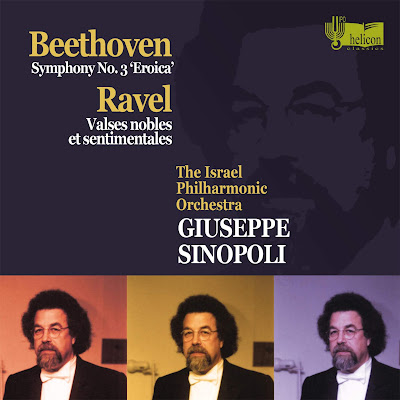
Beethoven: Symphony no. 3; Ravel: Valses nobles et sentimentales

Giuseppe Sinopoli, the great Venetian conductor, has a reputation for cool and aloof interpretations, but I'm always as aware of his passionate undercurrents as I am of the cerebral arguments with which he builds his interpretations.  Back in 2015 I noted the dramatic tension in his Schubert Unfinished Symphony with the Philharmonia Orchestra, contrasting it with a slightly underpowered version from Philippe Jordan. Sinopoli's white-hot recording of Schumann's 2nd Symphony with the Vienna Philharmonic (one of my all-time favourite discs) is another example. It was his experience in the opera pit, I believe, that provides the dynamic force of many of his orchestral recordings, and we hear it again in this release of a recording from Tel Aviv on October 28, 1993. There's plenty of drama in Beethoven's Eroica, but few recordings are as dramatically, indeed theatrically, shaped and shaded as this performance with the high-performing musicians of the Israel Philharmonic. Though Ravel's Valses nobles et sentimentales might seem at first glance to be more about music (in this case, Schubert's waltzes) than anything dramatic or theatrical, or indeed anything extra-musical at all. But after the composer orchestrated his original piano work, it was soon adapted as a ballet, Adélaïde, ou le langage des fleurs, with a plot taken from Dumas's La Dame aux Camélias. As one of the greatest interpreter's of Verdi's La Traviata, Giuseppe Sinopoli certainly knows his way around that story!

Sinopoli's day job may have been at the podium, but he had an astonishing range of interests and expertise, from medicine and criminology to anthropology and art collecting. There's a popular misconception that someone with a sophisticated intellectual life must be cold and analytical. It's like the common misinterpretation of the character of Spock in Star Trek's many iterations as exclusively cerebral. The half-Vulcan and half-human Spock is Gene Roddenbury's stand-in for all of the thoughtful people who pay attention to, and believe passionately in, the arts and culture and philosophy. To hold these not-at-all contradictory sides of our nature in balance is a worthy goal for us all, and the recordings of Giuseppe Sinopoli are powerful models.

This disc will be released in North America on September 7, 2018.

Thursday, July 12, 2018

The precision of ideas


Beethoven: Complete String Quartets

I've been keeping an ear on Audite's complete Beethoven String Quartets series with the Quartetto di Cremona as they've been released since the recordings began in 2012, though I missed a few along the way. Now with this release of the complete quartets on 8 CDs I can take a long close look at the well-received series from this fine group, who hail from the city of the great stringed instrument-makers.

These are elegant, controlled performances, though without the final burnished sheen of the Amadeus or Alban Berg Quartets. "Without minute neatness of execution," William Blake once said, "the sublime cannot exist! Grandeur of ideas is founded on precision of ideas." The "final minute neatness" is not here, or at least not all the time, though that neatness would in an case wear a bit thin through a full nine hours of music. The string quartets of Beethoven go on a meandering voyage through his own messy life, from his early days nearly to his death. This music, which began in the candle-lit salons of the Ancien Régime, emerges in the worlds of fashion and celebrity that made him a household name throughout Europe, and comes to an end in the squalor, regret and frustration of his final years. It's all too real to have the same Platonic existence of the music of Bach, though that doesn't make it any less grand, or sublime, in the Blakean sense. The Cremona musicians connect with this real-life Beethoven, his folk-song references, musical jokes and sentimental tags. And yet they're still able to bring a nearly full account of the soaring genius of the late quartets. Consider the Quartetto di Cremona a reliable guide to one of the greatest of all musical journeys.

A sketch for Beethoven's op. 131 String Quartet, from 1826

Tuesday, January 30, 2018

Beethoven from the heart


Beethoven: Missa Solemnis

At the top of the autograph score of Beethoven's Missa Solemnis the composer wrote the motto "From the heart, may it return to the heart!" Conductor Masaaki Suzuki has made this the keynote of an impressive new recording of this late work, emphasizing the very personal, almost ecstatic spirituality Beethoven added to what might not have seemed at first a congenial musical project. Suzuki is a deeply religious man, whose faith infuses all the music he makes, and he begins by taking seriously Beethoven's setting in a liturgical context. Beethoven's Christianity may not have always been orthodox, but it was always sincere. Indeed, I don't think he had an insincere bone in his body! So there's indeed a Bachian (and Handelian) air about this music, and Suzuki also highlights the other older sources Beethoven brings in (which the composer referred to as "the monk's Church chorales". But Suzuki remains true to the score, and with some by now unsurprisingly perfect choral singing from his amazing choir, he brings true authenticity, but also a new freshness and immediacy to this sublime music. The soloists are also all first-class. I was especially impressed with tenor James Gilchrist, who made a strong impression as The Evangelist in John Eliot Gardner's recent St. Matthew Passion, and mezzo-soprano Roxana Constantinescu, so good in Stravinsky's Pulcinella under Boulez.

This album will be released on March 2, 2018. Here is the first part of the Gloria from a live Bach Collegium Japan performance in 2017.

Wednesday, January 17, 2018

A picture of greatness


Otto Klemperer: live recordings from the BBC

Here's another release from the great Itter Broadcast Collection, recordings to tape and acetate disc made by Lyrita's Richard Itter from BBC FM transmissions beginning in the mid-1950s. These recording premieres on four CDs show Otto Klemperer, my favourite 20th century conductor, at the peak of his powers. His Mozart should win over all but the most doctrinaire HIPsters. The middle-period A major Symphony K.201 is relaxed and winning, while the late, great G minor Symphony K. 441 is wound up considerably tighter. "Mozart's in the closet," the last movement begins, "Let him out, let him out, let him out!" Klemperer has us worried about the composer's release, and his fine musicians keep up the pressure throughout. Violinist Bronislav Gimpel provides a lovely tone in Mozart's final Violin Concerto, K. 219, weaving through the most perfectly constructed accompaniment. This is the happiest I've felt after listening to a Mozart disc in a long time. Beethoven (no. 2), Schumann (no. 4) and Brahms (no. 2) symphonies are so impressive, but it's the Bruckner 7th that's the real standout here. This is a performance for the ages, from the quiet by-ways to the blazing glory of the slowly building climaxes. This is a picture of greatness, and I couldn't possibly recommend it more highly.