"All camp objects, and persons, contain a large element of artifice. Nothing in nature can be campy."
Reviews and occasional notes on classical music
"Music, both vocall and instrumental, so good, so delectable, so rare, so admirable, so super excellent, that it did even ravish and stupifie all those strangers that never heard the like." - Thomas Coryat, after hearing 3 hours of music at the Scuola di San Rocco in Venice, 1608.
Wednesday, July 13, 2022
Haydn Symphonies "Les Jeux et Les Plaisirs"
Wednesday, February 2, 2022
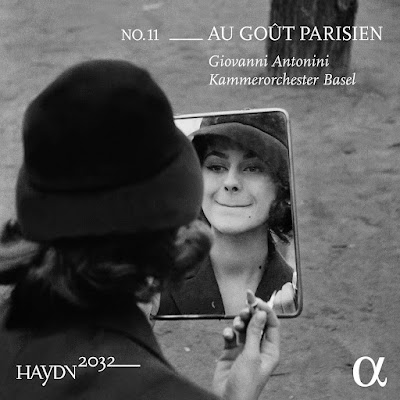
Great Haydn Symphonies "Au Goût Parisien"
Haydn: Symphonies 2, 24, 82, 87
Though the Basel orchestra is considerably larger than Il Giardino Armonico - the string complement is ten Violin I, seven Violin II, five Viola, three Double Bass - this is a nimble group that Antonioni takes through the twists and turns of Haydn's music as if he were driving a Ferrari. I've always loved the six Paris Symphonies commissioned by the Chevalier de Saint-Georges in 1788; two are included here. Number 82 is subtitled "L'Ours", for the comical, slightly grumpy features of its finale, complete with the drone of a folk instrument, perhaps a kind of bagpipe. Though it doesn't come with a cute title, Symphony 87 is a perfect mature Haydn symphony, an on-ramp for the Beethoven Symphony Freeway to come. The 24th Symphony is from 1764, a period when Haydn brought a bit of mystery and drama to the gallant symphonies of the time. It's bracketed by two stone-cold masterpieces - number 22, "The Philospher", and number 26, "Lamentatione" - but number 24 has its own positive qualities. I find it at once unsettling and exciting. There's something a little bit dangerous in this performance!
The Paris connection for Symphony 24 is that it was performed there - to great acclaim - in 1773. The 2nd Symphony, written in the late 1750s, was actually published in Paris in 1764. At under 10 minutes, it's the shortest of his symphonies, but there's plenty of incident packed in here. It's slight in stature, but not in style; the Little Symphony That Could.
Antonini brings great energy to all four symphonies here - great and small. Though this series doesn't replace my all-time choice for the complete Haydn symphonies, Adam Fischer's version on 37 CDs with the Austro-Hungarian Haydn Orchestra, I'm beginning to see that we now have a very close challenger, not quite a third of the way to 2032.
Each of the Haydn 2032 releases features a Magnum photographer in the album liner booklet, and this time it's the turn of the great Elliot Erwitt, a great choice considering the theme: "Au Goût Parisien". He took so many great photos of the City of Light; I'll post one here that he took in 1989; for some reason it isn't included in the booklet.
Tuesday, October 17, 2017
A promising new direction for Haydn 2032
Haydn: Symphonies 19, 80 and 81; Kraus: Symphony in C minor
Giovanni Antonini shifts gears with this fifth issue of his wonderful Haydn 2032 recordings, in the lead-up to the Haydn Tri-Centennial. This is a great series; volume 3 was my top release from last year. Instead of the marvellous Il Giardino Armonico, he now directs the Kammerorchester Basel, which will also get the call in volumes 6 and 7. What's the word on this new reliever from the bullpen?
It's very good news indeed. Though both play on original instruments, the Basel orchestra is considerably larger than Il Giardino, 6:6:5:3:2 in the strings versus 4:4:2:2:2. But though there's a fuller, richer, sound that's more appropriate for Haydn's Symphonies 80 and 81 from the mid-1780s, this is a very tight band that gives Antonini all the grace and lightness that Haydn still requires. I know these symphonies very well; my default version of Haydn's Symphonies is Adam Fischer's set with the Austro-Hungarian Haydn Orchestra, and the Basel musicians come close to this high standard. Stripped down to a smaller ensemble for the slight but charming (and fun) Symphony 19, we here have the same nimbleness of Il Giardino with all of expressiveness.
Haydn is great (great? - he's super-great!), but the star of the show here is Joseph Martin Kraus, an exact contemporary of Mozart, and a composer not too terribly far off in quality from the two great classical composers of the period. His Symphony in C minor is an outright work of genius. I slightly prefer this version over the very good Concerto Köln recording from 1992; the new recording is as theatrical, but its cooler temperature shows off its classical bones better.
A final note, once again, on Alpha's fabulous presentation for this series. The notes (in three languages) are excellent, and the featured photographs by a Magnum artist, in this case Stewart Franklin, are especially apposite. I await volume six with the Kraus Symphony set on repeat....
This disc is due to be released on November 3, 2017.