Reviews and occasional notes on classical music
"Music, both vocall and instrumental, so good, so delectable, so rare, so admirable, so super excellent, that it did even ravish and stupifie all those strangers that never heard the like." - Thomas Coryat, after hearing 3 hours of music at the Scuola di San Rocco in Venice, 1608.
Showing posts with label Prokofiev. Show all posts
Saturday, April 22, 2017
A mixed bag: from oddness to greatness
This is the second 6-CD set from Profil of recordings made by Yevgeny Mravinsky with the Leningrad Philharmonic Orchestra, largely live recordings from the 1940s and 50s. It's very much a mixed bag, with some oddly shaped and accented Mozart, Berlioz and Bizet, thin sounding in the bargain. A bit better is the Richard Strauss Alpensymphonie, though one cannot put it in the top class. But the high end is high indeed.The standouts are, naturally, music by Russian composers.
The Stravinsky ballets on the third disc, Petrushka and The Firebird, are completely alive, fresh and airy but also cruel and barbaric. Remastering has delivered impressive sound considering the vintage and recording sources, though of course there isn't quite the presence of the best new recordings. The Prokofiev works, the 2nd Romeo & Juliet Suite and the 6th Symphony, sound even better, in performances of style and again some considerable violence. Romeo & Juliet has a paranoid edge; after all, orchestral musicians as well as composers must have worried about official disapproval of "degenerate modernism". The same is true of the 6th Symphony. "Now we are rejoicing in our great victory, but each of us has wounds that cannot be healed," the composer said when he wrote this music in 1947. The pain and loss in this music comes from a sharing of those wounds, with many personal losses I'm sure. This is an affecting document as well as an artistic statement of considerable merit. I've only rarely heard as impressive a Pathetique Symphony as Mravinsky delivers here, taut with menace but finely and delicately balanced, and in the end heartbreakingly sad. This is Tchaikovsky laid bare, stripped of false sentimentality. Mravinsky and his wonderful musicians demonstrate that this is indeed one of the greatest of all 19th century works of art.
Thursday, April 6, 2017
A marathon of great music and great performance
The great cellist Mstislav Rostropovich was in his prime, about to turn 40, when he arrived in New York with the London Symphony Orchestra for eight concerts at Carnegie Hall between February 23 and March 12, 1967. The excitement surrounding this project is easy to hear; there's a real sense of occasion in this music, and though the applause for each piece is cut quite short, what's left is (rightly) very enthusiastic. For this six-CD set Doremi has chosen 22 concertos from the 30 performed. It seems a bit churlish to complain, with all the amazing riches included, about what isn't here. But what a shame to have the greatest of 20th century cello concertos, the Elgar, to lead off the set, without the greatest 19th century concerto, the Dvorak, to go with it. I also regret not having the Schumann concerto, and the two Haydn concertos. But let's accentuate the positive, beginning with the Elgar Cello Concerto. Comparing it with the classic performance by Jacqueline du Pre (with the same LSO), it seems much cooler at first than du Pre's more emotional attack, but Rostropovich soon turns on the afterburners, and provides just as satisfying an experience when the piece is over. Other highlights include Prokofiev's Concertino, a work that is much more substantial and interesting than the diminutive title would suggest, and the Britten Symphony for Cello and Orchestra, which was written for Rostropovich in 1964. I also much enjoyed the Hindemith Concerto, and the two American world premieres, by Foss and Piston. Ottorino Respighi's Adagio con variazioni is a really remarkable piece of music, which Rostropovich sinks his teeth into. It's marvellous to have it available in such a strong performance.
Unfortunately, my enjoyment in this music is not completely unalloyed. The baroque music, concertos by Vivaldi and Tartini, does not match the level of the rest of the program. I was perfectly willing to put aside my love for the historically informed style in vogue today, even indulging in a bit of guilty pleasure. But I got no pleasure from these lumpish, unformed performances. There was precious little charm here, and no real feeling that Rostropovich was engaged in this music. These are the exceptions, though, rather than the rule, and I can enthusiastically recommend this marathon of great music and great performance.
Saturday, July 30, 2016
Duelling Prokofievs
There are two complete Prokofiev Symphony series on the go right now: Marin Alsop's on Naxos with the Sao Paulo Symphony (OSESP), and Andrew Litton's on BIS with the Bergen Philharmonic, and a third just finished at the end of 2015, by Kirill Karabits with the Bournemouth Symphony on Onyx. This is music that rewards comparative listening: I can listen for hours to different versions of different symphonies, stopping to compare passages, or just letting the music wash over me. There is a great range in musical styles among the symphonies and miscellaneous orchestral works included on these discs, and even within some of the works themselves. I couldn't listen to this much Shostakovich at once without musical or emotional fatigue. Prokofiev often lightens the moment with an innocent, non-sarcastic motif by the flute, or softens a martial movement with a consoling passage from the strings. He never cloys, and sentimentality seems foreign to him. How many composers can you honestly say this about?
All three of these series have received rave reviews; it's the fine details and one's personal preferences that will help someone decide which one to purchase. Luckily, with nearly ubiquitous streaming services you can pop in and out of all three, or even do some comparisons of your own. Here is Karabits in the grand opening movement of the greatest symphony, no. 6:
And a slightly more expansive reading by Litton:
Alsop's version will be released on August 12, 2016; I'll add the Spotify link here when it's available. Once again, Alsop and the Naxos producer and engineers are taking a best-strings-forward approach, with less of a focus on brass and woodwinds. This results in a softer, more restrained, less acerbic interpretation, which is made clear by listening to the first minute of all three versions (and especially Karabits' witheringly in-your-face beginning, which I found effective in its own way). There is plenty of power on display from Sao Paulo, though, and Alsop makes sure to highlight Prokofiev's bleakest and harshest passages for maximum poignancy.
When you have orchestras of the calibre of the Bergen, Bournemouth and Sao Paulo ones, and such gifted conductors as Litton, Karabits and Alsop, there are no losers in a competition like this. Only winners: everyone who loves Prokofiev.
Monday, April 18, 2016
Intensity in concert, and in the studio
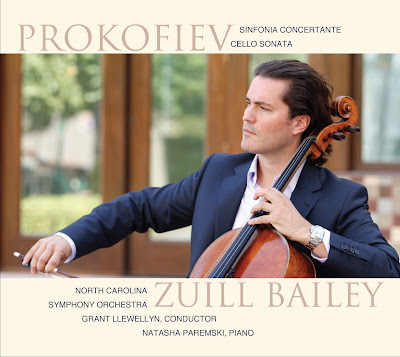
Cellist Zuill Bailey repeats almost exactly the formula that won raves from the critics in his 2014 Telarc recording of cello music by Benjamin Britten. That included the Symphony-Concerto and a Cello Sonata, as does this new Steinway disc of music by Sergei Prokofiev, due to be released on April 29, 2016. Bailey has the same supporting cast as well: the North Carolina Symphony conducted by Grant Llewellyn, and in the Sonata, pianist Natasha Paremski. The concerted works of both discs were recorded live at the Meymandi Concert Hall in Raleigh, while the sonatas come from the studio.
Way back in 2002 Bailey gave a wide-ranging interview with Tim Janof of the Internet Cello Society, in which he talked about the cello recordings that he especially loved. I'm not surprised with his choice of Rostropovich's famous recording of the Sinfonia Concertante with the Royal Philharmonic Orchestra and Sir Malcolm Sargent. Bailey and Llewellyn follow the great Russian/English team in terms of tempi, which tend to be a bit brisker than other recordings (especially Ma's, with Maazel in Pittsburgh). The cello is brought quite far forward, front and centre, in the recording, though, putting the emphasis more on the Concertante than the Sinfonia. It's an especially fine live recording, though, with that electric feeling you sometimes get in the concert hall. There's no sign of the audience, even at the end, which is different from the nine minutes of applause included in the latest recording from Atlanta.
This great work is extremely well served on disc. I listened to bits of a dozen versions, and all of the Rostropovich, Ma, Harrell, and Wallfisch, and marvelled at the way great and modest cellists could differ in small and large ways while still sounding so musical. The lovely tone of Bailey's venerable instrument - the 1693 Goffriller played by Mischa Schneider for three decades in the Budapest String Quartet - and Bailey's confident mastery of the work, puts this recording in the same league as those masters, with the very fine orchestral playing of the Carolinians very nearly up to the Royal Philharmonic, Pittsburgh or Liverpool orchestras.
I shouldn't forget the 1949 Sonata, which is fine indeed. Prokofiev, who had recently been charged with formalism in music, did not know if he'd ever have his music performed again, or worse. So he forgets about impressive effects to wow the audience; this is more like a personal working out of things in his brain. And what a brain! Bailey and Paremski (again, an equal musical partner) keep their eyes down and the feeling intense, eschewing obvious effects in favour of the work's bleak architecture.
In the world of the recording star you're always moving on to the next project. I follow Bailey on Twitter (as should you), and on April 16, 2016 he tweeted about the latest live recording project with the North Carolina Symphony, conductor Grant Llewellyn, and violinist Philippe Quint: the Brahms Double Concerto. I'm looking forward to this recording!
![]() |
| Bailey, Llewellyn & Quint with the NC Symphony, from Bailey's Facebook page. |
Monday, November 2, 2015
Another winner from CSO-Resound
From November 11, 2014:
Some of the best recordings that have come my way recently are from new orchestra-based labels. Seattle Symphony Media's track record has been outstanding, and this fourth release from the Chicago Symphony's CSO-Resound label follows superlative releases as well, most notably of music by composers in residence Mason Bates and Anna Clyne - Riccardo Muti Conducts Mason Bates and Anna Clyne. This Prokofiev disc is an all-around winner: a strongly-played live recording with lots of energy. It includes a suite of 10 movements well chosen by Riccardo Muti from the ballet score for Romeo and Juliet. One of the coolest things about this project is the special relationship between the composer and the Chicago Symphony going back to 1917. Following commissions and performances from Chicago over a good part of his career, Prokofiev presented the North American premiere of Romeo and Juliet music with the Chicago Symphony in 1937. It's encouraging to see that while the CSO moves ahead in the 21st century with new music and distribution channels, it is also aware of its strong heritage and history.
Saturday, October 31, 2015
The Soviet Experience
From May 1, 2012 (Happy May Day, comrades!):
This is the second set in the Pacifica Quartet's Soviet Experience series for Cedille, and it's another winner. The two discs include the first 4 string quartets in Shostakovich's great cycle, and the 2nd quartet by Prokofiev, both of whose quartets are of the highest quality. The music on this disc reflects the tumultuous times in Soviet Russia from the period just before to just after the Second World War.
I know the Pacifica Quartet from their amazing Naxos recording of the String Quartets of Elliott Carter, which won a Grammy Award in 2009. The new Cedille set has the same outstanding levels of musicianship and engineering. The series provides the opportunity to immerse oneself in the heroic, horrific and incredibly sad period of the Soviet war with Nazi Germany, and the emerging war of Stalin against his own greatest artists. From the deceptive simplicity of the first Shostakovich quartet, with its folk-like melodies and glimpses of chaos to come, to the tragically great Quartet #3, the Pacifica players present an amazing tableau of the broadest range of emotions and the highest peaks of art. I look forward to the next release in this series!
This is the second set in the Pacifica Quartet's Soviet Experience series for Cedille, and it's another winner. The two discs include the first 4 string quartets in Shostakovich's great cycle, and the 2nd quartet by Prokofiev, both of whose quartets are of the highest quality. The music on this disc reflects the tumultuous times in Soviet Russia from the period just before to just after the Second World War.
I know the Pacifica Quartet from their amazing Naxos recording of the String Quartets of Elliott Carter, which won a Grammy Award in 2009. The new Cedille set has the same outstanding levels of musicianship and engineering. The series provides the opportunity to immerse oneself in the heroic, horrific and incredibly sad period of the Soviet war with Nazi Germany, and the emerging war of Stalin against his own greatest artists. From the deceptive simplicity of the first Shostakovich quartet, with its folk-like melodies and glimpses of chaos to come, to the tragically great Quartet #3, the Pacifica players present an amazing tableau of the broadest range of emotions and the highest peaks of art. I look forward to the next release in this series!
Absolut Prokofiev
February 22, 2012:
Non-musicans often think of arrangements as being analogous to translations, and we're inclined to worry about what's "lost" in the process. But the adaptive re-use of music might be done for all sorts of practical or artistic reasons, and there is often something gained as well. In the case of Vadim Borisovsky's arrangements for viola & piano of Prokofiev's amazing Romeo & Juliet ballet, I think a better analogue is "distillation". If these clever arrangements don't exactly bring out the "essence" of the score, which is one of the greatest and most colourful orchestral works of the 20th century, they distill some of the many moods of Shakespeare's original work, as they were so imaginatively re-imagined by Prokofiev.
This new Naxos disc of Borisovsky's arrangements includes three additional movements, transcribed by David Grunes and Matthew Jones, and all the pieces have been reordered to follow the original ballet score. The choice of viola and piano works well for the more neo-classical scenes, which can sound like movements from an angular trio-sonata. The more romantic scenes take advantage of the full expressive range of the viola (and in a couple of cases, two violas) and the complete dramatic arsenal of the pianist. The Dance of the Knights is amazing: the viola provides so many different sounds through different bowing techniques and the full range of the viola, ncluding harmonics. This is a rich re-orchestration!
Violists Matthew Jones and Rivka Golani and pianist Michael Hampton provide passion and expertise in equal parts. They really convinced me of the value of this music!
Non-musicans often think of arrangements as being analogous to translations, and we're inclined to worry about what's "lost" in the process. But the adaptive re-use of music might be done for all sorts of practical or artistic reasons, and there is often something gained as well. In the case of Vadim Borisovsky's arrangements for viola & piano of Prokofiev's amazing Romeo & Juliet ballet, I think a better analogue is "distillation". If these clever arrangements don't exactly bring out the "essence" of the score, which is one of the greatest and most colourful orchestral works of the 20th century, they distill some of the many moods of Shakespeare's original work, as they were so imaginatively re-imagined by Prokofiev.
This new Naxos disc of Borisovsky's arrangements includes three additional movements, transcribed by David Grunes and Matthew Jones, and all the pieces have been reordered to follow the original ballet score. The choice of viola and piano works well for the more neo-classical scenes, which can sound like movements from an angular trio-sonata. The more romantic scenes take advantage of the full expressive range of the viola (and in a couple of cases, two violas) and the complete dramatic arsenal of the pianist. The Dance of the Knights is amazing: the viola provides so many different sounds through different bowing techniques and the full range of the viola, ncluding harmonics. This is a rich re-orchestration!
Violists Matthew Jones and Rivka Golani and pianist Michael Hampton provide passion and expertise in equal parts. They really convinced me of the value of this music!
Outstanding new disc of 20th Century piano concertos
From January 28, 2011:
Following a well-reviewed debut CD of meaty Russian music for solo piano, Anna Vinnitskaya returns with a very strong concerto disc on the Naive label. The Prokofiev 2nd Piano Concerto has had its share of fine versions on disc; Martha Argerich, and Horacio Gutierrez stand out for me. The new performance of this concerto master-work is not at all out of place in that company. And in the Ravel, a special favourite of mine, Vinnitskaya is right up there with Argerich, and even Michelangeli.
Reading Vinnitskaya's reviews from her major competition triumphs beginning in 2007 to her recent concerts and recordings, it wasn't surprising to hear such accomplished playing, with the widest range of power and delicacy. I was also impressed, though, with the orchestral accompaniment of Gilbert Varga and the Deutsches Symphonie-Orchestrer Berlin, especially in the Prokofiev; and with the sound provided by the Naive producers and engineers. While the real focus of the Prokofiev work is in the piano part, the Ravel Concerto is as much about the virtuosity of the orchestra as that of the pianist. Though Varga lets the energy falter just a bit in the middle of Ravel's brilliant first movement, this is a fine performance overall, with excellent playing from both individual instruments and the whole orchestra.
Following a well-reviewed debut CD of meaty Russian music for solo piano, Anna Vinnitskaya returns with a very strong concerto disc on the Naive label. The Prokofiev 2nd Piano Concerto has had its share of fine versions on disc; Martha Argerich, and Horacio Gutierrez stand out for me. The new performance of this concerto master-work is not at all out of place in that company. And in the Ravel, a special favourite of mine, Vinnitskaya is right up there with Argerich, and even Michelangeli.
Reading Vinnitskaya's reviews from her major competition triumphs beginning in 2007 to her recent concerts and recordings, it wasn't surprising to hear such accomplished playing, with the widest range of power and delicacy. I was also impressed, though, with the orchestral accompaniment of Gilbert Varga and the Deutsches Symphonie-Orchestrer Berlin, especially in the Prokofiev; and with the sound provided by the Naive producers and engineers. While the real focus of the Prokofiev work is in the piano part, the Ravel Concerto is as much about the virtuosity of the orchestra as that of the pianist. Though Varga lets the energy falter just a bit in the middle of Ravel's brilliant first movement, this is a fine performance overall, with excellent playing from both individual instruments and the whole orchestra.
Subscribe to:
Posts (Atom)