Reviews and occasional notes on classical music "Music, both vocall and instrumental, so good, so delectable, so rare, so admirable, so super excellent, that it did even ravish and stupifie all those strangers that never heard the like." - Thomas Coryat, after hearing 3 hours of music at the Scuola di San Rocco in Venice, 1608.
Matthias Goerne's searching, haunted Winterreise has always been special, whether his supporting partner is Alfred Brendel, Christopher Eschenbach or, as here, Markus Hinterhauser. A new dimension is added in this splendid Blu-ray, the visualizations of artist and film-maker William Kentridge. Kentridge's monochromatic animations, stripped down, sophisticated versions of the great experimental films of the surrealists and Canada's National Film Board, are so evocative. They add context and emotional depth to the story Wilhelm Müller and Schubert tell in this song cycle. To be sure, the interpretation by Goerne and Hinterhauser stands alone in its greatness, but Kentridge's images add a dimension of no small artistic import as well.
Blu-ray with a large-screen HD TV and surround-sound was made for concerts like this. Recorded live on August 2, 2016 for NPR's Great Performances, this is a delight from beginning to end. There's a real sense of presence at a significant event, and the LA Philharmonic respond with standout playing. The crowd is into this program completely; they're especially enamoured of guitarist Angel Romero, looking fabulous in his many-coloured shirt. Dudamel, as always, is a charismatic figure, but he's often the still, calm centre when things get exciting with the dancing of Tango Buenos Aires and the always inventive orchestration of three great composers from Argentina. Ginastera's Dances from Estancia have the odd hint of modernism, but remain accessible; their rhythms are often much more complex than the tangos and milongas of the rest of the program, but Dudamel and his superb musicians handle them with ease. Lalo Schifrin brings his entire musical life into his Concierto de la Amistad, which receives its world premiere here. Schifrin played piano in Piazzolla's band in Paris in 1955; he worked with Dizzy Gillespie later in the 50s; and he became a household name with his film and movie scores with a huge filmography in the rest of the 20th century and into the 21st. It was great to hear the audience's response when Dudamel brought him out after the Concierto, and touching to see Schifrin, Dudamel and Romero hugging. Music by Astor Piazzolla begins and ends the program, with fabulous support from the dancers of Tango Buenos Aires and Seth Asamow on bandoneon. This passionate, ultra-Romantic, gorgeous music is just the thing to watch in the evening after a hard day reviewing Arnold Schoenberg.
Sir Andras Schiff plays and conducts masterworks of Beethoven, Schubert and Mozart in this outstanding Blu-ray from C-major, filmed at the Great Hall of the Salzburg Mozarteum Foundation in January of 2015. His boundless charm is the keynote of the whole project, which is evident in this short clip:
It's almost, but not quite, too cute sometimes. I love the way he leans back after finishing a run to the top of the keyboard in the Beethoven Concerto, and gives a cue over his shoulder to the concert-master. I love the way he mimics playing a wind instrument to get the perfect sound from his flutes and oboes. But underneath the geniality and wit is an astounding virtuosity, a complete grasp of the underlying meaning of this music, and an ability to communicate with the hand-picked instrumentalists of the Cappella Andrea Barca, virtuosi themselves, as perfectly as he communicates with the audience. There's still a big chunk of the year to go, but I know now that this video will end up close to the top of my Top 10 recordings of 2016.
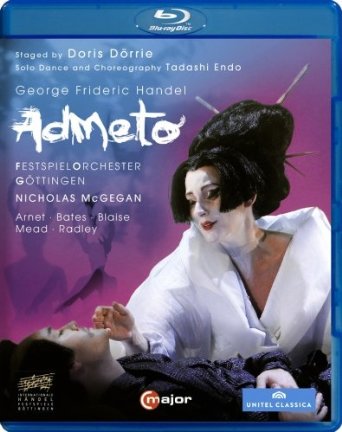
The orchestral playing and solo singing in the musical side of this production from the Internationale Handel-Festspiele Gottingen, from May of 2009, is under the capable direction of Nicholas McGegan. It's great to see him wedged sideways with his Festspiel Orchestra into the tiny pit of the Deutsches Theater; you have complete confidence that he'll keep things moving in a Historically Informed and dramatically appropriate way. Even though this is 7 years old now, the C Major Blu-ray is from a very fine HD source, and the surround sound is outstanding.
But it's naturally the theatrical concept of Doris Dorrie that causes the most discussion, since it adds an additional layer of abstraction to the already formalized conventions of Baroque opera. This layer, the transposition of the ancient Greek source materials from 18th century Europe to the Samurai culture - also 18th century - of Japan, didn't convince me at first. But then a set-piece of outstanding beauty justified the entire project for me, Ercole the Hero dressed as a Sumo wrestler included. This was Alceste's recitative 'Non lagrimate, o miei seguaci' and her aria 'Faro cosi piu bella', in which the heroine tells her entourage that she plans to kill herself to save her husband Admeto. Beginning as shadows behind a screen - another layer of abstraction - Alceste and her maids form a tableau vivante, and though they emerge in three dimensions, the formalized beauty remains and they seem no more flesh and blood than before. Indeed, with their pastel robes and faces painted white, they're more like faded early Renaissance frescoes than actual people. When Alceste returns behind the screen and the deed is done, again in a scene that could be a painting, it's sad, but sadder still because all the time Alceste (Marie Arnet) is singing an aria of exquisite beauty.
There are other highlights in the staging, and each is lamp-shaded to ensure we're very much aware of the conventions being flouted and new conventions being inserted. This is the very acme of self-aware stage-craft. The talented members of the Mamu Dance Theatre are variously ghosts, sheep, demons and deer, each time in set-pieces that I'm sure are no more artificial than the original ballets from Handel's time. This is highly imaginative stage-craft, nearly as imaginative as Handel's music. What it isn't is subtle, and of course Handel is a master of subtle effects, musical and dramatic.
Singing honours go to Marie Arnet, of course, but also to Tim Mead as Admeto and to Kirsten Blaise as Antigona. All are fine actors as well as excellent singers, and remind us of the humanity underneath the 18th century European and Japanese conventions and the 21st century International operatic emphasis on whimsy, irony and self-reference. The more opera tries to subvert itself, the more like traditional opera it seems, and that's largely to the good, when musicianship and stagecraft and technology together can create something as beautiful as this.
Jean Berain pour le char du Soleil, à la dernière scène de Phaéton (livret de Quinault; musique de Lully)
From its beginning at the end of the 16th century, the spectacle has been an important part of the multi-media genre of opera. In the above drawing, Jean Berain sketches a machine representing Phaéton's chariot in the Lully opera presented at Versailles in 1683. Audiences always wanted something bigger than the last opera, going back all the way to Peri's Dafne in 1598. Lully had the latest theatrical technology available to him, and he wowed his audience and his King with special musical and theatrical effects; in other words, a spectacle.
Between then and today we've seen spectacle's role in opera rise and fall as fashions for naturalism or surrealism or minimalism or magic realism come and go. The complete takeover of the movies by CGI, 3D and other technology-enhanced goodies has raised the bar in terms of what audiences expect. Nowadays we feel it's our right to be amazed, and more amazed than we were last time. It's also led to a bit of a backlash where practical effects (live, non-digital special effects) become more important, re-balancing the mix with those effects added in post-production (as in the amazing Mad Max: Fury Road). And of course live special effects are pretty much the only thing available in a live medium like opera.
There's a counter-balance to the bigger-is-better spectacle, even for an opera as blood-soaked as Elektra, the Freudian nightmare remix of ancient Greek myth put together by Hugo von Hofmannsthal and Richard Strauss. This less-is-more idea has the enormous bottom-line advantage. Even with this amount of blood in the TV teaser, the Norrlands Operan 2014 production of Elektra might have led to a relatively subdued affair, in the style of Hitchcock's Psycho. But no, with the frightening vision of Director Carlus Padrissa and the help of the Spanish theatrical collective La Fura Dels Baus they went big.
Blood is gushing forth in the barrack square.
Elektra is biding her time.
Enormous steel giants are rising.
Elektra curses her mother.
A forest is set on fire at Umestan.
Elektra demands revenge!
Just how big you'd only know if you were there in Umeå in August of 2014, in front of the largest opera stage in the world. But you'll also get a pretty good idea from this really special DVD/Blu-ray from Unitel Classics.
Spectacle by itself is pretty empty, but that is definitely not the case here. The singing and acting of the principal singers is absolutely outstanding, beginning with the electrifying performance of Ingela Brimberg in the title role. Put Brimberg on an empty stage with a black fright wig and an axe, and she would provide a good percentage of the sheer horror we get from this performance. She's that good. A great deal of credit must also go to Rumon Gamba who keeps what might have been a spectacularly chaotic project from spinning out of control. That it didn't is due to his steadfast reliance on the music of Strauss and the drama of von Hofmannsthal. That's the real bottom line.
The magnificent Duomo di Milan, the Milan Cathedral, was originally a gothic cathedral built atop an early Christian basilica which was itself built atop a Roman temple, and it's been tinkered with ever since. It's the site of a marvellous new production of Rossini's "sacred melodrama", Mosè, which has been packaged into an equally marvellous Blu-ray disc.
There's plenty of impressive music in this piece; its surprising how it can sparkle like the Barber of Seville and yet provide a full measure of drama and piety. In this production so much of the credit goes to conductor Francesco Quattrocchi, who has the enormous challenge of providing a cogent orchestral sound in such a huge volume as the interior of this massive church. It's the largest church in Italy, the fifth largest in the world. The singers are led by the great Ruggero Raimondi, but this is more an ensemble piece than a star vehicle. There are no weak links amongst the principal singers, though the acting in this semi-staged version set within a huge space is necessarily broad, to reach the audience as well as the HD cameras. The chorus is equally important, and comes through with flying colours. In the end we rely on Quattrocchi to marshall all of these resources - the fine solo singers and the excellent Veneranda Fabbrica del Duomo di Malano Orchestra and Chorus - while keeping them all in balance, acoustically, dramatically, and musically.
We come now to the thing that makes this really special: the production treats the Duomo interior, which somehow seems super-opulent while also being super-austere, as a giant stage set, and the new technology of video mapping, or projection mapping, turns the Duomo into a dynamic space that opens up the story. The timeless stones come alive and help to tell the story. This is the second time in the last couple of weeks I've ended up talking about new technologies when reviewing a new classical music disc; I love it!
This YouTube clip gives you only a hint of an idea of how impressive this is on a large HD screen with good 5.1 surround sound. For the full effect you'll have to buy the disc and see for yourself!
When Gustavo Dudamel takes the microphone towards the end of this LA Philharmonic concert at the Disney Concert Hall, his tribute to John Williams as one of the top 20th century composers seemed to ring true with the audience, as I’m sure it will to many watching this Blu Ray at home. The audience is surprisingly enthusiastic, considering the many tuxedoes and designer gowns at this gala concert. Let’s just say this is more a Golden Globes crowd than an Academy Awards one.
There’s so much to be enthusiastic about. Soundings, a piece Williams wrote to focus attention on the special qualities and capabilities of the Walt Disney Concert Hall, is a serious and always interesting showpiece for orchestra. The orchestra and Dudamel are definitely up to the task. But it’s two of Williams’ strongest film scores that provide what I feel are the best works in the concert. Three Pieces from Schindler’s List is a short but intense suite for violin and orchestra. Itzhak Perlman plays the beautiful, inventive violin part in a tasteful fashion, never maudlin but with just the tiniest bit of “schmalzig”. This is the way, perhaps, that Fritz Kreisler would have played "Theme", one of the saddest and most beautiful pieces of music ever written. Incidentally, I much prefer this order of the movements, rather than the version sometimes played where “Theme” comes first. I loved the bit of stage business before this piece. Dudamel carries Perlman’s violin as he follows the violinist slowly making his way to the podium on his crutches. When he hands Perlman the violin, he gets a wink, a funny face, and his baton in return.
Escapades from Catch Me If You Can, one of Spielburg’s most under-rated films, is a hugely entertaining piece that the otherwise excellent liner notes by Jon Burlingame mis-identifies as “a miniature alto saxophone concerto.” In fact, this is a jazzy miniature concerto for three instruments which deserve equal billing. Billing, I’ve heard, is important in Hollywood! The piece is played here by three expert, charming instrumentalists. They are saxophonist Dan Higgins, vibraphonist Glenn Paulson, and bassist Michael Valerio. This is a piece that deserves to be programmed much more often, though good luck finding three musicians at this level, especially by plucking them out of the orchestra!
Spoiler alert: hijinks! Spoilers don’t usually loom large in classical music reviews, but lots of fun happens during the encores. This, and the substantial bonus interviews with Williams, Dudamel and Perlman, are enough on their own to buy this disc. The Blu Ray, with its excellent sound and beautiful HD picture, is very highly recommended.
Here is a substantial excerpt from the DVD: the Throne Room music and Finale from Star Wars:
In my favourite parts of this new Richard Strauss documentary director Eric Schulz lets his camera linger on the faces of the artists and scholars who have been interpreting the great composer’s life and music, as they watch, along with us, Strauss at the podium. This goes way beyond the ‘talking heads’ that are a cliche of cultural documentaries. We hear amazing insights from people like pianist Stefan Mickisch, musicologist Walter Werbeck, and soprano Brigitte Fassbaender. But more importantly Schulz catches their expressions as they make new connections, thinking about Strauss as a conductor, a composer and a human being.
Schulz did the same thing in his award winning 2011 documentary Carlos Kleiber: Traces to Nowhere, which is really a splendid film. In the Strauss film he introduces some very appealing young artists: actors Henning Hartmann and Sina Reiss, who read letters by Strauss and his strong-willed wife Pauline; and soprano Emma Moore and pianist Diana Al Hassani, who participate in an amazing lesson with the great singer Brigitte Fassbaender. In speeches and letters Strauss talks about German music and art and culture, and the hope that it might someday be reborn as artists come together in a vital way. Eric Schulz demonstrates in his excellent films just such a coming together of the best and most profound ideas and experiences, in a new Germany and a new Europe.
Thanks to Schulz and his diverse cast I feel that I know much more about Strauss than I did before. Schulz is building as fine a series of classical music documentaries as the amazing early 1960s films of Ken Russell. I hope they serve as a model for future work in this genre.
Stravinsky may have been a towering genius and the greatest 20th century composer, but he was also an odd duck. The time Stravinsky spent in Hollywood in the 40s, 50s and 60s was considerable, and the artistic journey he took there was profound, in spite of his eccentricities. The stories told by the filmmaker Marco Capalbo in this film present both the music and the personality of a special man in a special place and time.
Some have complained about the re-enactments with actors portraying the Stravinskys and Robert Craft, but I enjoyed the performances enough to forgive the ingenuousness of the presentation. (With the focus on archival film, it’s not made clear in the DVD/Bluray packaging that these reenactments are part of the project at all. I’ve read reviews that talk about ‘home movies’, but there’s no mention of the actors.) Eric Gorlow, who plays Craft, has a Tony Perkins vibe, which is entirely appropriate for this charming but slightly sinister character. And Giovanni Ombra channels Stravinsky as Johnny Depp as Hunter S. Thompson: bald, smoking cigarettes with a holder, and walking completely self-absorbed a few steps ahead of both Craft and Mrs. Stravinsky.
Stravinsky’s Hollywood hopes, like so many others (Heitor Villa-Lobos, F. Scott Fitzgerald and William Faulkner to name a few) didn’t pan out, either in terms of his artistic or his pecuniary dreams. Neither composers nor writers were particularly valued by the system at the time. In one of the most striking sections of the film, Capalbo matches music Stravinsky originally planned with the scenes of classic movies he worked on, including Jane Eyre and The Song of Bernadette. What might have been!
The Bluray of the film looks and sounds splendid. I thoroughly enjoyed the whole project.