During a career filled with as many failures as triumphs, and a life with an equal measure of pain and delight, Robert Schumann often seemed to be swimming against the flow. While the great virtuoso composers like Liszt and Paganini were creating a new concerto paradigm of the hero (soloist) fighting against the world (orchestra), Schumann in 1850 wrote his cello concerto as a "Concert piece for cello with orchestral accompaniment." This more organic, integrated music never caught on during his lifetime, and it wasn't until well into the 20th century that it became part of the standard cello concerto repertoire. Schumann himself suggested a chamber version of the piece, though he never had a chance to make it happen.
The idea of illuminating the inner structures and meaning and the outer textures of an orchestral work by subtraction has a long and honourable tradition. Liszt's own transcriptions of Beethoven's Symphonies for solo piano were like virtuoso x-rays. Meanwhile, Hummel's chamber reductions of Mozart's Piano Concertos were designed to bring the music from the concert hall to the middle class music rooms of Germany. In those days such reductions were often a strategy to build markets and sell sheet music.
In his own reduction Schumann would have been mainly interested, I think, in exploring interesting musical issues relating to orchestral vs. chamber music textures and colours. In their outstanding version on this new Sono Luminus disc (to be released August 26, 2016), Zuill Bailey, the Ying Quartet and Julliard composer Philip Lasser, do just that. This outstanding collaboration seems to have been similar to a big band jazz arrangement: Lasser provided the basic charts, and the performers worked out a final performing version following significant give-and-take, and, I'm sure, some improvisation. This is an completely successful project: I've listened to this piece often in the past week or so, and it convinces me completely. It doesn't make one forget the orchestral version, but I rate it very close as a separate work.
Meanwhile, the Beethoven arrangement (an anonymous one from not too long after Beethoven's death) opens up the Kreutzer Sonata to emphasize its implicit concertante nature. This is a very interesting experiment, but it's not at the level of the Schumann. Still, there's no denying the fun in listening, which comes partially, I think, from the obvious fun these musicians are having as they play with each other.
Reviews and occasional notes on classical music
"Music, both vocall and instrumental, so good, so delectable, so rare, so admirable, so super excellent, that it did even ravish and stupifie all those strangers that never heard the like." - Thomas Coryat, after hearing 3 hours of music at the Scuola di San Rocco in Venice, 1608.
Showing posts with label Zuill Bailey. Show all posts
Saturday, August 6, 2016
Monday, April 18, 2016
Intensity in concert, and in the studio
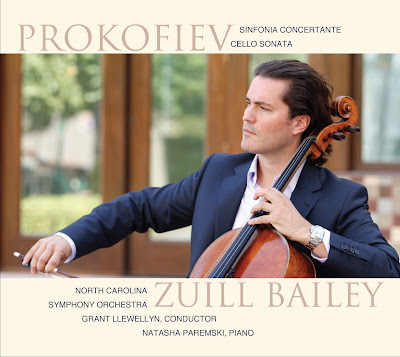
Cellist Zuill Bailey repeats almost exactly the formula that won raves from the critics in his 2014 Telarc recording of cello music by Benjamin Britten. That included the Symphony-Concerto and a Cello Sonata, as does this new Steinway disc of music by Sergei Prokofiev, due to be released on April 29, 2016. Bailey has the same supporting cast as well: the North Carolina Symphony conducted by Grant Llewellyn, and in the Sonata, pianist Natasha Paremski. The concerted works of both discs were recorded live at the Meymandi Concert Hall in Raleigh, while the sonatas come from the studio.
Way back in 2002 Bailey gave a wide-ranging interview with Tim Janof of the Internet Cello Society, in which he talked about the cello recordings that he especially loved. I'm not surprised with his choice of Rostropovich's famous recording of the Sinfonia Concertante with the Royal Philharmonic Orchestra and Sir Malcolm Sargent. Bailey and Llewellyn follow the great Russian/English team in terms of tempi, which tend to be a bit brisker than other recordings (especially Ma's, with Maazel in Pittsburgh). The cello is brought quite far forward, front and centre, in the recording, though, putting the emphasis more on the Concertante than the Sinfonia. It's an especially fine live recording, though, with that electric feeling you sometimes get in the concert hall. There's no sign of the audience, even at the end, which is different from the nine minutes of applause included in the latest recording from Atlanta.
This great work is extremely well served on disc. I listened to bits of a dozen versions, and all of the Rostropovich, Ma, Harrell, and Wallfisch, and marvelled at the way great and modest cellists could differ in small and large ways while still sounding so musical. The lovely tone of Bailey's venerable instrument - the 1693 Goffriller played by Mischa Schneider for three decades in the Budapest String Quartet - and Bailey's confident mastery of the work, puts this recording in the same league as those masters, with the very fine orchestral playing of the Carolinians very nearly up to the Royal Philharmonic, Pittsburgh or Liverpool orchestras.
I shouldn't forget the 1949 Sonata, which is fine indeed. Prokofiev, who had recently been charged with formalism in music, did not know if he'd ever have his music performed again, or worse. So he forgets about impressive effects to wow the audience; this is more like a personal working out of things in his brain. And what a brain! Bailey and Paremski (again, an equal musical partner) keep their eyes down and the feeling intense, eschewing obvious effects in favour of the work's bleak architecture.
In the world of the recording star you're always moving on to the next project. I follow Bailey on Twitter (as should you), and on April 16, 2016 he tweeted about the latest live recording project with the North Carolina Symphony, conductor Grant Llewellyn, and violinist Philippe Quint: the Brahms Double Concerto. I'm looking forward to this recording!
![]() |
| Bailey, Llewellyn & Quint with the NC Symphony, from Bailey's Facebook page. |
Subscribe to:
Posts (Atom)