Reviews and occasional notes on classical music

Reviews and occasional notes on classical music

"Music, both vocall and instrumental, so good, so delectable, so rare, so admirable, so super excellent, that it did even ravish and stupifie all those strangers that never heard the like." - Thomas Coryat, after hearing 3 hours of music at the Scuola di San Rocco in Venice, 1608.

Showing posts with label Storyville. Show all posts

Wednesday, February 22, 2023

Bird With Strings


Phil Woods: Bird With Strings... And More!


On November 30, 1949, Charlie Parker recorded a 10" Mercury LP for producer Norman Granz, with Stan Freeman on piano, Ray Brown on bass and Buddy Rich on drums. Jimmy Carroll arranged six standards for Parker and his trio, with five strings and a harp, plus an oboe, played by future A&R man and conductor Mitch Miller. The album, which featured an iconic David Stone Martin cover, was so successful that a second 10" LP was recording the following summer, with 8 standards, arranged this time by Joe Lipman.

On June 12, 2005, Phil Woods presented his new arrangements of Parker's famous standards in Zurich, with a much larger string section: 24-30 strings rather than the original 5. This fine 2-disc set from Storyville Records also includes new standards with similar arrangements. 

Parker's albums were always controversial: the jazz cognoscenti thought he was selling out, both for the lush arrangements and the fact that he was playing standards exclusively. But the jazz-with-strings genre that began with this project has always been a popular one. I've always enjoyed the Charlie Parker albums; I played this music a lot during my CD-player days! So there's certainly a bit of nostalgia mixed in when I listen to Phil Woods' album, but I appreciate this project on its own merits: for Woods' playing as well as that of his sidemen, and for the gorgeous sound of the full complement of the Zurich Chamber Orchestra's strings. This is very highly recommended!

Here is a video of Woods playing "I'll Remember April" with the Zurich Chamber Orchestra, from 2005. 


And this is the original: "I'll Remember April", from Charlie Parker with Strings, July 1950:


This album will be released on March 3, 2023.

Monday, April 13, 2020

Warm, joyful jazz from Copenhagen


Benny Carter Quartet: Summer Serenade

Benny Carter, alto saxophone
Kenny Drew, piano
Jesper Lundgaard, bass
Ed Thigpen, drums

This is a re-issue of a 1982 Storyville LP of a Copenhagen concert from August 17, 1980. This is very fine, swinging jazz, from a city that always seemed to bring out the best in visiting American musicians. It's partly due to the warm reception they received, but also because of the very fine Scandinavian sidemen who often played with visiting jazz stars. Here we have the great bassist Jesper Lundgaard, as well as drummer Ed Thigpen, famous for his long tenure with the Oscar Peterson Trio. Yes, Thigpen was born in Chicago, but he made a permanent move to Copenhagen in 1976 to take advantage of the fine music scene there. Both Lundgaard and Thigpen show up on another Storyville release I reviewed this month: a Teddy Wilson Trio disc also recorded in 1980. And there's another expatriate in the group: pianist Kenny Drew, originally a New Yorker, moved to Paris in 1961, and then to Copenhagen a few years later. What a jazz town!

These are fine sidemen, and they play exceptionally well together, but it's all in support of Carter's legendary alto sound. With more than fifty years of recording behind him at the time, this is tried-and-true music, but never tired or merely routine. Remarkably, Benny Carter went on recording into the 1990s, and it's not surprising when you hear such warmth, vitality and joy in this music.

I should mention a fun interlude right in the middle of this 45 minute concert: it's All That Jazz (not the Kander & Ebb song from Chicago, but the great song by Benny Carter, with lyrics by Al Stillman). It's perfectly sung by Richard Boone. Have a listen:

Sunday, April 12, 2020

Making jazz history in Copenhagen


Archie Shepp + The New York Contemporary Five: Vol. 2

Archie Shepp, tenor sax
Don Cherry, cornet
John Tchicai, alto sax
Don Moore, bass
J. C. Mose, drums

Two LPs' worth of music by Archie Shepp + The New York Contemporary Five were recorded at the Montmartre jazz club in Copenhagen in 1963. A previous CD tried to include both, but a track had to be dropped because of lack of space on the disc. This reissue of the second volume is welcome; short measure at less than forty minutes, but this remastering is excellent, and it wouldn't do to leave out any music this amazing. This may be jazz of an avant garde variety - post-bop or hard bop, on the way to free jazz - but it gets under your skin after a while. I guess that's what was intended!

This was the swan song for The New York Contemporary Five, with this lineup, at least. Soon Shepp and others in the group began to work with Ornette Coleman, making new kinds of jazz history. Here, from the Montmartre session, the group plays Coleman's Emotions.


Songs from the past, bittersweet


Teddy Wilson Trio: Revisits the Goodman Years

This concert, recorded in Copenhagen on June 15, 1980, is an exercise in nostalgia, as Teddy Wilson plays tunes from his time with Benny Goodman in the mid-1930s. What's amazing is how fresh this music sounds. That speaks volumes about Wilson's professionalism and his amazing technical skills, but it's a tribute as well to his very fine sidemen: bassist Jesper Lundgaard and the amazing Ed Thigpen on drums. The Copenhagen concert is coming up to forty years in the past, while the original Goodman sessions they refer to were just over forty years old at that time. We're looking into a mirror that shows us something even farther away, and each nostalgic bounce provides its own pleasures, no matter how bittersweet. "To memory", Jacques Roubaud says in The Great Fire of London, "everything is present, everything distant; this is the axiom of intertwining."

Thursday, February 27, 2020

Prize-winning jazz from Denmark


Roy Haynes: My Shining Hour

Roy Haynes, drums
Tomas Franck, tenor sax
Thomas Clausen, piano
Niels-Henning Ørsted Pedersen, bass

This album is from a concert in Copenhagen on the occasion of Roy Haynes winning the 1994 Jazzpar Prize. The prize, organized by trumpeter Arnvid Meyer from 1990 to 2004, came with 200,000 Danish Kroner (worth then, I believe, around $30,000), from the sponsorship of the Scandinavian Tobacco Company. Haynes is in fine form here, obviously enjoying the attention, and the spirited playing of his Scandinavian side-men. All three are standouts, with impressive playing from Swedish tenor player Tomas Franck, sensitive work by one of the top Danish pianists, Thomas Clausen, and most importantly, the superb bass support of Niels-Henning Ørsted Pedersen, known to many jazz lovers as NHØP.

Europe has been a major destination for American jazz greats for a long time. It was a welcome respite from Jim Crow for African-American musicians, and from the 1960s on, a return to what it was like when jazz was truly a popular music. You can tell from the audience response at the end of the final track that these are dedicated, even rabid, fans. It's great to have such an important concert easily available, very well mastered, and documented with Storyville's usual thoroughness.


This album will be released on March 13, 2020, which just happens to be Roy Haynes' 95th birthday!

Wednesday, November 21, 2018

A special new jazz album for Christmas


Kristin Korb: That Time of Year

Every year I'm on the lookout for a special new jazz Christmas album, and I've found one that will surely be part of my holiday playlist in years to come: That Time of Year, from the Danish vocalist/bassist Kristin Korb. Korb modulates her voice with the expert bassist's feel for what her fine trio - Magnus Hjorth on piano and Snorre Kirk on drums, along with featured soloist Mathias Heise on harmonica - is up to all the time. Rather than a soloist with accompaniment we have Korb's vocals as part of a very musical whole.


The album's final song is my favourite. Though Count Your Blessings (Instead of Sheep) isn't really a Christmas song, the fact that Irving Berlin wrote it for Bing Crosby to sing in 1954's White Christmas gives it all the authenticity you could want. The arrangement calls out for guest appearances from Linus and Snoopy and Bill Melendez's animation (though Hjorth's superb, spare piano here is probably more like Bill Evans than Vince Guaraldi). The gorgeous song and fine arrangement, along with Korb's Blossom Dearie-style voice, makes this an instant classic, and worthy of Christmas airtime everywhere, from Spotify in front of your tree to the Walmart PA on Black Friday.

Thursday, May 10, 2018

An important concert finally on CD


Duke Ellington in Coventry, 1966

The February 21, 1966 concert of the Duke Ellington Orchestra at Coventry Cathedral was a big deal.  "It’s one of the most satisfying things I’ve ever done,” said Duke in an interview with TV Times, “...and the most important. It’s a personal statement. It’s a personal statement about belief." The concert has been very well documented with photographs from both the rehearsal and the concert itself. Here's a shot by Bill Wagg:


As well, the 55 minute television broadcast from ABC Midlands, first shown in April 1966, has apparently been re-shown recently on ITV in Britain, though I haven't yet found it on DVD or streaming video. Now, finally, we have this great-sounding CD from Storyville, due on June 8, 2018. Storyville knows its Duke; they have more than 100 Ellington titles in their catalogue. Their restoration engineers also have demonstrated that they can make the most out of pretty much any source material, and this disc ends up sounding pretty decent. The band is on top form; here is the lineup:


The orchestra added English vocalists for the concert, soloist George Webb and the Cliff Adam Singers, and they're very fine in their numbers. The band of course misses Billy Strayhorn, who died in May of the following year, but Duke's piano solos are first class and very moving. There's so much expression here; some of that comes of course from his deeply-held spiritual beliefs, but I expect he's already beginning to mourn the loss of his great collaborator.

Here's a lovely story about a 14-year old boy & his jazz-loving father listening in on Duke's rehearsal at the Cathedral.


Saturday, March 24, 2018

Hank Jones: Playing in Depth


Hank Jones in Copenhagen: Live at Jazzhus Slukefter, 1983

In a fascinating passage in his memoir Act One, Moss Hart talks about the ineffable something that great actors have, which some call 'star quality',

"... but among the learned it is more often discussed in terms of 'level of emotion' or 'playing in depth.'"

It's the latter phrase that occurred to me when I considered the long and distinguished career of the pianist Hank Jones. In at the beginning of the bebop revolution, and making music until his death at 91 in 2010, Jones was extremely prolific in the recording studio. He made more than 60 albums as a solo pianist or group leader, and many, many more as a session musician.

William P. Gottlieb's 1947 photo of Milt Orent, Mary Lou Williams, Hank Jones & Dizzy Gillespie in Williams' New York apartment. Library of Congress.

Jones had played with drummer Shelly Manne back in 1962 (on the album 2-3-4, with Coleman Hawkins), and he worked with Manne again in the late 1970s (though most of his trio activity at the time was with the Great Jazz Trio, usually with Ron Carter and Tony Williams). In 1983 Jones and Manne went to Copenhagen to record a live album at the Tivoli Gardens, with Danish bassist Mads Vinding. This Storyville CD is the first ever release in any format for a fine set of just over an hour of classic songs by some of the great jazz composers, among them Bud Powell, Benny Golson and Charlie Parker, as well as great standards.


Mozart talks in one of his letters about a pianist who plays "with taste, feeling, and a brilliant style of playing," and Hank Jones exhibits all three of these. But towards the end of such a distinguished career, it's "playing in depth" that I think sums it up the best.

This disc will be released on April 6, 2018.

Wednesday, April 5, 2017

The real Duke underneath


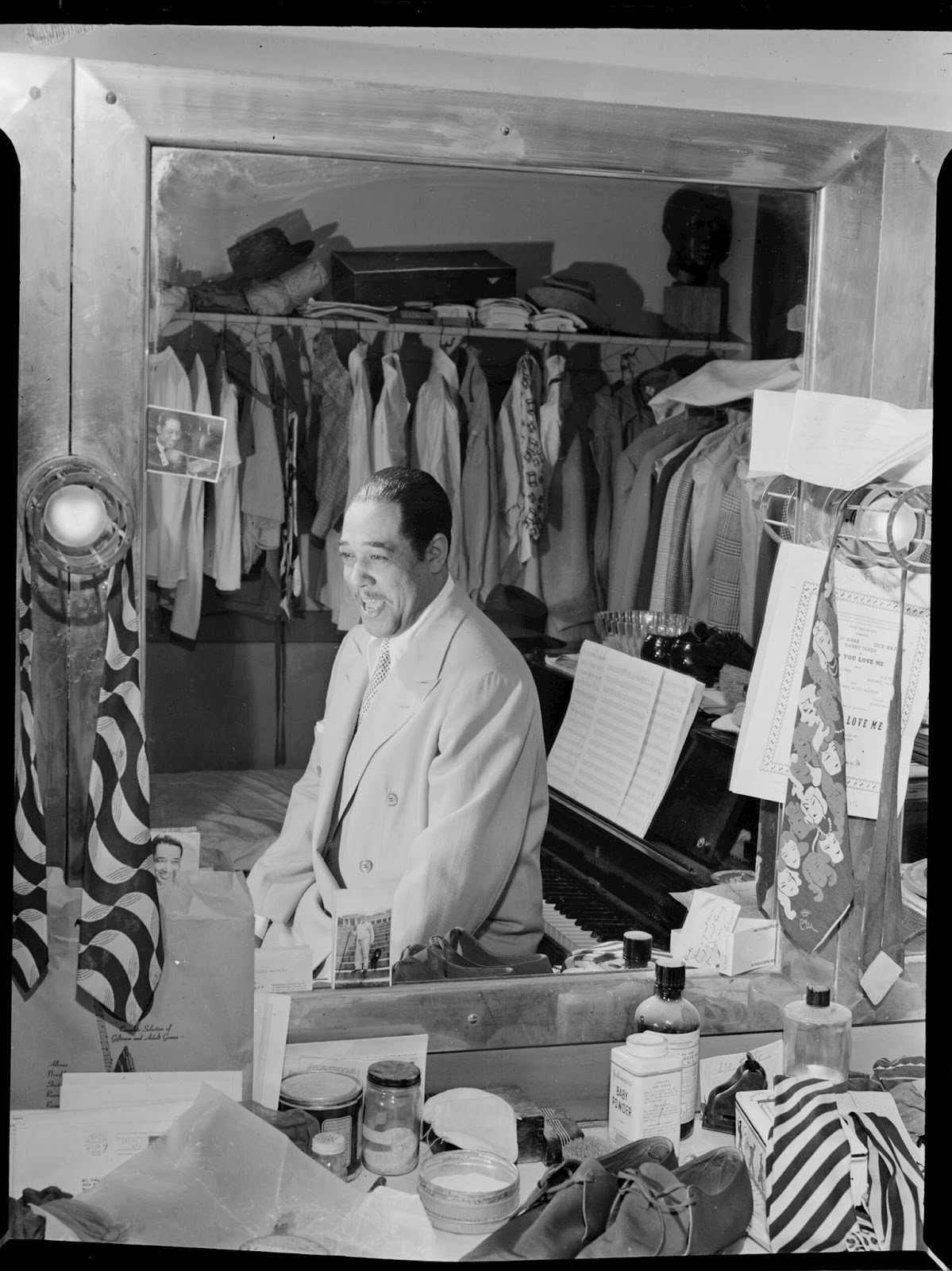
From the beginning Duke Ellington had style and a strong sense of himself; as a child, according to Terry Teachout's excellent biography A Life of Duke Ellington, he "carried himself like a prince of the realm." Once he became Duke, with his own band, everything was subsumed by elegance and refinement; nearly every description of his ensemble includes the words "style" and "sophistication". This is apparent in the famous picture William P. Gottlieb took of Duke in his dressing room at The Paramount in New York in September 1946.

Library of Congress
The outward trappings are obvious - Gordon Parks even took a photo of his many ties - but there's just as much elegance and sophistication in the music itself, composed and arranged, ofttimes, by Ellington himself or by his loyal lieutenant Billy Strayhorn. Polish, style, grace and elegance speak to outward beauty, and we're naturally curious, as we are about Mozart or Flaubert or Fragonard, about what's underneath the surface. That's the promise of this new Storyville album An Intimate Piano Session. On August 25, 1972, two years before his death, Duke recorded a very simple and heartfelt album of songs, many of which held a deep meaning for him. Most of the tracks are just Ellington himself at the piano, and that's such an exposed, open, vulnerable place to be.

Here's his first take of Billy Strayhorn's lovely Lotus Blossom:


Ellington has said that Billy Strayhorn loved to listen to him play Lotus Blossom; it's the last track on ...And His Mother Called Him Bill, Ellington's 1967 memorial for Strayhorn, who died that year. The emotional impact of that track is astonishing. This album is full of such personal items; My Mother, My Father and Love is one, which looks back on a largely happy childhood and deep, deep feelings of family and connection and love. There are more extroverted songs from the 1972 concert as well, with contributions from band singers Anita Moore and Tony Watkins. Storyville has filled out the album with four songs by Ellington's band from a 1969 concert in Holland. This project has given us a glimpse, underneath the surface elegance, of a great artist and a great (though, of course, flawed) person.

Tuesday, January 3, 2017

Duke Ellington's patriotic pitch


In 1945 the American Treasury Department arranged with Duke Ellington to broadcast a series of one-hour musical radio programs promoting American Savings Bonds. This long-running series from Storyville Records is up to vol. 21 of a total of 24 releases. It's a format that served everyone well. I'm sure the War Bonds people were pleased with the response, the Duke had a regular gig for 18 months in 1945 and '46 to present his musicians from venues around the U.S., and even James C. Petrillo, the President of the American Federation of Musicians, gets regular mentions, following the labour issues of the early 1940s.

Storyville has bundled two radio programs into each 2-CD album, with added material from the archives. This one has sets from The Million Dollar Theatre in Los Angeles, July 6, 1946 and the Orpheum Theatre in San Diego, July 27, 1946: plus music from the El Patio Ballroom in Denver, July 14, 1942 and the Trianon Ballroom, South Gate, California, May 2, 1942. The introductory track from volume 20 in the series will give you an idea of the material included:


The musicians in the orchestra are, of course, legendary. Featured on this album are saxophonists Johnny Hodges and Ben Webster, with Ray Nance on trumpet, and vocalists Kay Davis and Al Hibbler. The broadcast sound is very good, and with all of the announcements (but otherwise no commercials) this makes for a fascinating two hours of listening. I don't know that I'd want to listen to 24 of these, but I am looking forward to volume 22.


Here's Duke Ellington in his dressing room at the Paramount Theater, New York, ca. Sept. 1946, in one of William P. Gottlieb's great photos (all of which are available at the Library of Congress' website.) Ellington's style and sophistication are evident throughout his War Bond appeals; he's such an effective pitchman for this important cause.