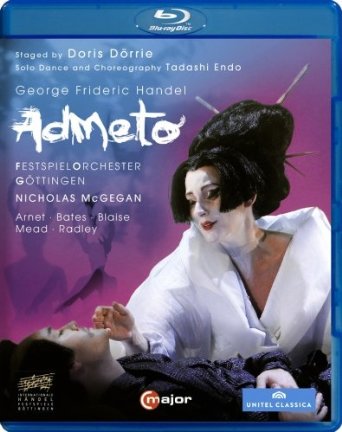
The orchestral playing and solo singing in the musical side of this production from the Internationale Handel-Festspiele Gottingen, from May of 2009, is under the capable direction of Nicholas McGegan. It's great to see him wedged sideways with his Festspiel Orchestra into the tiny pit of the Deutsches Theater; you have complete confidence that he'll keep things moving in a Historically Informed and dramatically appropriate way. Even though this is 7 years old now, the C Major Blu-ray is from a very fine HD source, and the surround sound is outstanding.
But it's naturally the theatrical concept of Doris Dorrie that causes the most discussion, since it adds an additional layer of abstraction to the already formalized conventions of Baroque opera. This layer, the transposition of the ancient Greek source materials from 18th century Europe to the Samurai culture - also 18th century - of Japan, didn't convince me at first. But then a set-piece of outstanding beauty justified the entire project for me, Ercole the Hero dressed as a Sumo wrestler included. This was Alceste's recitative 'Non lagrimate, o miei seguaci' and her aria 'Faro cosi piu bella', in which the heroine tells her entourage that she plans to kill herself to save her husband Admeto. Beginning as shadows behind a screen - another layer of abstraction - Alceste and her maids form a tableau vivante, and though they emerge in three dimensions, the formalized beauty remains and they seem no more flesh and blood than before. Indeed, with their pastel robes and faces painted white, they're more like faded early Renaissance frescoes than actual people. When Alceste returns behind the screen and the deed is done, again in a scene that could be a painting, it's sad, but sadder still because all the time Alceste (Marie Arnet) is singing an aria of exquisite beauty.
There are other highlights in the staging, and each is lamp-shaded to ensure we're very much aware of the conventions being flouted and new conventions being inserted. This is the very acme of self-aware stage-craft. The talented members of the Mamu Dance Theatre are variously ghosts, sheep, demons and deer, each time in set-pieces that I'm sure are no more artificial than the original ballets from Handel's time. This is highly imaginative stage-craft, nearly as imaginative as Handel's music. What it isn't is subtle, and of course Handel is a master of subtle effects, musical and dramatic.
Singing honours go to Marie Arnet, of course, but also to Tim Mead as Admeto and to Kirsten Blaise as Antigona. All are fine actors as well as excellent singers, and remind us of the humanity underneath the 18th century European and Japanese conventions and the 21st century International operatic emphasis on whimsy, irony and self-reference. The more opera tries to subvert itself, the more like traditional opera it seems, and that's largely to the good, when musicianship and stagecraft and technology together can create something as beautiful as this.


