Reviews and occasional notes on classical music "Music, both vocall and instrumental, so good, so delectable, so rare, so admirable, so super excellent, that it did even ravish and stupifie all those strangers that never heard the like." - Thomas Coryat, after hearing 3 hours of music at the Scuola di San Rocco in Venice, 1608.
Jozef Elsner: String Quartets, op. 8
The Silesian composer Jozef Elsner is best known as Chopin's teacher, but he was also one of the most distinguished administrators in both the theatrical and musical worlds in Poland. Still, on the evidence of these three string quartets published in 1806 his skill as a composer would have eventually Elsner put on the map; one hopes that this excellent album will help to do that very thing. The Equilibrium String Quartet is made up of talented young musicians playing period instruments, and their cohesion as a group is evidence of diligent work and knowledge of historical practice as well as musical skills. While obviously designed for the salon rather than the more lofty artistic reach of his contemporaries Haydn (who had finished all of his quartets by then) and Beethoven (who at the time was about to begin his middle-period Razumovsky Quartets, op. 59), Elsner's quartets have a concertante focus. They're all well-wrought and are designed to showcase the virtuosity of each instrumentalist in turn. More importantly, they're fun to listen to, and for that, I think, we have to thank the Equilibrium String Quartet as much as Jozef Elsner.
I've always thought of Urania as a re-mastering and re-packaging company, and over the years I've enjoyed a number of their historic reissues (most recently, a fine album of Paul Hindemith conducting his own music). But they also do a lot of original recording in Italy, and there are many such discs to explore on their website. One that naturally caught my eye was this all-Villa-Lobos disc from guitarist Andrea Monarda. His version of Villa's Preludes and Etudes for Solo Guitar goes into the very, very long queue of recordings of these works. Popular works that fit nicely on a single LP or CD have a tendency to multiply. I'd rate Monarda a bit above the middle of this crowded pack, he delivers a lively performance that's especially well recorded. I often find that a particular guitarist will be stronger in one group or the other ("the classical guitar world is divided into two types of musicians..."), and Monarda, I think, is much more successful in the Etudes. A couple of the Preludes are perhaps a bit under-characterized, when compared with outstanding versions by Norbert Kraft or Timo Korhonen. But Monarda impressed me with the drama of the 1st and 12th Etudes, and the saudade of the 5th and 11th.
However, it's the title work which sets apart this album: the remarkable Sextuor Mystique (aka Sexteto Mistico), nominally written in 1917, though the score was lost and Villa-Lobos re-wrote it from memory decades later. The musicologist Lisa Peppercorn believes it was actually written during the 1920s, Villa's modernist period that includes some of his greatest music; I would tend to agree. Monarda has put together an ensemble named for the work, though it's unlikely the Sextuor Mystique Ensemble will be able to find anything else written for just this combination of instruments: guitar, flute, oboe, harp, saxophone and celesta. The SME do a marvellous job in this case, highlighting its Paris/Rio split personality.
The two decades before and after the Millennium were a golden age of Villa-Lobos recordings. The great composer's reputation was rising after its inevitable decline following his death in 1959, and his Centennial in 1987 primed the pump for a strong comeback. Soon there were multiple new discs released every month. Lately, though, there have been fewer and fewer new releases, with the notable exception of the recently completed Complete Symphonies series from Naxos. It's encouraging, then, to see this new project from Italy. I hope it's the sign of more Villa-Lobos activity to come.
Darius Milhaud introduced the marimba into the classical orchestra with his extraordinary 1947 Concerto for Marimba and Vibraphone, and composers from Leoš Janáček to Steve Reich were quick to introduce the striking colours this marvellous instrument can add to chamber and orchestral works. This new disc from marimbist Mike Stoltzman and her husband, clarinettist Richard Stoltzman, provides a great overview of various styles ("from Bach to Zorn" is a great way to talk about a wide range of music!)
Mika Stoltzman's own adaptation of Bach's perfectly adaptable Chaconne, from his D minor Partita for Solo Violin, shows the musical and emotional range of the instrument, as well as her own brilliant playing. Ravel's Pavane pour une infante défunte is another work that's made its way into many, many arrangements, and Richard Stoltzman's version for marimba & clarinet sounds exotic and familiar at the same time, in other words, just right for this kind of music.
For me the highlight of the album was the John Zorn piece which provides the title of the project. Richard Stoltzman describes the work in the liner notes:
Mika begins by playing quite tonal music, and then the clarinet jumps in with something abstract and arrhythmic, with crazy leaping intervals, almost as if Ornette Coleman had stepped into the room, and it keeps in conflict with the steady metre of the “old manuscript” underneath Mika’s part. It’s really fun to play, and it has been a surprise hit with audiences.
So many of the pieces here (including the Bach arrangements) are jazz- and blues- inflected. The Piazzolla works seem so natural, partly because the great composer from Argentina worked in his own jazz/classical idiom, but also because of the groove that the Stoltzmans and bandoneonist Pedro Giraudo are in throughout.
Mika and Richard Stoltzman play John Zorn's Palimpsest
The Jupiter String Quartet and pianist Bernadette Harvey bring us a standout disc of music for piano and strings commissioned by the Friends of Arizona Chamber Music, with important works by Pierre Jalbert, Steven Stucky and Carl Vine. Jalbert's large-scale Piano Quintet, written in 2017, includes both music-historical ("Mannheim Rocket") and liturgical ("Kyrie") references, and the formal architecture of the work is from the 19th century, but this is an urgently contemporary piece, full of today's turbulence and an intense foreboding about the future. This is a compelling piece.
In the liner notes Steven Stucky expresses his love for the Piano Quartet form, and especially for the works of Mozart and Brahms in this special chamber music niche. As so often happens with art that comes out of a special connection with works from the past - think of Villa-Lobos's Bachianas Brasileiras, for example, or Cy Twombly's veneration of Nicolas Poussin ("I would've liked to have been Poussin, if I'd had a choice, in another time.") - the contemporary artist's true self is discovered. That's, I think, what's happened here, in Stucky's Piano Quartet from 2005. In another large-scale work, this time in one movement, Stucky explores landscapes of doubt and fear and anguish, with occasional episodes of solace and grace.
Carl Vine has compared his music to the growth of crystals, and there's a strong impression of organic growth in his 2013 Fantasia for Piano Quintet, with themes emerging from fragments and taking odd turns and unexpected paths. The Jupiter Quartet and Bernadette Harvey bring just the right, very light, touch to this fragile music, allowing it to unfold in its own way.
The program ends with Pierre Jalbert's 2012 Secret Alchemy for Piano Quartet, but this is no bravura encore, but rather another substantial piece that explores matters of significant import. The focus here is on mystery, secrecy and mysticism, with the sound of medieval chants and the reverberations of a cathedral, all wrapped up in a kind of post-modern pastiche. Indeed, this might work (thought it certainly wasn't intended to be) as the soundtrack to an Umberto Eco novel, perhaps to his Postscript to The Name of the Rose.
What a fine program this is! I enjoyed every minute, and found many new delights waiting every time I listened again.
Here are the Jupiter String Quartet with Bernadette Harvey, performing the world premiere of Pierre Jalbert's Piano Quintet.
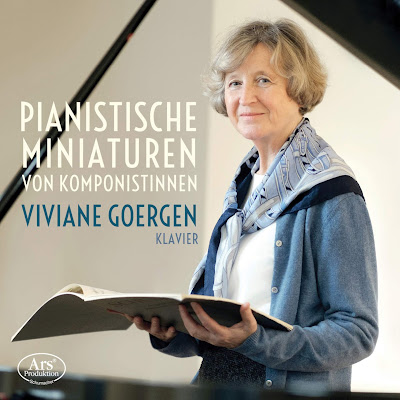
Of the nine composers on this well-filled disc of piano miniatures played by Viviane Goergen, I had only heard (and even heard of!) two: Alicia Terzian and Germaine Tailleferre. I was encouraged by Viviane Goergen's performance of Tailleferre's marvellous Sicilienne, an outstanding piece that transcends its salon-piece genre, redolent of the South of France and beyond to the cities and back country of Brazil (as communicated to the composer, I'm sure, by her colleague in Les Six: Darius Milhaud). Goergen plays up both the languid atmosphere and the more jazzy drama, and captures both to perfection. In music of this scale you only get one chance, as they say, to make a good impression.
Alicia Terzian is an accomplished composer, though I know her as a conductor as well. In 2018 she released a fabulous album of 20th and 21st Century music with the group Grupo Encuentros; my review was very positive. On this disc, Goergen plays her Danza Criolla, an outstanding op. 1 (I love to collect opus ones!), a fine work reminiscent of her compatriots Ginastera and Piazzolla, as well as another great piano miniaturist, Heitor Villa-Lobos.
What of all the rest, all these World Premiere recordings? Viviane Goergen has put together a very strong groups of miniatures here, all of them "character" pieces in the Schumann style. Within a variety of moods and rhythms many of the works have a strong character. Standouts include Marguerite Roesgen-Champion's two charming Bucoliques; Mel Bonis's impressive La Cathédral blessée; and the two Danses of Vera Winogradowa. I've been riding the wave of new interest in women composers, & this new disc certainly has added to the thrills.
"ComposerX conducts ComposerX" is a formula that results in some very mixed results. Authenticity is enhanced, to be sure, but what are the odds that a composer might have the communication skills to approximate with a symphony orchestra what was imagined at the composing desk? Off the top of my head I would include on the list of the best composer conductors Britten, Richard Strauss and Stravinsky, and I have no hesitation, based on the evidence of this disc, in including in that list Paul Hindemith. Hindemith is lucky here to have two of the world's very finest orchestras: the Berlin Philharmonic and the Philharmonia Orchestra. In addition, in his London sessions, Hindemith's recording is guided by the great EMI producer Walter Legge.
There have been a number of different combinations of Hindemith conducting Hindemith released over the years, but this two disc set is one of the best, containing his best orchestral works, and including some of the best sounding recordings. It's great to have the Horn Concerto here, with the irreplaceable Dennis Brain. The remastering is excellent, and everything points to a very enthusiastic recommendation.
Julian Cannonball Adderley, alto sax
Nat Adderley, trumpet
Victor Gaskin, bass
Roy McCurdy, drums
Joe Zawinul, piano & keyboards
Listening to the reaction of the crowd in the Liederhalle Stuttgart on March 20, 1969 you can tell that something important is happening. The musicians are obviously energized by this enthusiasm, and play with urgent inspiration, which of course gets passed back to the audience. From today's vantage point this concert at the end of the 1960s can seem like a kind of coda to a genre that emerged from 1940s dance bands to become a great International Style, the musical counterpart of the New York School of Painting, practiced and appreciated as much in the Liederhalle as on West 52nd Street in New York.
The rises and falls of history only become apparent after the fact, of course, and especially in peak moments like this hour of music one is completely in the moment, blind and deaf to the power of musical entropy that would transform jazz in the 1970s. Pianist Joe Zawinul had spent most of the 60s with Cannonball Adderley, but was only a year away from the creation of Weather Report with Wayne Shorter. Cannonball contributed to the transformation of jazz in the early 70s - he continued to play with both Miles Davis and Bill Evans in this period, but by 1975 he was gone, tragically early. His brother Nat carried on the Adderley tradition for the rest of the century, as a band leader and, increasingly, as a teacher for new generations. But this hour of music remains as a beacon, sending light into the past and the future, as inspiring today as it was for those listening fifty years ago in Stuttgart.