Reviews and occasional notes on classical music

Reviews and occasional notes on classical music

"Music, both vocall and instrumental, so good, so delectable, so rare, so admirable, so super excellent, that it did even ravish and stupifie all those strangers that never heard the like." - Thomas Coryat, after hearing 3 hours of music at the Scuola di San Rocco in Venice, 1608.

Thursday, April 6, 2017

A marathon of great music and great performance


The great cellist Mstislav Rostropovich was in his prime, about to turn 40, when he arrived in New York with the London Symphony Orchestra for eight concerts at Carnegie Hall between February 23 and March 12, 1967. The excitement surrounding this project is easy to hear; there's a real sense of occasion in this music, and though the applause for each piece is cut quite short, what's left is (rightly) very enthusiastic. For this six-CD set Doremi has chosen 22 concertos from the 30 performed. It seems a bit churlish to complain, with all the amazing riches included, about what isn't here. But what a shame to have the greatest of 20th century cello concertos, the Elgar, to lead off the set, without the greatest 19th century concerto, the Dvorak, to go with it. I also regret not having the Schumann concerto, and the two Haydn concertos. But let's accentuate the positive, beginning with the Elgar Cello Concerto. Comparing it with the classic performance by Jacqueline du Pre (with the same LSO), it seems much cooler at first than du Pre's more emotional attack, but Rostropovich soon turns on the afterburners, and provides just as satisfying an experience when the piece is over. Other highlights include Prokofiev's Concertino, a work that is much more substantial and interesting than the diminutive title would suggest, and the Britten Symphony for Cello and Orchestra, which was written for Rostropovich in 1964. I also much enjoyed the Hindemith Concerto, and the two American world premieres, by Foss and Piston. Ottorino Respighi's Adagio con variazioni is a really remarkable piece of music, which Rostropovich sinks his teeth into. It's marvellous to have it available in such a strong performance.


Unfortunately, my enjoyment in this music is not completely unalloyed. The baroque music, concertos by Vivaldi and Tartini, does not match the level of the rest of the program. I was perfectly willing to put aside my love for the historically informed style in vogue today, even indulging in a bit of guilty pleasure. But I got no pleasure from these lumpish, unformed performances. There was precious little charm here, and no real feeling that Rostropovich was engaged in this music. These are the exceptions, though, rather than the rule, and I can enthusiastically recommend this marathon of great music and great performance.

Wednesday, April 5, 2017

Bach and Villa-Lobos for Saxophone


Here's an impressive new release from a young artist with a bright future in the classical music world, saxophonist Asya Fateyeva. My primary interest here is the music by Villa-Lobos, but the Bach arrangements, by Fateyeva herself, are musical and show off the capabilities both of her instrument and herself. She receives solid support from the Württembergisches Kammerorchester Heilbronn under Ruben Gazarian. The saxophone's natural singing tone is used to good effect, but the subtle colour effects that Fateyeva provides as an arranger and a performer keep things fresh, while Gazarian's brisk tempi make sure things don't get bogged down in sentimentality. The celebrated Aria from the Fifth Bachianas Brasileiras is arranged with due respect to the composer's original version where the voice has support from 8 cellos (or, rather, a solo cello and seven others), and not with a more generic "strings" accompaniment that is often used. This performance of the Fantasia for Saxophone should help provide some traction for a work that I've always felt should be much better known than it currently is. It's been turning up fairly regularly on programs around the world since it was the center-piece of Branford Marsalis's Marsalis Brasilianos tour back in 2012, and young saxophonists like Asya Fateyeva are right to play it often. A highly recommended disc!

The real Duke underneath


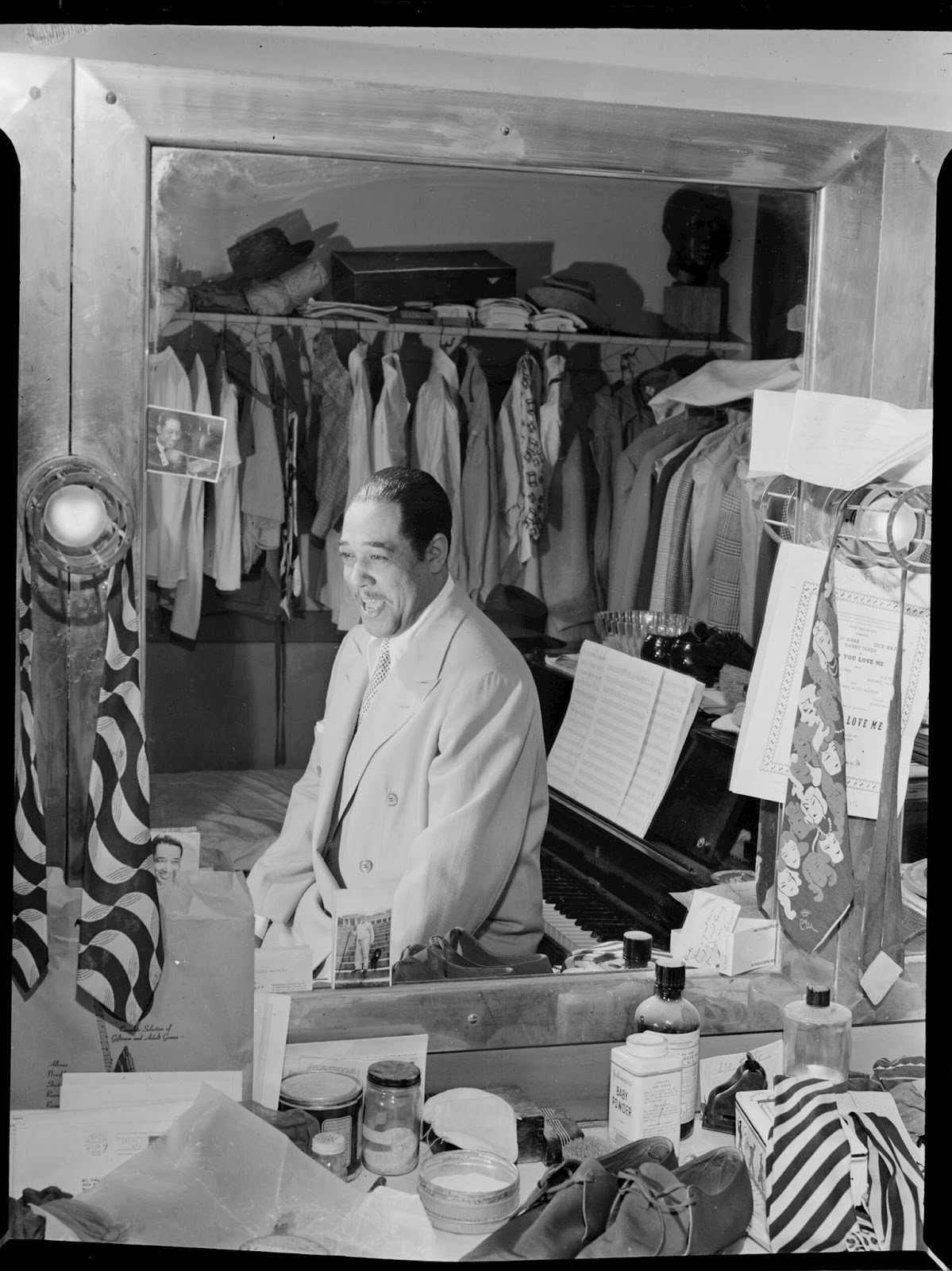
From the beginning Duke Ellington had style and a strong sense of himself; as a child, according to Terry Teachout's excellent biography A Life of Duke Ellington, he "carried himself like a prince of the realm." Once he became Duke, with his own band, everything was subsumed by elegance and refinement; nearly every description of his ensemble includes the words "style" and "sophistication". This is apparent in the famous picture William P. Gottlieb took of Duke in his dressing room at The Paramount in New York in September 1946.

Library of Congress
The outward trappings are obvious - Gordon Parks even took a photo of his many ties - but there's just as much elegance and sophistication in the music itself, composed and arranged, ofttimes, by Ellington himself or by his loyal lieutenant Billy Strayhorn. Polish, style, grace and elegance speak to outward beauty, and we're naturally curious, as we are about Mozart or Flaubert or Fragonard, about what's underneath the surface. That's the promise of this new Storyville album An Intimate Piano Session. On August 25, 1972, two years before his death, Duke recorded a very simple and heartfelt album of songs, many of which held a deep meaning for him. Most of the tracks are just Ellington himself at the piano, and that's such an exposed, open, vulnerable place to be.

Here's his first take of Billy Strayhorn's lovely Lotus Blossom:


Ellington has said that Billy Strayhorn loved to listen to him play Lotus Blossom; it's the last track on ...And His Mother Called Him Bill, Ellington's 1967 memorial for Strayhorn, who died that year. The emotional impact of that track is astonishing. This album is full of such personal items; My Mother, My Father and Love is one, which looks back on a largely happy childhood and deep, deep feelings of family and connection and love. There are more extroverted songs from the 1972 concert as well, with contributions from band singers Anita Moore and Tony Watkins. Storyville has filled out the album with four songs by Ellington's band from a 1969 concert in Holland. This project has given us a glimpse, underneath the surface elegance, of a great artist and a great (though, of course, flawed) person.

Saturday, March 25, 2017

A fascinating reboot from Versailles


Every year, beginning in early December, I enjoy listening to as many versions of Handel's Messiah as I can: from rambling, romantic traditional versions to HIP re-enactments. I especially love hearing the version Mozart prepared in 1789, which adds trombones and clarinets, but more importantly brings a new sensibility to bear on this great music, which was first performed in 1741. Something very similar is at play here: in 1770 three composers, Antoine Dauvergne, François Rebel and Bernard de Bury, were commissioned to update the classic Lully opera Persée, originally written in 1682 for the inauguration of the new opera house at Versailles. It's presented by Le concert Spirituel under Herve Niquet in a beautiful package from Alpha Classics, who are fast becoming my favourite label.

The late 18th century didn't have the same regard for historical accuracy that has become the norm in the 21st, and the French musical establishment had been monkeying around with the great scores of the 17th century long before this project. This is a much more thorough reboot of Lully than the Mozart Messiah, and it's the source of much pleasure for the open-minded. Of the three new composers I know Dauvergne the best; I had an LP of his short comic opera Les Trouquers many years ago that I loved. The other two I was unaware of (once I realized that the Rebel I know is the father Jean-Féry and not the son François). All three do their thing with freedom, adding flutes and bassoons, clarinets and horns, and writing a fair amount of new music. Here's the original overture by Lully, played by the present band, Le Concert Spirituel under Herve Niquet:


and the new Overture by Dauvergne:


A new sound for a new Opera House! We have the torso of Lully's opera left, along with a general feeling of stateliness, grandeur and shameless flattery towards royalty. In all, this is a fun package with a scrupulously researched back story for those who want to delve into the music historical aspects. It's so beautifully played and sung that I have no hesitation in recommending it.

Friday, March 24, 2017

Premiere recordings of appealing string quartets


These "early" string quartets by William Alwyn receive their first recordings in a fine disc from the Tippett Quartet. But these are hardly juvenilia, written as they were during the composer's late twenties and early thirties. Nor do they reveal any compositional defects or a feeling that we're listening while the composer is learning. Some composers (Villa-Lobos is an obvious example) aren't sufficiently self-critical, but by suppressing these works Alwyn seems to lean too far in the opposite direction. Luckily the Tippett Quartet and Somm Recordings (with support from the William Alwyn Foundation) have recorded these appealing works, and hopefully the previous nine quartets will eventually follow.

The single movement No. 12 is the most experimental in sound, and the most intense in feeling. I can't imagine why Alwyn witheld this powerful work. It packs a lot in 13 minutes, and leaves a strong impression of passion, loss and mystery. It seems a natural piece to be picked up by other ensembles, though they would be hard pressed to improve on the playing of the Tippett Quartet. Both No. 11 and No. 13 have very positive passages as well, but my favourite is the 10th Quartet, a lovely suite of sea voyage pictures with echoes of Ravel and a strong sense of atmosphere.

Wednesday, March 22, 2017

Two great works played with energy & drive


This Chandos CD is Andrew Davis's second recording of the coupling of Job and the 9th Symphony, which he recorded with the BBC Symphony in the early 1990s as part of his complete symphonies set for Teldec. In the new disc, Andrew Davis appears with the Bergen Philharmonic Orchestra, pinch hitting for the late Richard Hickox to allow Chandos to finish off a complete Vaughan Williams series. These are both great works. The ballet Job has, according to Michael Kennedy, "the stature and cohesion of a symphony', its 1930 date of composition placing it between the three early symphonies and the three middle ones. The Ninth Symphony was completed just a few months before Vaughan Williams' death; I've always been baffled by the questions about its merits. Perhaps the critics were expecting something else when it was premiered in 1958, but this has always sounded to me just like what it is: a work of great power and complexity.

In February 2014 Jonathan Swain surveyed the available Vaughan Williams 9th Symphony recordings for BBC Radio3's CD Review; you can listen to that program here. Of course this was before the present disc was available, and Vernon Handley's version is Swain's top choice. He likes the first Andrew Davis recording, but wishes he could talk instead about Davis's performance with the BBC SO at the 2008 Proms, on the occasion of the 50th anniversary of VW's death. Swain feels Davis's conception of the work has changed, and grown: "it was all gain," he says. I'm thinking he would like the new version very much; he thinks that "energy, drive and brilliance of tone" are vital in this music, and I agree. The Chandos recording, helped by amazing sound (I would have loved to hear the surround sound version), has that in abundance. Davis brings tons of energy to this performance, and the Bergen players come through with flying colours. Speaking of players, the saxophones & flugelhorn shine here. This goes for Job as well, whose incidents are as vivid and sharply described as an Annie Leibowitz photograph. The effect of the organ in the Sixth Scene "A Vision of Satan" (which is dubbed in from a recording of the Rieger organ in the Domkirken, Bergen) is astounding.

Here's Sir Andrew Davis re-conducting his own work, listening on headphones in the studio. You know you want to do the same thing: go for it!


Saturday, March 18, 2017

A new classic of the operatic stage


By coincidence, I'm writing this review a day before the 90th birthday of the British composer John Joubert. As it turns out, it's the easiest thing possible to give this a 5-star review, but this gift to Joubert is sincere. Happy birthday!

Joubert isn't afraid to take on classics of English literature; his other major operas are based on works by Joseph Conrad and George Eliot. He and his librettist Kenneth Birkin have cut the classic novel to its dramatic bone to come up with this two act adaptation of Jane Eyre. And Joubert has provided vital music to move the plot along; it's theatrical in the best sense. It takes its cue, perhaps, from the splendid 1943 film of the novel made by Robert Stevenson, with a script by Aldous Huxley and John Houseman, and with fine performances by Orson Welles as Rochester and Joan Fontaine as Jane. But the real value in Joubert's Jane Eyre comes from the gorgeous music, often reminiscent of Richard Strauss or Pfitzner. "Great music is in a sense serene;" says Rebecca West, "it is certain of the values it asserts." With all the heightened emotions and passion on display while the melodrama works outs its plot points, there is always a still, calm centre in Bronte's remarkable heroine. Rochester himself comments on it:
How still she is!
So still and silent . . .
so slight, so solitary, so calm . . .
All of this works beautifully on a theatrical level, but it fits as well into Joubert's musical scheme, which is as symphonic as it is operatic. Opera at this high level of sophistication communicates the full emotional range of the novel. It's a remarkable accomplishment.

Kenneth Woods has the music well in hand here, with fine, committed work from the players of the English Symphony Orchestra. The singers are very strong, with outstanding performances, both dramatic and musical, from April Fredick as Jane and David Stout as Rochester. The recording is from a live concert performance, which is all to the good. There's a sense of occasion, with a major work rescued from many decades of obscurity, and perhaps the beginning of a long life on operatic stages around the world.