Reviews and occasional notes on classical music

Reviews and occasional notes on classical music

"Music, both vocall and instrumental, so good, so delectable, so rare, so admirable, so super excellent, that it did even ravish and stupifie all those strangers that never heard the like." - Thomas Coryat, after hearing 3 hours of music at the Scuola di San Rocco in Venice, 1608.

Showing posts with label Ars Produktion. Show all posts

Monday, April 10, 2023

Sunny and dark music for string trio


The string trio is one of my favourite formats; it doesn't have the baggage of the string quartet: that daunting mass of masterworks from Haydn to the present day. The String Trio has, on the one hand, the light serenade side, and on the other the intensity of great string trios by Schoenberg, Villa-Lobos and Schnittke. In the middle is the perfection of Mozart's great string trio from 1788, the Divertimento, K. 563.

The first two works chosen by the exceptional group Leipziger Streichtrio - violinist Adrian Iliescu, violist Atilla Aldemir and cellist Rodin Moldovan - try for that Goldilocks medium attained by Mozart. This is joyful music, but not completely ignoring dark undercurrents. Ernö Dohnányi's Serenade for String Trio, Op 10, is a relatively early work, written in 1902. It takes as its formal model not Mozart's Divertimento, but rather Beethoven's Serenade for String Trio, op. 8, from 1796-97. Jean Françaix's String Trio, from 1933, is a neo-classical gem, which exemplifies the modus operandi of Les Six: slightly sad nostalgia, slightly ironic romps, slightly erudite fugal passages, always having fun with serious matters. 

Jean Sibelius's String Trio, which dates from 1894 is a more serious beast. This is an almost altogether stern work, and though it's only 8 minutes long, it has a symphonic feel to it. When have you ever seen Sibelius smiling in a portrait? *

There are two additional pieces in this interesting program, which one might consider encores. George Enescu's Aubade, from 1899, is a bit of fun, a rustic folkloric piece full of swoops and pizzicati. Andras von Toszeghi's arrangement of J. S. Bach's great Chaconne from the 2nd Partita for Solo Violin is substantial, and interesting. Mozart himself transcribed six Bach Preludes & Fugues for string trio in 1788, K. 404a. I love listening to the Chaconne in any guise - I especially enjoy Brahms' version for piano, and Leopold Stokowski's for full orchestra. But this isn't quite a complete success as an arrangement - the violin gets to keep most of the good bits, and the viola and cello have the leftovers that make the soloist sweat while double-stopping in the original. It's neither fish nor fowl, but tasty anyway! Altogether this makes an exceptional hour of music.

* Here's your answer: Werner Bischof very nearly got a full smile out of Jean Sibelius in this 1948 portrait.


Monday, January 24, 2022

Skeletal charm


This is the second disc of Stefan Potzmann's clever arrangements of opera excerpts for a chamber ensemble of strings and winds. Puccini, Tchaikovsky and Richard Strauss are the perfect composers for this type of project, since they're all brilliant melodists, and the operas chosen - La Bohème, Elektra and Eugene Onegin - all have enough diverse elements to build dramatic suites of instrumental music. Of course there's much lost when the voices are tossed, but the musical bones that remain have their own skeletal charm. The committed performances of the nine members of Ensemble Minui makes this release a real treat - perhaps even better than the first in the series.

This album isn't yet available on Spotify, so I'll add a link to Ensemble Minui's Act I, released in 2020. Music by Puccini, Richard Strauss and Dvorak.

Friday, June 28, 2019

Only one chance to make a good impression


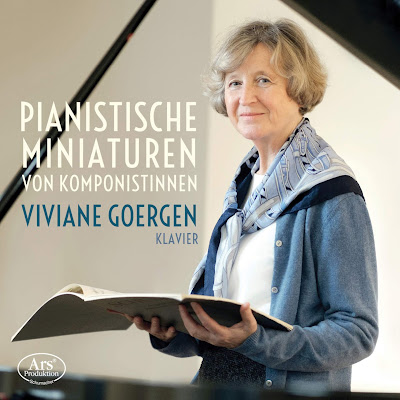
Pianistische Miniaturen, piano works by Bonis, Jaell, Kaprálová, Roesgen-Champion, Sukova-Dvorakova, Tailleferre, Terzian, Winogradowa, Zaranek

Of the nine composers on this well-filled disc of piano miniatures played by Viviane Goergen, I had only heard (and even heard of!) two: Alicia Terzian and Germaine Tailleferre. I was encouraged by Viviane Goergen's performance of Tailleferre's marvellous Sicilienne, an outstanding piece that transcends its salon-piece genre, redolent of the South of France and beyond to the cities and back country of Brazil (as communicated to the composer, I'm sure, by her colleague in Les Six: Darius Milhaud). Goergen plays up both the languid atmosphere and the more jazzy drama, and captures both to perfection. In music of this scale you only get one chance, as they say, to make a good impression.


Alicia Terzian is an accomplished composer, though I know her as a conductor as well. In 2018 she released a fabulous album of 20th and 21st Century music with the group Grupo Encuentros; my review was very positive. On this disc, Goergen plays her Danza Criolla, an outstanding op. 1 (I love to collect opus ones!), a fine work reminiscent of her compatriots Ginastera and Piazzolla, as well as another great piano miniaturist, Heitor Villa-Lobos.

What of all the rest, all these World Premiere recordings? Viviane Goergen has put together a very strong groups of miniatures here, all of them "character" pieces in the Schumann style. Within a variety of moods and rhythms many of the works have a strong character. Standouts include Marguerite Roesgen-Champion's two charming Bucoliques; Mel Bonis's impressive La Cathédral blessée; and the two Danses of Vera Winogradowa. I've been riding the wave of new interest in women composers, & this new disc certainly has added to the thrills.

This disc will be released on August 9, 2019

Thursday, April 11, 2019

Civilized musical conversations for the time traveler


Heinrich Anton Hoffmann: Three String Quartets, op. 3

Heinrich Hoffmann was an almost exact contemporary of Beethoven's, and his opus 3 String Quartets were published only a few years before Beethoven's ground-breaking opus 18 set. But these beautifully balanced examples of civilized musical conversation are more like (in style and pretty darn close to quality) Haydn, and especially Mozart, than the more abrupt young composer from Bonn. Everything about this project from the original instruments ensemble Alte Musik Köln is well-researched, thoughtful and sophisticated. One can easily imagine oneself listening to the great virtuoso musicians of the day, playing in the drawing rooms of aristocrats, temporary respites from the social change and danger of the Napoleonic wars in Germany at the time. Time travel really does work in the musical realm, and we can experience the same enlightenment and peace that this music still provides in our own troubled times.

This disc will be released on May 17, 2019.

Tuesday, October 4, 2016

Music from the time of Rubens


I've been on a Rubens kick lately, and seeing some of his great pictures last month in London and Edinburgh really emphasized for me what a genius he was. Two recent books, Rubens and His Legacy and Master of Shadows: The Secret Diplomatic Career of the Painter Peter Paul Rubens, showed that Rubens was much more than just a painter. His political career was wide-ranging, his accomplishments as an entrepreneur were outstanding, and he consorted as an equal with all the top intellectuals and artists of the age. I was really interested to read about his diplomatic and artistic connections at the court of the Gonzagas at Mantua, where he connected with Claudio Monteverdi.

Jean Tubery and Ensemble La Fenice present this fascinating new project L'Atelier de Rubens: Musica Belgicae, which assembles music from Antwerp and other Belgian centres during the period when Rubens built his studio and an international reputation as Europe's greatest painter. I knew, and was very impressed with, the Tubery's similar project in 2015, Velazquez and the Music of His Times; the current disc meets those very high standards of scholarship and presentation.

The composers aren't very well-known: Nicolo à Kempis, Cornelis de Leeuw, Jan/John Bull, Jan-Jacob van Eyck. The only names I knew were Jacobus Clemens non Papa and that prolific artist Anonymous. But there are many felicitous moments here: many of the pieces are reminiscent of better known Italian music of the period, and there are some really special works included. The Symphoniae for cornetto and strings have an appealing Monteverdi/Gabrieli sound, with a Northern lilt. Philipp van Wichel's La Ciacogna has a real pan-European sound; I love to hear a Chaconne in whichever guise it's presented! I also loved the carol Een kindeken is ons gheboren (To us a little child is born), and the three pieces based upon it by different composers. I plan on including these in my Christmas playlists!

Sunday, August 7, 2016

The beautiful spirit in Mozart and Mendelssohn


The first concerto disc by Danae Dörken is definitely a winner; a strong personality emerges in both of these great works, which is impressive for such a young musician. Lars Vogt and the Royal Northern Sinfonia give strong support, and the Ars Produktion surround sound is outstanding.


The C major concerto K.467 has always been one of my favourites; there's so much vitality and drive here - this is Mozart at the peak of his powers. Dörken and Vogt keep things going at a rolling boil, and their keynote is appropriately dramatic and operatic (the concerto was written in the year before The Marriage of Figaro). Here's an example of their dramatic shading: in the middle of the first movement (just after 6:30), there's a hesitation that reads almost as a full stop. It's a light that shines on a moment of high drama, and the exquisite filigree that follows.


Meanwhile, Daniel Barenboim (just after 7:00, in a much more relaxed version) passes the moment by almost nonchalantly:


There's the same nimble precision in the 2nd Mendelssohn Concerto. Dörken and Vogt are serious when they need to be, but the music is never fraught. Matching it with the Mozart definitely brings out the clean lines and serene mood in Mendelssohn's beautiful piece. In a really interesting discussion between Dörken and Daniel Knaack in the liner notes comes this quote of Schumann on Mendelssohn:
Music is the outflow of a benign spirit, whether it flows in the presence of hundreds or in solitude; but let it always be that beautiful spirit which expresses itself. That is why Mendelssohn's compositions are so irresistible when he plays them himself.... I often think that Mozart must have played like that.
The beautiful spirit is heard loud and clear in this fine recording. I look forward to more projects with these talented musicians!

Monday, February 29, 2016

The lyrical bassoon


The lyrical side of the bassoon fits the French sound of this music, providing a nostalgic sadness that the elegant accompaniments of Francaix, Tomasi and Jolivet only make sadder. Even the jauntier sounds of the quick movements stay away from the bassoon-as-clown stereotype; this is light music but not unserious. And though the great Villa-Lobos Ciranda das sete notas is from 1933, when the Brazilian master was exploring national folklore in his Bachianas Brasileiras and Guia pratico, it fits in nicely amongst its French cousins. Though it makes reference to Brazilian dance forms, there's as much nostalgie as saudade in this lovely music. The soloist Matthias Racz has a light touch and a lovely tone, and he receives stellar suport from the Stuttgarter Kammerorchester under Johannes Klumpp. This CD is not just for bassoon afficionados, though I'm sure they'll lap it up. It's also highly recommended for all fans of French music and Villa-Lobosians.