Reviews and occasional notes on classical music

Reviews and occasional notes on classical music

"Music, both vocall and instrumental, so good, so delectable, so rare, so admirable, so super excellent, that it did even ravish and stupifie all those strangers that never heard the like." - Thomas Coryat, after hearing 3 hours of music at the Scuola di San Rocco in Venice, 1608.

Showing posts with label Glossa. Show all posts

Wednesday, December 28, 2022

Disruptive music by Boccherini

Luigi Boccherini: Six Symphonies à Quatro, op. 35

Earlier today, I was listening to a symphony by Muzio Clementi that impressed me by its complete blandness, and I thought how wonderful it is that at one point in the late 18th Century there were three absolute geniuses writing music at the same time: Haydn, Mozart and Beethoven. The gap between these composers and Clementi seems too large to bridge. But luckily, there's a second tier of composers in between, including Bach's sons, the Bohemians Franz Benda, Carl Stamitz & Christoph Willibald Gluck, and an Italian who spent most of his life in Spain: Luigi Boccherini.

These Six Symphonies are billed as being in four parts, but they're actually in five: two violins, viola, cello and bass. They could be played one to a part, but here, with the wonderful Orchestra of the Eighteenth Century, we have a small chamber orchestra: five first and four second violins, three violas and cellos, and a double bass and harpsichord. Boccherini was of course a master of chamber music, but this music sounds exactly right in this orchestral guise.

The two discs begin with the Fourth Symphony in F major, which in its first movement takes off immediately in an exciting gallop. Clearly, unlike Clementi Boccherini has something positive to say, and an exhilarating and original way of saying it. In his fine liner notes, Emilio Moreno compares Boccherini's op. 35 Symphonies with Mozart's Haffner Symphony, K. 385 and Haydn's Symphonies 76-78, all of which were written in 1782. (Beethoven, meanwhile, was only 12 years old; his first orchestral music was well in the future). Moreno doesn't hear much Haydn or Mozart in this music:

"Boccherini conceives of a discourse very close to that of the divertimento in which the unconventionally emotional goes beyond the structural and the Dionysian goes beyond the Apollonian, without its formal and harmonic ease of construction corresponding to predetermined models and schemes."

Boccherini disrupts the galant schemas, whereas Haydn, and especially Mozart, work their special magic largely within the structures that have come to be called classical. Boccherini worked, at least in 1782, in what Friedrich Schlegel called the 'poetry of the frenzied', as opposed to the 'poetry of the sober.'

The slow movement of the Sixth Symphony is quite wonderful, and it's played here with grace and style, with passion occasionally bubbling up from beneath the surface. This movement brings to mind the wonderful music Geoffrey Burgon wrote for the 1981 TV version of Brideshead Revisited; I don't know if Burgon knew Boccherini, but I hear in both a nostalgic sadness: Charles Ryder's for Sebastian and the Brideshead of the past; Luigi Boccherini's, perhaps, for his Italian homeland to which he would never return.

Wednesday, January 12, 2022

Wonderful Leclair Concerti from Basel


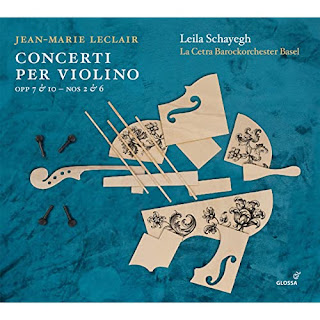
Jean-Marie Leclair wrote two sets of six violin concertos: his op. 7 from 1739 and op. 10 from 1743. This is the third and final release from Glossa of these twelve works with the very fine violinist Leila Schayegh and La Cetra Barockorchester Basel. The works are cleverly arranged on disc, with two from each set per disc; this time we have numbers 4 & 5 from each. 

These are scrupulously Historically Informed Performance recordings. Schayegh plays a marvellous Andrea Guarneri: Santa Teresia, from Cremona, 1675. The band is a compact group with four violins (plus a second solo violin), two violas, two cellos, one violone and harpsichord, played at A = 408 Hz.

Leclair's violin concertos show the influence of the Italian masters: Corelli, Vivaldi, and especially Pietro Locatelli. It was Locatelli's presence in Amsterdam in 1743 that caused Leclair to travel to Holland. The two are almost exact contemporaries; the Italian composer was a year and a half older. I'm sure that there was a give and take in Amsterdam between these two virtuoso violinists and wonderful composers. By the way, both composers died in the same year: Locatelli in March of 1764, and Leclair in October. Unfortunately, the circumstances of the French composer's death are grim; he was murdered by an unknown assailant. 

Locatelli has long been one of my favourite Baroque composers. I only knew Leclair from his chamber music with violin, and didn't realize how appealing his violin concertos are. I don't think I could have been introduced to this music by a better violinist and orchestra. This is superb playing: stylish and sophisticated. I plan on listening to the first two releases in this series, and I'm definitely up for anything these fine musicians release in the future!

The wonderful album cover design for all three releases is by Rosa Tendero.


Wednesday, February 26, 2020

Reliably great music from Budapest


Michel Pignolet de Montéclair: Jephté, Tragédie, Paris, 1737

I'm so excited every time I see a new recording on Glossa that features the Purcell Choir and the Orfeo Orchestra, conducted by Gyorgy Vashegyi. I've reviewed four in the past: Rameau in 2019, and again in 2018; and Mondonville in both 2017 and 2016. I've come to expect the highest level of both choral and solo singing, the most stylish, Historically Informed orchestral playing, with superb engineering and really excellent supporting documentation, including libretti and good English translations.

Now it's the turn of Michel Pignolet de Montéclair, and I can encapsulate my review in a single phrase: more of the same! Montéclair is hardly a household name, and I admit never having heard his music before. I know: I don't spend enough time listening to the music of the French Baroque, which is quite surprising considering how enamoured I am of Rameau, Lully, Charpentier and Mondonville. In any case, this is a superb tragic opera, a huge hit from its first performance in 1732 through many revivals (over one hundred performances at the Paris Opéra and the Queen's Concerts at Versailles, over thirty years). And it's no wonder, considering the splendid orchestral and choral effects the composer produces. As well, there was some controversy driving the strong interest in this work, the only operatic work from the periodf based on Biblical stories. I never worry too much about the story in these kinds of stage spectaculars, since there's so much great music to move things along.

This album will be released on March 6, 2020

Tuesday, April 23, 2019

Woke Rameau


Jean-Philippe Rameau: Les Indes galantes

Gyorgy Vashegyi's Budapest-based Purcell Choir and Orfeo Orchestra has become my favourite Original Instruments group. They were so good in Mondonville's Grands Motets and Isbé, also from Glossa; more recently they've moved on to the great genius of the French baroque, Jean-Philippe Rameau, and his Naïs.

"I like people", said Voltaire, speaking about Jean-Philippe Rameau, "who know when to drop the sublime in order to banter." In moving from tragedie to "the naïve graces of ballet",  Rameau had taken on the impressively advanced - anti-clerical and anti-imperialist - politics of his librettist Louis Fuzelier. As happens so often, satire can hide revolutionary ideas. This is actually very nearly a "progressive" agenda, even by today's standards (don't get me started on the 2020 Democratic primary), but for someone who made a (good) living flattering the monarchy, it's an interesting side-line.

As in the previous project, Vashegyi and his talented musicians work with the Centre de Musique Baroque in Versailles. Academic precision never gets in the way of the obvious fun of the project, though. Once again we're treated to great choral and solo singing, again led by soprano Chantal Santon-Jeffery. In a review of another recording of Les Indes galantes, I talk about "the great, dumb fun" of this project, and this is something that would be easy enough to lose. But there's no worry of that here; we get the full deal, and it's fun to go along for the ride.

This album will be released on May 3, 2019.

Thursday, August 16, 2018

The magnificent enthusiasm of English Gothic music


The Liberation of the Gothic: Florid polyphony by Thomas Ashwell and John Browne

Bjorn Schmelzer brings his speculative musical-historical approach to English music of the late 15th and early 16th century, once again combined with the highest levels of both music and recording technology, and the result is stunning. The fine singers of the Belgian choir Graindelavoix completely won me over to this music, even though I had been immersed in the less ornate but still moving (and more or less contemporary) music from the Peterhouse Partbooks, as sung by Scott Metcalfe's Blue Heron.

One of Schmelzer's starting points is this short video by Paul Binski, Professor of the History of Medieval Art at Cambridge University, who discusses the amazing art and architecture, sadly defaced by iconoclasts during the Reformation, of Ely Cathedral's Lady Chapel.


Schmelzer finds in the splendour of the Lady Chapel and its impetus in Marian theology a parallel to the music of John Browne, who was born in 1480 but lived only until 1525; and Thomas Ashwell, who may have been nearly an exact contemporary, though it's possible he died as early as 1513. The "florid polyphony" of Browne and Ashwell has the same ebullient drive as the double-curved ogee arches of the Lady Chapel, and Schmelzer underlines this exuberance through his animated interpretation, which his expert choir handles with aplomb. This is what Pater meant when he said in The School of Giorgione (1873) that "All art constantly aspires towards the condition of music."

Still, there's another level beyond the florid decorations, and John Ruskin touches on it in The Stones of Venice:
There are however, far nobler interests mingling, in the Gothic heart, with the rude love of decorative accumulation: a magnificent enthusiasm, which feels as if it never could do enough to reach the fulness of its ideal ; an unselfishness of sacrifice, which would rather cast fruitless labour before the altar than stand idle in the market; and, finally, a profound sympathy with the fulness and wealth of the material universe, rising out of that Naturalism whose operation we have already endeavoured to define. 
In the end it is the spiritual nature of both Ely Cathedral and the music of Browne and Ashwell, a deep connection to the cult of Mary. Ruskin's "magnificent enthusiasm" is evident in this marvellous disc.

Monday, March 26, 2018

Marvel before Marvel


Jean-Philippe Rameau: Naïs

The operas of the French baroque are much more accessible to the non-specialist than one might think. It's not only about the music, as gorgeous as it is. With gods, demigods and super-heroes, and an emphasis on special effects and stage machinery, we're more than half-way to today's DC and Marvel-based blockbuster movies. Jean-Philippe Rameau's Naïs is especially appealing, with a story based on Greek myth overlaid with very un-subtle political commentary, or rather, shameless flattery of the King. To further extend its appeal, there are nymphs and shepherds dancing Gavottes, Sarabandes, Contredanses and Tambourins in what I'm sure were spectacular ballets.

Gyorgy Vashegyi's Purcell Choir and Orfeo Orchestra, so good in Mondonville's Grands Motets and Isbé, also from Glossa, provide the sumptuous music that keeps the action flowing and the ballet dancers cavorting. The singing is absolute first class, beginning with superb choral singing, and moving throughout the cast. Chantal Santon-Jeffery is superb in the title role.


Though recorded in Budapest, this is a joint project with the Centre de Musique Baroque in Versailles. Everything is carefully researched to ensure the authenticity of French musical heritage, which in that country is taken extremely seriously. More importantly, this is obviously the result of musicians engaged in and enjoying their music-making.

This album will be released on April 20, 2018.

Monday, January 29, 2018

Neapolitan music of light and shade


Neapolitan Concertos by Fiorenza, Pergolesi, A. Scarlatti, Porpora & Mancini

The composers represented on this disc are roughly Bach and Handel's contemporaries (Nicola Porpora and Francesco Mancini), or come from the generation before (Alessandro Scarlatti) or after (Giovanni Battista Pergolesi and Nicola Fiorenza). They all share a common heritage and a peculiarly brilliant and lyrical style intensified by a sophisticated system of conservatories with high musical standards for both vocal and instrumental music. Josetxu Obregon has created a varied and at times inspired program for the fine players of La Ritirata. The featured soloists are all excellent: Tamar Lalo (recorder), Hiro Kurosaki (violin), Ignacio Prego and Daniel Oyarzabal (harpischords), with his own cello solo rounding up this distinguished group of musicians. The standout works are, unsurprisingly, by Pergolesi (a spritely work featuring two harpsichords), and Alessandro Scarlatti (a recorder concerto on the Telemann level if not quite in the Bach/Handel range). Naples is a city of light and shade; melancholy is never far away, even in the midst of its gaiety. Thanks to Glossa for such a compelling album.

Thursday, June 8, 2017

A courageous thing


Luigi Boccherini: String Trios op. 34
Life is a more complex struggle now. It is now valiant to be simple: a courageous thing to even want to be simple. It is a spiritual thing to comprehend what simplicity means. ~ Frank Lloyd Wright
Something curious often happens when a composer removes an instrument from a string quartet. Though the lightening of texture sometimes results in less serious music, serenade-like, often folk-inspired, it's just as likely that a new gravity comes with the more austere form. Villa-Lobos's late String Trio, the ground-breaking Trio by Webern, and the astonishing, concentrated Schoenberg String Trio all come to mind. The best example is Mozart's Divertimento K. 563 of 1788, about which Alfred Einstein said "Each instrument is primus inter pares, every note is significant, every note is a contribution to spiritual and sensuous fulfillment in sound." These six trios for two violins and cello by Luigi Boccherini from 1781 show this same tendency, and it's no coincidence, I think, that they're from the same period as his intimate and deeply religious Stabat Mater for soprano and string quintet, a new recording of which I just reviewed last week. From listening a great deal to these two CDs, I'm inclined to place Boccherini just behind Haydn and Mozart as a composer of chamber music. This is inspired, and inspiring, music. This is not a brand new recording; it was made back in 2010, and was previously released on the Colmna Musica label in 2012. But the remastering by Glossa reveals fresh and lively performances by the original instruments group La Ritirata, who bring out the Spanish flavour of Boccherini's music in an appealing way.

Thursday, April 27, 2017

Slip, slidin' away


Orazio Vecchi Requiem: Rubens's funeral and the Antwerp Baroque

I've been immersed in the Glenn Gould world lately, reading Sandrine Revel's new graphic novel and watching 32 Short Films About Glenn Gould. The reason I mention this here is that Gould's 1955 recording of the Goldberg Variations was such a ground-breaking event, a revolution in performance practice. Looking back on some of the early responses to Gould's interpretation, his use of a piano in the repertoire, even the choice of music itself, some of it seems quite reactionary more than 60 years later. I dabble, at most, in music from the Renaissance and early Baroque, so I don't know too much about how this music should be sung. My first thought, though, was that the ornamentation, mordents (trills) and slides in abundance, threatens to swamp the music entirely. Trying to keep an open mind I was alternately swept away by the choir's gorgeous singing of unearthly beautiful music and irritated by the swoops and curlicues Bjorn Schmelzer has introduced into the music in apparent imitation of the sound of cornets and sackbuts of the Venetian composers of the time. Frank Sinatra famously imitated Tommy Dorsey's trombone style in developing his vocal technique. Similarly, Ella Fitzgerald once said "I stole everything I ever heard, but mostly I stole from the horns." This cross-fertilization is a sign of a vibrant musical culture, and the reluctance to fall in line with an exact precision of ensemble and a punctiliously straight-forward presentation is very much the same. The music should swing, but maybe not quite so much.

Schmelzer places this music at Rubens' funeral in Antwerp in June of 1640, perhaps on some rather sketchy evidence. This is what got me interested in this album; I adore Rubens' paintings and admire him greatly as a artist and a person (I highly recommend Mark Lamster's book Master of Shadows, by the way, a fine portrait of a cosmopolitan man of letters and public affairs). Vecchi's Requiem was published in Antwerp in 1612, so at least we have the geography lined up. I guess it doesn't really matter too much in the end; we all have our own lineup of people to remember when we listen to Requiem masses, and the list gets longer for all of us every year.

Come back to this review in 60 years to see if I've missed the boat here. What I mainly am right now is puzzled.

Here is the Dies Irae from the Vecchi Missa pro defuncta.

Sunday, January 1, 2017

A pastorale of astonishing beauty


What a great way to start off the New Year! One of the musical highlights of 2016 (and a Top Ten pick of mine) was the Purcell Choir/Orfeo Orchestra recording of Mondonville Grands Motets from György Vashegyi on Glossa. This new 3-CD album of the opera Isbé, premiered in 1742, brings the same musical forces to a work that makes just as positive an impression. Isbé is a pastorale with a libretto by Henri François de La Rivière, and while I never pay much attention to the ins and outs of the plots of these sorts of entertainments, there are plenty of opportunities here for Mondonville to do what he does best: write music, and especially choral music, of astonishing sweetness.

It's not only the Purcell Choir that excels here, though. The Orfeo Orchestra play with style and verve under the direction of Vashegyi, who seems to have a special feeling for French Baroque music that belies the Hungarian origin for the Mondonville projects. One of Mondonville's many accomplishments was his integration of the latest trends in Italian orchestral music into French opera. The innovations of composers like Vivaldi become part of the richness and wonder of Mondonville's presentation. And Vashegyi's vocal soloists impress as well; especially Katherine Watson, who provides a full and rich sound for the title role, but also communicates a full measure of charm.

Saturday, July 16, 2016

The International Style of the Spanish Corelli


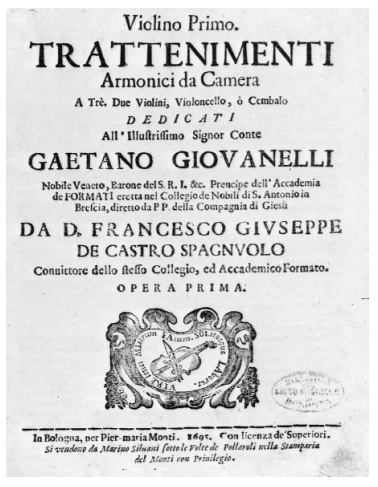
When I spent two years in the Twin Cities back in the olden days (Go Vikings!), I never felt more Canadian. Francisco José de Castro was born in Seville in 1670, but he spent his artistic life in Italy. He called himself "Spagnuolo", and one can very much hear a Spanish flavour in this music.


Still, this Opus 1 collection shows that De Castro had adapted completely to what had become the International Style of instrumental music at the end of the 17th century. Corelli is the obvious influence, but there are other strands to hear besides the Spanish and Italian. French dances make an appearance as well. This is wonderful music: rich with operatic flair (a number of these movements may have been used, with doubled string parts, as overtures), dance rhythms, emotional interludes, and special musical effects to wow the cognoscenti.

And it's a wonderful performance, by La Real Cámara, under the leadership of Emilio Moreno. Moreno apparently recorded this music for Radio Nacional de España back in the 1980s, so he knows this music well. This is playing of the highest standard, which expresses an obvious commitment and love, and Moreno's album is the best possible advocate for this composer.


Recorded in the Auditorio y Palacio de Congresos Príncipe Felipe, in Orviedo, Asturias, by Spanish musicians, I was a bit surprised when I compared the great 9th sonata with the only other Castro recording I could find, by Chatham Baroque:


This actually has a stronger Spanish flavour than the new version, though maybe that's because of the context, a (highly recommended) album called Españoleta.

I'm so impressed with De Castro's music, and wish there were more to listen to, but it looks like this might be the Complete Works at this point. The Concerti Accademici, op. 4, as appealing as they are, are probably mis-attributed. His Opus 2 collection is, according to the liner notes by Marco Bizzarini, "currently missing", so I'm hoping they might turn up some day.  I certainly hope when they do the scores go first to Emilio Moreno and La Real Cámara.

Monday, April 18, 2016

Elastic, buoyant, ravishing music


This new CD from Glossa, to be released on April 29, 2016, was recorded at the Bela Bartok Concert Hall in Budapest with Hungarian singers, instrumentalists and conductor, but it sounds as authentically French as any recent recording I've heard. This is gorgeous music, and it's hard to believe it's not as popular as Rameau or Handel. In fact, I believe three of these Grands Motets are recording premieres, though there's no indication on the album cover.


Jean-Joseph de Mondonville was born, or at least baptized, on Christmas Day, 1711, which puts him in the generation behind Jean-Philippe Rameau. He was relatively productive as an instrumental and stage composer, but my favourite of his works are the sacred Grands Motets, only nine of which have survived. Judging by the quality of this music, the missing eight Motets are a great loss to the world of music. Of the four Motets included on this disc only one, De profundis, a setting of Psalm 129 from 1748, has been recorded before, as far as I can tell. This work is included in both Edward Higginbottom's 1999 Hyperion disc with Oxford New College Choir, and William Christie's 1997 Erato disc with Les Arts Florissants. I wish I could play the Purcell Choir version, but it's not available on Spotify yet. But I wanted those who don't know Mondonville's Motets to hear what ravishing music this is:


I actually much prefer the Purcell Choir/Orfeo Orchestra version under György Vashegyi to Christie's, as fine as it is. This new disc is fresher and lighter and more alive. Mondonville has such a dancing sound, "the rhythmical elasticity and buoyancy" in John Eliot Gardiner's words, of Baroque music. I like to think that after a hard day at the Concert Spirituel, Mondonville would take his wig off, let his hair down, and play some jazz with his friends. You can hear it in this music.