Reviews and occasional notes on classical music
"Music, both vocall and instrumental, so good, so delectable, so rare, so admirable, so super excellent, that it did even ravish and stupifie all those strangers that never heard the like." - Thomas Coryat, after hearing 3 hours of music at the Scuola di San Rocco in Venice, 1608.
Showing posts with label Vivaldi. Show all posts
Thursday, March 5, 2020
A musical, scholarly and cultural triumph
The Other Cleopatra, Queen of Armenia: Arias by Hasse, Vivaldi, Gluck
This remarkable album is more than a classical music recording; it's also a work of original scholarship and an effective cultural advocacy project. I hasten to add that it works especially well musically. Isabel Bayrakdarian is in fine voice, and she receives stellar support from the very fine conductor Constantine Orbelian and the excellent Kaunas City Symphony in Lithuania. As a bonus, the superb harpsichordist Jory Vinikour is on hand to add special zest to the continuo parts. He and Bayrakdarian are especially fine partners in the recitatives.
In the 18th century Abate Francesco Silvani wrote a libretto based on the story of King Tigranes II, the greatest king in Armenian history, and his wife Cleopatra of Pontus. It was set by a number of composers, including three who feature on this album: Johann Adolph Hasse, Antonio Vivaldi and Christoph Willibald Gluck. Bayrakdarian put this program together as part of her research at the University of California, Santa Barbara, where she is Associate Professor of Voice and Opera, choosing these arias and recitatives, which fit her "voice and temperament". There are some exciting moments here: "Squarciami pure il seno" by Vivaldi and Gluck's "Presso l’onda" are stand-outs. But even better are the slower, more contemplative, moments: Hasse's "Parte, parte" and "Presso a l'onde", and Gluck's "Priva del cara bene". This is lovely, graceful music. Even more impressive, though, is Vivaldi's aria "Qui mentre mormorando", introduced by the recitative "Lasciatemi in riposo". It's music worthy of the mature Mozart, full of sadness and pathos, but always dramatic. Like Mozart, Vivaldi has a keen sense of the psychology of his characters. So it doesn't matter what actually happens with the plot (alas, Abate Silvani was no Da Ponte!); what is key is how the music helps us to understand what the character is feeling. And, of course, that communication also requires a singer of some psychological awareness as well as technical and dramatic skills, and we are indeed lucky to have in this project such a remarkable soprano as Isabel Bayrakdarian. I couldn't recommend this album more highly.
This album will be released on March 30, 2020
Friday, November 1, 2019
Reuse, Recycle, Reduce
Antonio Vivaldi: The Paris Concertos
The well known aphorism, that Vivaldi didn't write 500 (or 450, or 600) concertos, but one concerto 500 times, has been nicely debunked by Linda Shaver-Gleason, at her blog Not Another Music History Cliché. I'm pleased with this, because I'm a diehard Vivaldi fan. What impresses me about Vivaldi, especially as I learn more about his operas and sacred music, as well as his concertos and chamber music, is its incredible variety. Yes, there is a special Vivaldi sound, but I don't consider this self-plagiarizing, but more like an accent, or a way of expressing himself. It made me think of Jimmy Stewart's trademark hesitations. "You want the moon? Just say the word and I'll throw a lasso around it."
But here's a time when Vivaldi actually was recycling his music. Sad to say, the Red Priest from time to time involved himself in some rather shady business dealings, which is something he had in common with such great composers as Handel, Haydn and Beethoven. He promised brand new concertos to a German music lover, but delivered instead a mix of new and slightly used music. The very detailed essay written by Maestro Sardelli doesn't say whether Vivaldi's deception was ever found out. More likely, the buyer was too busy enjoying this hugely enjoyable music. And speaking of recycling, you'll need to look closely at copyright dates in the fine print to see that this Tactus release is actually a re-issue of a recording that Modo Antiquo made in 1999, previously issued on Tactus in 2000. That's not a real problem in this case, luckily, since these are marvellous performances, which still sound very fresh. I highly recommend that you pluck this album from the blue box and put it on your CD or MP3 player.
The well known aphorism, that Vivaldi didn't write 500 (or 450, or 600) concertos, but one concerto 500 times, has been nicely debunked by Linda Shaver-Gleason, at her blog Not Another Music History Cliché. I'm pleased with this, because I'm a diehard Vivaldi fan. What impresses me about Vivaldi, especially as I learn more about his operas and sacred music, as well as his concertos and chamber music, is its incredible variety. Yes, there is a special Vivaldi sound, but I don't consider this self-plagiarizing, but more like an accent, or a way of expressing himself. It made me think of Jimmy Stewart's trademark hesitations. "You want the moon? Just say the word and I'll throw a lasso around it."
But here's a time when Vivaldi actually was recycling his music. Sad to say, the Red Priest from time to time involved himself in some rather shady business dealings, which is something he had in common with such great composers as Handel, Haydn and Beethoven. He promised brand new concertos to a German music lover, but delivered instead a mix of new and slightly used music. The very detailed essay written by Maestro Sardelli doesn't say whether Vivaldi's deception was ever found out. More likely, the buyer was too busy enjoying this hugely enjoyable music. And speaking of recycling, you'll need to look closely at copyright dates in the fine print to see that this Tactus release is actually a re-issue of a recording that Modo Antiquo made in 1999, previously issued on Tactus in 2000. That's not a real problem in this case, luckily, since these are marvellous performances, which still sound very fresh. I highly recommend that you pluck this album from the blue box and put it on your CD or MP3 player.
Saturday, August 17, 2019
Shimmering, shining Vivaldi
Vivaldi Con Amore: Concertos
This is the first Tafelmusik album under Music Director Elisa Citterio, who in 2017 replaced Jeanne Lamon, the only other Music Director the orchestra has had since its inception in 1981. It was recorded at Toronto's Humbercrest United Church on the Tafelmusik Media label. When run properly, the orchestral-led label can be a real plus, with recording, marketing and musical issues all under the control of the same organization. From the evidence of the past few releases, I would judge Tafelmusik Media a big success, much like another of my favourites, Seattle Symphony Media. We have here a bright, clean, open auditory experience to go along with a similar interpretation of Vivaldi's marvellous music. "Sparkling" has been a word that keeps coming up in reviews of Tafelmusik performances under Citterio, and it's a hallmark of the new disc as well. Though always solid, I've found Tafelmusik was getting just a tiny bit routine in its performances in this century, as it was passed by hot new groups like Il Giardino Armonico, and, in Canada, by Arion Baroque Montreal. But Vivaldi's marvellous music shimmers and shines here, and this bodes well for this great institution of Canadian culture.
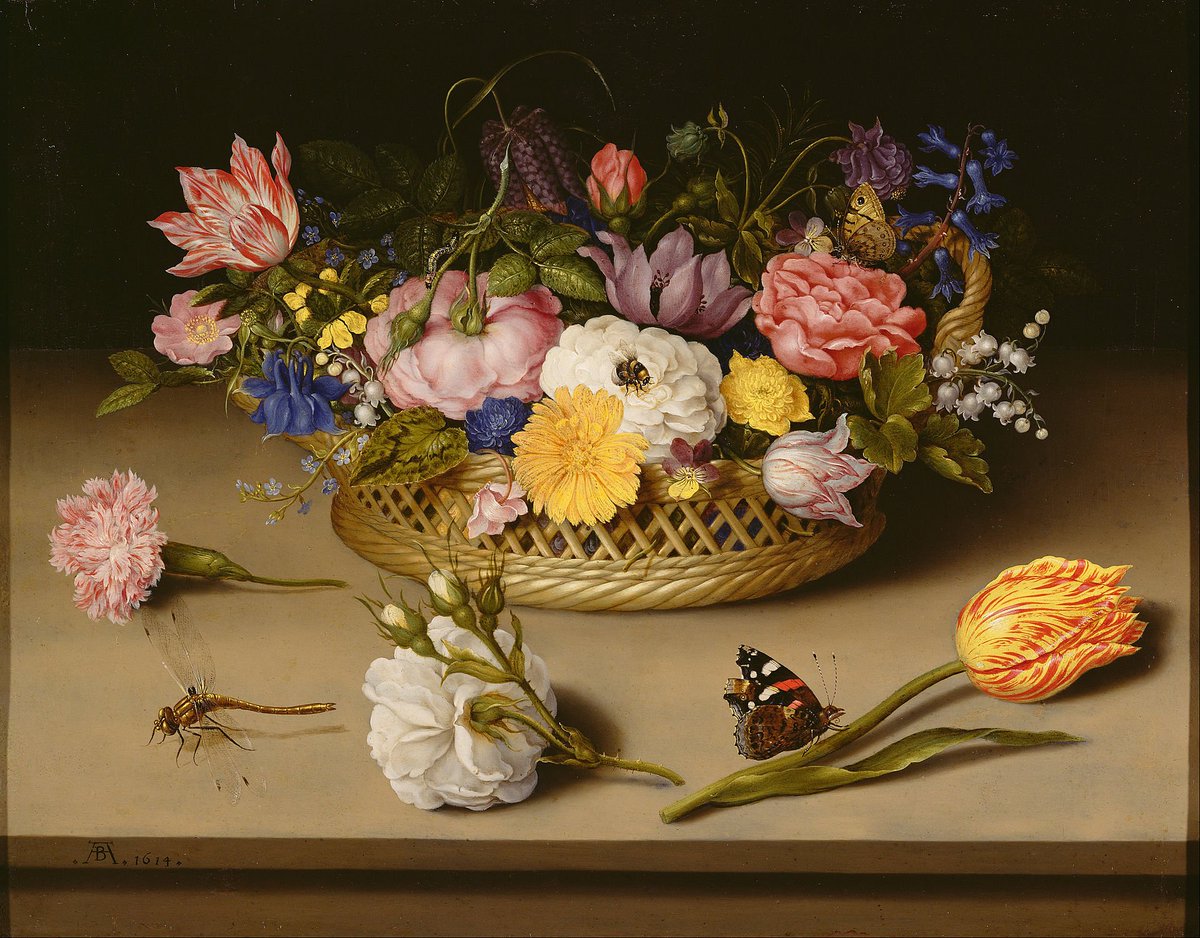
Speaking of marketing, I love the design of this album. The cover photo, by Michael Barker, is in the great tradition of the Dutch flower still life, like this one by Ambrosius Bosschaert at the Getty Museum, painted in 1614. The two flower pictures together are a good illustration of, and analogue for, Historically Informed Practice.
This album will be released on September 20, 2019
Saturday, September 8, 2018
Supremely characterized musical happenings
In their follow-up to 2014's well-received Vivaldi Premieres CD, Lina Tur Bonet and Musica Alchemica bring us another well-chosen, scrupulously researched and divinely performed program of theatrical music by the great Venetian ginger, Antonio Vivaldi. Once again we have the distinguished Vivaldi scholar Olivier Fourés leading the charge on the musicological front. He provides new musical editions of many of these works, and has dug up earlier and more authentic versions of works already in circulation. The bulk of this music receives premiere recordings here. But as important as this is to the scholarly world, none of it would mean much for us listening at home without someone with the same musical skill and charisma as the prete rosso himself, in these set-pieces of theatrical as well as musical magic. Lina Tur Bonet really delivers: the gorgeous, full sound of her Amati violin from c.1740 grips us in the concertos, and she dials things down a bit for the more intimate sonatas, with still lovely but more subdued sound from an anonymous 17th century violin. In every case she has sensitive, responsive support from the musicians of Musica Alchemica. Forget the canard about all of Vivaldi's huge corpus of music sounding alike; just feel lucky that we have musicians like these to provide us with these supremely characterized musical happenings.
Note that the "Graz" Sonatas included here (numbers 1, 2 & 5) are from the same 2013 recording as the two included on the Vivaldi Premiere disc (numbers 3 & 4). The concertos are from a 2018 recording, which incidentally sounds great.
This disc will be released on September 21, 2018.
Wednesday, September 6, 2017
Music of awakening sensibilities
Dresden: Chamber music by Califano, Fasch, Heinichen, Lotti, Quantz, Telemann, Vivaldi
Zefiro's very fine oboe and bassoon players come to the fore again in this album of chamber music from the Dresden court of Friedrich August I around 1720. Music in the Italian style at this stage in musical history meant virtuosity, yes, but more importantly expressiveness and sparkle. These are highly entertaining sonatas, trio sonatas and quartets, which occasionally attain something close to the profound, especially in works by Georg Philipp Telemann and Johann Friedrich Fasch. This music from these two fine composers stands out from any hint of background court music as routine elevator music. Don't think of the lounge pianist playing under sightly drunken conversations and waiters dropping trays, but rather Bill Evans' Trio playing Live At the Village Vanguard, with a mainly rapt, largely musically engaged audience. There's a sense of awakening sensibilities that moves toward the pre-Romantic Sturm und Drang movement later in the century. The stylish playing is a sign of Alfredo Bernardino's group's completely secure Historically Informed Performance tradition. Having singled out the playing of the winds, I should not forget to praise the excellent continuo players, who provide solid support with the occasional sparkling, and historically informed, insertion of their own.
This album is due to be released on October 20, 2017.
Thursday, April 6, 2017
A marathon of great music and great performance
The great cellist Mstislav Rostropovich was in his prime, about to turn 40, when he arrived in New York with the London Symphony Orchestra for eight concerts at Carnegie Hall between February 23 and March 12, 1967. The excitement surrounding this project is easy to hear; there's a real sense of occasion in this music, and though the applause for each piece is cut quite short, what's left is (rightly) very enthusiastic. For this six-CD set Doremi has chosen 22 concertos from the 30 performed. It seems a bit churlish to complain, with all the amazing riches included, about what isn't here. But what a shame to have the greatest of 20th century cello concertos, the Elgar, to lead off the set, without the greatest 19th century concerto, the Dvorak, to go with it. I also regret not having the Schumann concerto, and the two Haydn concertos. But let's accentuate the positive, beginning with the Elgar Cello Concerto. Comparing it with the classic performance by Jacqueline du Pre (with the same LSO), it seems much cooler at first than du Pre's more emotional attack, but Rostropovich soon turns on the afterburners, and provides just as satisfying an experience when the piece is over. Other highlights include Prokofiev's Concertino, a work that is much more substantial and interesting than the diminutive title would suggest, and the Britten Symphony for Cello and Orchestra, which was written for Rostropovich in 1964. I also much enjoyed the Hindemith Concerto, and the two American world premieres, by Foss and Piston. Ottorino Respighi's Adagio con variazioni is a really remarkable piece of music, which Rostropovich sinks his teeth into. It's marvellous to have it available in such a strong performance.
Unfortunately, my enjoyment in this music is not completely unalloyed. The baroque music, concertos by Vivaldi and Tartini, does not match the level of the rest of the program. I was perfectly willing to put aside my love for the historically informed style in vogue today, even indulging in a bit of guilty pleasure. But I got no pleasure from these lumpish, unformed performances. There was precious little charm here, and no real feeling that Rostropovich was engaged in this music. These are the exceptions, though, rather than the rule, and I can enthusiastically recommend this marathon of great music and great performance.
Sunday, August 21, 2016
Gems from Steven Staryk's Baroque archive
Centaur's Steven Staryk Retrospective series reaches its 8th volume (to be released September 9, 2016), and new gems from Staryk's own archives keep coming. Staryk's discography was never as broad or well-distributed as it should have been for a violinist of his calibre, but with this series and the previous Steven Staryk Anthology we're getting a clear picture of a giant in 20th century violin performance.
I spend most of my time in the Historically Informed Performance camp when it comes to Baroque music, but I have a soft spot for Steven Staryk and his perfect accompanist Kenneth Gilbert. Here, playing violin sonatas by Corelli, Tartini and Locatelli, the two are perfectly matched. Staryk's tone and intonation are superb, and Gilbert's continuo is so solid, but with plenty of variety and even the occasional surprise. In the finale to the Tartini sonata there is so much wit and such a strong swinging feeling that one thinks of jazz or the best improvisatory comedy: peak Martin and Lewis, perhaps. That oversells this, obviously, but the cool ease and waiting for the unexpected zinger are both here in Tartini's lovely music.
In the concertante Vivaldi selections Staryk soars. This is what Vivaldi violin playing sounded like at its best in the second half of the 20th century, and it's rarely been better since. The sound is serviceable at best, but, and as was the case with volume 7 in this series, the orchestral support is better than expected. I've never heard of the Montreal Baroque Players, but this pickup band of Montreal's best instrumentalists must have been thrilled to play with a soloist at this level, and they're bringing their best game.
Friday, August 5, 2016
A personal reading of Vivaldi's cello sonatas
A second set of 14 albums will be re-released this September in Alpha's Essential Baroque Masterpieces series, including Marco Ceccato's Vivaldi Cello Sonatas originally released in 2014 on Zig Zag Territoires. These are packages in handsome uniform designs with informative liner notes.
This album includes a selection of Vivaldi's great op. 14 set of sonatas for cello & continuo, played here by Accademia Ottoboni (featuring Anna Fontana, harpsichord, Francesco Romano, theorbo & guitar, Rebeca Ferri, cello, and Matteo Coticoni, double bass). This was very well reviewed at the time of its original release, but let's give it a close listen now.
According to Ceccato's new liner essay, he went back to the original manuscripts in some cases:
I preferred to base the music on the manuscripts which most accurately reflect Vivaldi’s conception. The edition published in Paris by Le Clerc is, in fact, not always faithful to the original. Apart from revising some of the bowings, in the second movement of the Sonata in F Major Le Clerc even omitted half a beat to ‘adjust’ Vivaldi’s asymmetry, making it more symmetrical and, in his opinion, easier to listen to.Here is that movement from op. 14 no. 2 (RV 41), played by Lucia Swarts from a 2007 Challenge Classics release:
And here is Ceccato's much spikier version (from the original release):
I often prefer the raw to the cooked when it comes to music, and definitely in this case. On the other hand, Ceccato isn't afraid to add some flourishes which sound less authentic. Listen to the swoops just after 2:00 in the lovely Sarabande of the 9th sonata. Over-indulgent? Maybe a bit, but I love it!
Overall, I'm impressed with Ceccato's very personal view of this music, and also with the varied and imaginative continuo provided by his colleagues. This disc is a standout in a crowded field of very good performances of great music.
Monday, May 2, 2016
Great, but no bizarre
This new album from the Irish Baroque Orchestra is a lovely package of Baroque concertos, all but one of which are from north of the Alps. The music of the time is so full of melodic invention, instrumental colour and sophisticated musical effects, with so many opportunities to appeal to both sense and sensibility. Still, with thousands of albums of concertos quite like this out there, I'm sure it's hard to find a marketing hook for another one, even one with such appealing music.
The keynote of the album, I realized after my first listen, is instrumental colour. There are concertos here for these solo and group of solo instruments:
- Flute and Oboe
- 2 Violins and Bassoon
- Oboe
- 2 Cellos
- 2 Oboes da caccia, 2 Violas, 2 Bassoons
- Bassoon
- Flute d'amore, Oboe d'amore and Viola d'amore
That's quite an interesting mix, and one that ensures you won't get bored with this programme. I was especially anxious to hear what the last piece, Graupner's Concerto for Flute d'amore, Oboe d'amore and Viola d'amore, would sound like. I'd call it lovely, if only so I could make a multi-lingual pun, as weak as it is. The three instruments all have a rich, earthy sound, which Graupner emphasizes by providing sensual, though hardly orgiastic, music.
But "Concerti Bizarri"? Though there are interesting instrumental combinations here, I'd stop well short of calling this music bizarre, especially after listening to some of the truly odd music by Heinrich Biber on the last album I reviewed, Ars Antiqua Austria's Accordato. This is music well on the Enlightenment Civilization side of the spectrum. The only thing bizarre about this album is the fabulous gargoyle on the album cover.
None of this really matters, though, does it? This is amazing music, by some of my favourite composers. I loved the Fasch, and the Vivaldi, and the Telemann; what fine composers they are! I'm a big fan of Monica Huggett's approach to this repertoire, and the Irish Baroque Orchestra can deliver a slight edge without losing any freshness and melodic appeal. The IBO soloists and players are all superb, providing the best possible advocacy for this unfamiliar music. Just sit back, admire that handsome lug of a gargoyle, and listen to the music.
Thursday, March 3, 2016
Dynamism and variety
The new ATMA disc of Vivaldi concertos, to be released on Amazon on March 11, 2016, reminds us what an amazing composer Vivaldi was. I've been exploring the composer's operas and sacred music lately, and it was nice to get back to this well-chosen disc of orchestral music, with all of its dynamism and variety. There's often something dumb about a clever aphorism, and there's no dumber aphorism than Stravinsky's line (or was it Dallapiccola's?), that Vivaldi didn't write 500 concertos, but one concerto 500 times. "Very interesting," you say, like Arte Johnson in Laugh-In, "but stupid."
Some of the concertos chosen by associate conductor Mathieu Lussier are very familiar, and listening to the two concertos from the great series L'Estro Armonico, op. 3 you can see why these have been "greatest hit" material since Vivaldi's time. Indeed, I've known and loved these pieces since I first heard them on an Archiv LP in the late 60s. Mixing in more obscure pieces like the Sinfonia from the opera La Verità in Cimento brings in the opera-house excitement and anticipation of a great overture. And there are plenty of opportunities for excellent solos: oboes, bassoon, trumpets, horns and violins all have their chance to shine.
This is Mathieu Lussier's second disc in charge during the convalescence of founding conductor Bernard Labadie following his extended cancer treatment. I know Lussier best as a bassoonist and composer, and he brings soloist and compositional skills to bear in these controlled but exciting, inventive readings with the excellent Quebec musicians. I look forward to more discs from this group under Lussier and Labadie, and trust that the repertoire will be as well-chosen. And, of course, we're all pulling for a complete recovery for Maestro Labadie.
This is fun: video from the recording session:
Here's my old LP, which was released in 1967. Archiv LPs were expensive! I treasured this disc.
Monday, December 7, 2015
Highly recommended Vivaldi
Once you get to volume 4 of any comprehensive recording project you hope that the quality of the music can remain fairly high, and that the musicians aren’t just there to check off a number of pieces on their way to completion. No worries on the composition side: Vivaldi was exceptionally prolific, it’s true, but his music, to my ears at least, is always interesting and often inspired. The inspiration shows up even at this stage in the project, though many of the pieces were written for particular situations, and I would imagine often on short notice. Like Bach, Vivaldi was a practical musician whose genius shone through Monday to Sunday. Though this music slips into operatic tropes often, underlying the music is a strong sense of devotion. Vivaldi was an ordained priest and a highly religious person. As for the musicians, Kevin Mallon and his Aradia Ensemble are prolific themselves, having recorded 50 albums for Naxos. But I find this CD as fresh and energetic and musically accomplished as the best ones in their discography. Speaking of which, I highly recommend Mallon’s Samuel Arnold and Marc-Antoine Charpentier discs from Naxos. But back to this Vivaldi disc: the Aradia Ensemble is first rate as always, and the Aradia Chorus is excellent in the Laudate Dominum and In Exitu Israel. The two soloists, Claire De Sevigne and Maria Soulis, demonstrate virtuoso technique and a strong sense of drama, but also show taste and musicianship. This disc and the previous three are highly recommended.
Monday, November 2, 2015
A glorious mess!
From September 15, 2015:
There’s more real acting and theatrical magic in this ‘semi-staged’ version of Vivaldi’s great work than in many a traditional opera with realistic trees and togas. Conductor Federico Maria Sardelli conducts, with considerable star power, a fairly large group of fine instrumentalists (most playing period instruments) and a cadre of excellent singers who excel in the alternately dramatic and pathetic virtuoso arias of Vivaldi. As a bonus, the singers occasionally get together to sing - very creditably - as a chorus.
Certainly there’s also fashionable deconstruction and semiotics involved, but it’s all part of the fun. The costuming is clever, with breastplates worn under suits (perhaps the new trend in Florence this year?), and various armour bits signifying gender. The beauty of the music comes together with the bombast, pity and high stakes politics of three ages: the ancient world, 18th century Italy, and 21st century Europe. A glorious mess that I couldn’t recommend more highly.
Here is the trailer for the project. The YouTube comments are hilarious; world-class nitpicking combined with patient responses from the production side. What fun!
There’s more real acting and theatrical magic in this ‘semi-staged’ version of Vivaldi’s great work than in many a traditional opera with realistic trees and togas. Conductor Federico Maria Sardelli conducts, with considerable star power, a fairly large group of fine instrumentalists (most playing period instruments) and a cadre of excellent singers who excel in the alternately dramatic and pathetic virtuoso arias of Vivaldi. As a bonus, the singers occasionally get together to sing - very creditably - as a chorus.
Certainly there’s also fashionable deconstruction and semiotics involved, but it’s all part of the fun. The costuming is clever, with breastplates worn under suits (perhaps the new trend in Florence this year?), and various armour bits signifying gender. The beauty of the music comes together with the bombast, pity and high stakes politics of three ages: the ancient world, 18th century Italy, and 21st century Europe. A glorious mess that I couldn’t recommend more highly.
Here is the trailer for the project. The YouTube comments are hilarious; world-class nitpicking combined with patient responses from the production side. What fun!
Subscribe to:
Posts (Atom)