Reviews and occasional notes on classical music

Reviews and occasional notes on classical music

"Music, both vocall and instrumental, so good, so delectable, so rare, so admirable, so super excellent, that it did even ravish and stupifie all those strangers that never heard the like." - Thomas Coryat, after hearing 3 hours of music at the Scuola di San Rocco in Venice, 1608.

Showing posts with label London Philharmonic Orchestra. Show all posts

Tuesday, December 27, 2022

Vaughan Williams the Conductor


My favourite Vaughan Williams Symphony is no. 5, so I was pleased to see this new historic release from Somm Recordings with two complete versions conducted by the composer: the world premiere performance on June 24, 1943, and a Proms performance on September 3, 1952. What a great way to end the VW150 year!

The 1943 performance, recorded off-air from the BBC radio broadcast, sounds surprisingly good. Somm's audio restoration and remastering is always great; we have Lani Spahr to thank for finding fine music-making within low-fidelity source material. As to the performance itself, it's perhaps a bit hesitant, which is to be expected considering the uncertainties of the period. Still, Vaughan Williams' uplifting music must have been a great consolation for those listening in the performance hall and on the air; perhaps better times were indeed on their way. More problematic are the periodic missing bits that come about due to swapping out of acetate recording discs. But the historic nature of this performance trumps this technical issue; Nick Barnard, in a fine review, comes up with a good way to describe these lacunae:

"The best analogy I can come up with is when viewing an ancient fresco or mosaic which has been damaged over the centuries; you can see where parts of the original artwork are missing but the sense of the total magnificence of the original remains."

I have no reservations at all concerning the performance of Symphony 5 at the 1952 Proms. This is indeed one of the great Vaughan Williams recordings. That's partly due to better technology; this was recorded direct to long-playing acetate discs, so there are no side-breaks to cut up the music.

There are two other recordings here: a scintillating Dona Nobis Pacem from 1936; and a fine 2nd Symphony, from 1946. Again, there's an important bonus for authenticity and historic importance, but both performances are wonderful in their own right.

This is another fine release from Somm, with detailed liner notes that illuminate both the music and the recording and restoration processes. Perhaps most importantly, there's the great cover photo, by Dudley Styles from 1948, of the composer with his cat Foxy.

Here's the 1952 performance of the 5th Symphony:
 

Wednesday, February 7, 2018

Aldo and Yannick double down


Mozart Piano Concerto K. 466; Rachmaninov Piano Concerto no. 2

These two recordings were made during Yannick Nezet-Seguin's tenure as the LPO's Principal Guest Conductor, before Aldo Ciccolini's death in 2015. The Rachmaninov is from 2009, while the Mozart dates from 2011. These are fascinating performances, with one master at the end of a glittering career and the other at the beginning of his. The Rachmaninov is bright and brash and lush, but also tender and lyrical. I don't think a Romantic concerto could be more beautifully played by an orchestra than what we hear from the LPO musicians. They have the measure of this music, and the producers and engineers have come through with marvellous sound from the live recording in Royal Festival Hall. Romantic Rachmaninov is almost a redundant phrase, but Romantic Mozart approaches the oxymoronic in these Historically Informed Performance days. From its portentiously measured beginning to Ciccolini's incautious rubato to Nezet-Seguin's great swells from the strings, this is Mozart according to the Old Rites of the early days of recording. To be sure, the D minor concerto of 1785 points the way to Don Giovanni and the Requiem, and also to Beethoven, whose favourite Mozart concerto it was. My measured response? This Mozart is old fashioned and anachronistic, but within its own sound world, gorgeously played. It's inappropriately beautiful.

This disc will be released on March 2, 2018.

Friday, August 4, 2017

Bingeing Tchaikovsky


Tchaikovsky: Symphonies 1-6, Manfred Symphony, Francesca da Rimini, Serenade for Strings

I can't remember all the times I've been warned by a reviewer not to listen to an album all the way through in one sitting, but I'm going to go ahead and do the opposite. I've enjoyed this seven-disc set of Tchaikovsky orchestral music immensely in the last couple of weeks, and I found that listening straight through from the First Symphony to the Serenade for Strings gave me a new appreciation of Tchaikovsky's art, which hasn't always resonated with me in the past. It's a tribute to the composer's invention and to Vladimir Jurowski and his fine musicians that the music always seems fresh and dynamic. There are certainly Tchaikovsky markers throughout: phrases and felicitous orchestrations that could come from no one else, but the composer and conductor always make sure they sound uniquely positioned. This is a well-filled compilation: the six numbered Symphonies fit onto the first five discs, with a generous bonuses including two substantial works, the Manfred Symphony and Francesca da Rimini, and a light piece for afters, the Serenade for Strings. Everything seems perfectly judged in this release from the LPO's own label, and I don't apologize for my bingeing. All the music sounds great, though the live recordings of some of the works go back to 2004. Symphonies 2 and 3 as well as Francesca da Rimini and the Serenade are new recordings from 2016.

An afterword: I've been struck in the past couple of days, with Tchaikovsky still ringing in my brain, by how influential his orchestral music has been. Villa-Lobos's acknowledged influences are Bach and Stravinsky, but I hear so many Tchaikovskian bits in his Symphonies and Bachianas Brasileiras. Listening to Benjamin Britten last night I noticed the same thing. I expect I'll be hearing these echoes for a while.

Thursday, February 16, 2017

Nézet-Séguin's dramatic Dvorak from London


On his way to one of the great peaks of music, the Music Directorship of the Metropolitan Opera, which begins in the 2020-21 season, the Montreal-born conductor Yannick Nézet-Séguin made a number of stops. Besides his three current main jobs, with the Orchestre Métropolitain in Montreal, the Philadelphia Orchestra and the Rotterdam Philharmonic Orchestra, Nézet-Séguin was Principal Guest Conductor of the Victoria Symphony beginning in 2003, here on Vancouver Island where I live. We're proud of that connection, and pleased to see his continued success. But probably more important in his continued upward rise was his tenure from 2007 to 2014 as Principal Guest Conductor with the London Philharmonic Orchestra. Nézet-Séguin's rapport with the LPO musicians is clear from this new two-disc set of live recordings on LPO's own label. It includes an outstanding performance from May 2009 of Dvorak's 7th Symphony. Nézet-Séguin lets loose the full range of orchestra, which is considerable, and makes the best possible case for considering this one of the greatest symphonies of the 19th century. The brass is especially impressive, along with a solid, silky string sound providing such a delightful variety of musical textures. You can hear in this music, perhaps, an echo of Nézet-Séguin's mentor, Carlo Maria Giulini. The 6th Symphony and the Othello Overture are both more recent recordings, made in September 2016 as part of Google Play's Classical Live project. Like Giulini, Nézet-Séguin's experience in the opera pit bears fruit in his orchestral recordings. Not every conductor can effectively release the drama that Dvorak builds in to his symphonic works, most especially in the 7th Symphony, but also in lesser but still impressive works like the 6th and the Overture. We're lucky to have such an accomplished conductor recording so often in both the operatic and orchestral realms. And kudos should go as well to the LPO for their openness to new marketing and technology partnerships to help promote such high quality music.

This disc will be released on March 3, 2017.

Friday, October 14, 2016

A modern masterpiece brought to post-modern life


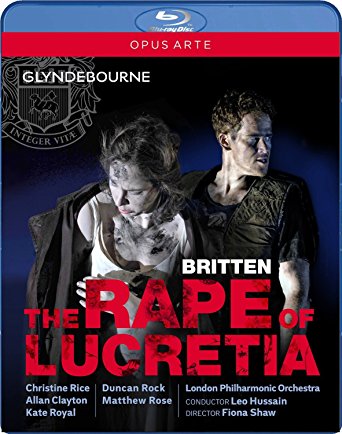
This new Opus Arte Blu-ray disc of last year's Glyndbourne production of Britten's The Rape of Lucretia is a very welcome record of the highly praised opera directed by Fiona Shaw. Shaw's concept adds new layers to the cleverly designed original concept of Britten and his librettist Ronald Duncan. There's an intended pun there, since the Male and Female Choruses act as if they were post-war British archaeologists uncovering the tragic story of Lucretia and her rape by Tarquinius, prince of Rome. We dig into the story through layers of dirt, and the set and lighting and costume design all focus our attention on Britten's perennial theme, the corruption of innocence. 

I watched this with the equally sordid American election swirling in the background, which seemed pertinent in a way, but unfortunate in others. There's lots in the story as told by Shaw that's vile, but it also has dignity and gravitas, and the violence of the central act is never gratuitous. That's helped immensely by the amazing acting and singing of the cast, and especially Christine Rice as Lucretia and Duncan Rock as Tarquinius. Musically as well we have the best possible players - thirteen musicians from the London Philharmonic Orchestra and their leader, Leo Hussain - who, as Fiona Shaw herself says, "have [the work] in their fingers, in their bodies." The HD sound and picture are outstanding; much more impressive than a video clip can put across. This is a modern masterpiece brought to post-modern life.


Thursday, August 18, 2016

More British Symphonies from the Lyrita catalogue

http://amzn.to/2dvHeMS

I came across a quote from Blaise Pascal today: "I would have written a shorter letter, but I did not have the time." I've found myself writing some longish posts here lately, and while I know that tightening things up always makes things better, I have trouble cutting really boffo stuff. I did take out some apposite thoughts about Gilligan's Island in a recent review. That's me: always trying harder to give you better prose. Having said that, my recent review of Lyrita's British Symphonies compilation only covered about half of the composers in that four-disc set. I promised to return with some impressions of the rest, and here I am.

I see that most of the symphonies I didn't mention in my last review come from the London Philharmonic Orchestra. This, of course, is one of the great strengths of Lyrita; they have access to some of the finest orchestras in the UK. Just in this set we have the LPO, the LSO, the Philharmonia Orchestra and the BBC Wales SO. There are three symphonies I'd like to single out this time around. One of the most impressive works, and a fitting end for the whole set, is John Joubert's First Symphony from 1955, which the composer himself said "... represents my coming-of-age as a composer." This passionate and well-constructed work has plenty of both light and shade, and it deserves to be heard more often.

Joubert, by the way, is the only composer from this set who is still living. Here is the original 2007 Lyrita release of Joubert's Symphony no. 1, played by the London Philharmonic Orchestra under Vernon Handley:


Humphrey Searle was a pupil of Anton Webern, and he began using the 12 tone method of composition in the 1940s. So you'd expect an insistent dissonance in an international, continental style from his Second Symphony, written from 1956-58. However, it has an open, honest, thoroughly British sound that veers on Romanticism at times. We're still, however, miles away from the classic English pastoral tradition that butts itself into the foreground whenever British symphonic music comes up. This is another crack performance by the LPO, this time led by Josef Krips. William Wordsworth's 3rd Symphony is similarly substantial, without sentimentality, and full of energy and significant wit. The honours this time go to Nicolas Braithwaite, who conducts the LPO.

Thanks again to Lyrita for repackaging their amazing catalogue of British and Commonwealth music. Every release gives us a chance to discover or re-discover composers as accomplished as Searle, Wordsworth and Joubert.

Tuesday, August 9, 2016

Earnest, and sometimes original, symphonic music from Britain


This four-disc set from Lyrita, due to be released on September 9, 2016, is a useful compilation of British symphonic music that matches the format of two previous collections: British Piano Concertos and British String Concertos, both of which received excellent reviews. The Lyrita catalogue is so strong in this repertoire that this re-packaging of a mixture of outstanding works and lesser-known gems is more than likely to be a success.

Not all of the works included here are out-and-out masterpieces. As God is my witness, the first thing I thought of when I was listening to William Stearndale Bennett's Symphony in G minor and saw it had been completed in 1867, was the Reform Act of that year. It's a solid, even stolid, symphony on the Mendelssohn model, which is a bit off considering Felix had been dead for 20 years. Like the Reform Act, which doubled suffrage from a million property-owning men but had no immediate effect on the politics of the day, Bennett's music tinkered around the edges of the established, in this case German, model, and British music had to wait until Elgar's First Symphony in 1908 to begin to make its own noise in the world. There's nothing wrong with this music, certainly, and I don't begrudge the 23 minutes of my life I spent listening to it. Sure, I could have squeezed an episode of BoJack Horseman in that time, but I'm trying to ration my BJ bingeing. Great show.

One work that definitely is a masterpiece is Edmund Rubbra's 4th Symphony, written during the 2nd World War. It's clear from the amazing mysterious and momentous opening that this is a serious and important work, and Rubbra fulfills all of our expectations by the end of the symphony. It's on the same level, I believe, as Elgar and the best of Vaughan Williams.  This version is played by the Philharmonia Orchestra conducted by Norman Del Mar, and was recorded in 1990. It's a toss-up between this and the Chandos recording with Richard Hickox and the BBC National Orchestra of Wales, which is my personal favourite by a whisker only.  I should pause at this point and acknowledge the superb work done by Michael Herman at Music-Web International in his discography of British and Commonwealth Symphonies from the 19th Century to the Present. It helped my research for this review immensely.


Another major work on the album is Alan Rawsthorne's Symphonic Studies, in which the young composer confronts the daunting challenge of Elgar's Enigma Variations, 30 years later. It begins with this impressive theme:


This is the best available version of this music, by the London Philharmonic Orchestra conducted by John Pritchard.

Dipping into this collection at random to try to get a feel for it, I'm afraid I sometimes found things more the same than I would have hoped. Not every voice here is completely original, though of course that's not the only thing one looks for in symphonic music. Certainly there's some very earnest music, and perhaps not enough wit or grace. Lennox Berkeley's 3rd Symphony, in a single movement, is a welcome exception:


Grace Williams' Symphony no. 2 is quite a pugnacious work, often martial in nature. As was the case in other works here, it was oddly reassuring to sometimes hear the familiar strains of the honourable English light music tradition which I've come to appreciate more lately. I'm planning on exploring more of this Welsh composer's music, from the discouragingly small amount that's made it on to disc.

What else? I think I'll leave these MP3s up in my iTunes and re-listen to some of the others over the next few weeks, and report back here. This is a lot of unfamiliar music to get into all at once. And BoJack beckons!

Saturday, October 31, 2015

Another excellent Daphnis from Haitink

May 1, 2012:


Bernard Haitink recorded this score more than a few times, with orchestras in America and Europe. Besides this live London recording from 1979 (from the BBC archives), I was very impressed with another more recent live recording, with the Chicago Symphony on CSO Resound in 2007. This newly-remastered CD from the London Philharmonic Orchestra's own label is welcome. The concert recorded at Festival Hall shows the orchestra and the John Alldis Choir in fine form, and the engineers have captured both the music itself and the excitement of a special live performance. This version is a bit more expansive than the tighter Chicago version, and the sonics don't quite compare. But in this instance Haitink and his musicians make a strong case for slowing this gorgeous music down just a bit.

I agree with Amazon reviewer Daniel Coombs that the Montreal Symphony version of Daphnis Et Chloe with Charles Dutoit is very special. It's both my favourite version of this great music, and one of the outstanding CDs I own. But Ravel's masterpiece has many facets, and Bernard Haitink is an outstanding guide, whether the journey starts in London or in Chicago.

Jaunty, accessible, sombre, spiritual Honegger

From December 13, 2011:


This new disc fom the LPO illustrates Honegger's journey from his modernist period as a member of Les Six in 1920s Paris to his less ironic and more expressive maturity in the 1940s and 50s. The earliest work on the disc, the 1920 Pastorale d'Ete, is a sometimes jaunty and jazzy trip into the countryside. It has a pastoral feel, but it's often slightly off-centre. This is a fascinating, and for me immensely appealing, seven minutes of music.

Honegger, like Villa-Lobos who took a similar journey during the same years, was swimming upstream in the post-WWII period. His 4th Symphony was designed to be just the opposite of the fashionable music of the day: accessible and expressive. In 1946 Honegger wanted to give his audience, and perhaps himself, some relief from the austerities of the post-war world. This music might have seemed old-fashioned and even banal at the time, but I appreciate its directness and simplicity.

Honegger's final composition is the 1953 Christmas Cantata, which was written during his final illness. The first movement is very dark - sombre seems too light a word for the oppressive mood Honegger creates. But of course darkness is part of many Christmas stories, from the Massacre of the Innocents to the depressing first draft of Have Yourself a Merry Little Christmas. When Honegger lets the light in, the effect is magical. This is deeply spiritual music, well-crafted and very moving.

So much credit for this excellent disc goes to the conductor Vladimir Jurowski. As he explains at the LPO website, he believes that Honegger deserves a much higher reputation than his present quite modest ranking. Jurowski seems to have communicated this passion to the musicians who performed at the Royal Festival and Queen Elizabeth Hall concerts recorded for this CD. And he's convinced me!

Heeere's Klaus!

From July 4, 2011:


This is a live recording from Royal Festival Hall made in 1991. You'll see from the other reviews here that while Tennstedt is universally admired as a Mahler interpreter, there is some controversy about whether his live recordings are more successful than those done in the studio. I come down more on the studio side myself. I acknowledge, though, that there can be some thrilling moments in a live Tennstedt recording, as there were in the 6th Symphony recorded with the LPO the same year as this one; and as there are occasionally in this disc, newly released on LPO's own label. Tennstedt often "milks" a phrase for maximum effect, while losing sight of the longer arcs of the Symphony. His highly emotional approach seems cranked up in these live recordings, while the studio recordings often have more discipline, though they still have real passion.

The sound on these CDs is better than you might imagine from a television recording of this vintage. The soloists mainly acquit themselves well, and the choral singing from the LPO Choir, Eton College Boys' Choir and the London Symphony Chorus is excellent.

If you like your Mahler with a touch of Jack Nicholson in the Shining, this might be your cup of tea.