Reviews and occasional notes on classical music "Music, both vocall and instrumental, so good, so delectable, so rare, so admirable, so super excellent, that it did even ravish and stupifie all those strangers that never heard the like." - Thomas Coryat, after hearing 3 hours of music at the Scuola di San Rocco in Venice, 1608.
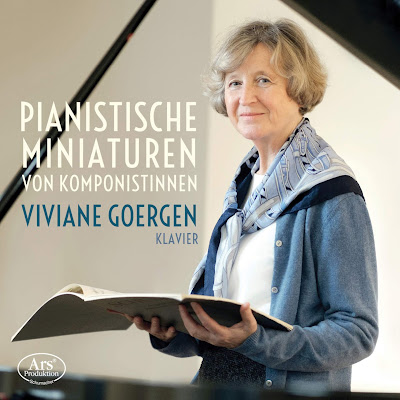
Of the nine composers on this well-filled disc of piano miniatures played by Viviane Goergen, I had only heard (and even heard of!) two: Alicia Terzian and Germaine Tailleferre. I was encouraged by Viviane Goergen's performance of Tailleferre's marvellous Sicilienne, an outstanding piece that transcends its salon-piece genre, redolent of the South of France and beyond to the cities and back country of Brazil (as communicated to the composer, I'm sure, by her colleague in Les Six: Darius Milhaud). Goergen plays up both the languid atmosphere and the more jazzy drama, and captures both to perfection. In music of this scale you only get one chance, as they say, to make a good impression.
Alicia Terzian is an accomplished composer, though I know her as a conductor as well. In 2018 she released a fabulous album of 20th and 21st Century music with the group Grupo Encuentros; my review was very positive. On this disc, Goergen plays her Danza Criolla, an outstanding op. 1 (I love to collect opus ones!), a fine work reminiscent of her compatriots Ginastera and Piazzolla, as well as another great piano miniaturist, Heitor Villa-Lobos.
What of all the rest, all these World Premiere recordings? Viviane Goergen has put together a very strong groups of miniatures here, all of them "character" pieces in the Schumann style. Within a variety of moods and rhythms many of the works have a strong character. Standouts include Marguerite Roesgen-Champion's two charming Bucoliques; Mel Bonis's impressive La Cathédral blessée; and the two Danses of Vera Winogradowa. I've been riding the wave of new interest in women composers, & this new disc certainly has added to the thrills.
40 Years of Contemporary Music: Chamber works by Villa-Lobos, Ginastera, Webern, Terzian, Berio, Boulez, Schreker Alicia Terzian begins a fascinating program of contemporary chamber music with one of the great works of Brazilian modernism, the Seventh Choros of Heitor Villa-Lobos, written in 1924. The 37-year-old composer spent most of that year in Paris, rubbing shoulders with Ravel, Cocteau, Stravinsky, Prokofiev and others, though he also brought with him his own strongly modernist works he'd written in Brazil. 1924 was a banner year for modernism on both sides of the Atlantic, by the way, with the publication of both Oswald de Andrade's Manifesto da Poesia Pau-Brasil and André Breton's Manifeste du surréalisme (though as Desmond Morris notes in his recent Lives of the Surrealists, the tone-deaf Breton wasn't interested in adding musicians to his group). It's refreshing to see Villa-Lobos in this modernist company, rather than the parrots-and-jungle exoticism that usually surrounds him. This is a marvellous version of this work, as well. It's subtitled "Settimino" (which means "Septet"), and it's written for flute, oboe, cello, clarinet, alto saxophone, bassoon, tam-tam and violin. I counted twice, and both times I got 8 instead of 7. I figure the tam-tam isn't counted, like when Ringo plays the tambourine. They're still the Fab Four.
Alberto Ginastera's Pampeana no. 2 for cello & piano comes from 1950, and thus is written in what he called his Subjective Nationalism style, a transition between with folkloric Objective Nationalism of his early years and the avant-garde Neo-Expressionism he worked in after 1958. This is an appealing piece, with Latin rhythms becoming insistently astringent and abstract. It's a fine bridge between the Latin American works and those of the Europeans later in the program.
The 8 Early Songs, a work without opus number by Anton Webern, is the earliest on this program. It's from 1901-04, and shows the strong influence of Wagner, Mahler, Richard Strauss and Hugo Wolf. Soprano Marta Blanco and pianist Claudio Espector are effective advocates for these marvellous, slightly naive but always characterful songs. I hadn't heard this music before, and I'm so grateful that it was included on this disc.
Marta Blanco is also featured in the version for voice and five instruments of Luciano Berio's O King, written in response to Martin Luther King Jr.'s assassination in 1968. I recently reviewed a fine recording from Seattle of O King in its extended version for eight voices and orchestra, and it's fascinating to hear a kind of essential distillation of this landmark work, which is all kinds of bleak, but ultimately somewhat hopeful.
Dérive by Pierre Boulez is the same kind of puzzle music that Bach and Mozart delighted in. He shifts and shuffles around a six-note chord among six instruments, and by changing the intervals derives new chords (hence the name). After five derivations, the original chord returns, and then fades into silence. At the highest level of sophistication one can hear and follow along these changes; if not one can puzzle them out while following along with the score. The rest of us might be content with the general idea that there are basic transformations happening, while enjoying the ornate decorations
Alicia Terzian contributes two works to the program. Yagua Ya Yuca for percussion is five minutes of ingenious sounds, alternately wistful and intense. Les Yeux Fertiles for voice and five instruments, is a setting of fragments of poems by Paul Eluard, serious mood pieces all.
Franz Schreker's Der Wind was written in 1909 as a ballet, though it was never performed in his lifetime. It's an occasionally jolly but ultimately sadly nostalgic piece, untroubled by the more experimental modernism of his contemporary Arnold Schoenberg. This work is a fine ending to a fascinating concert of twentieth century masterworks.