Reviews and occasional notes on classical music
"Music, both vocall and instrumental, so good, so delectable, so rare, so admirable, so super excellent, that it did even ravish and stupifie all those strangers that never heard the like." - Thomas Coryat, after hearing 3 hours of music at the Scuola di San Rocco in Venice, 1608.
Showing posts with label CPO. Show all posts
Sunday, August 25, 2019
The grand gestures of Telemann
Georg Philipp Telemann: The Grand Concertos for Mixed Instruments
I don't think there's a composer who has moved up more in my estimation in the past decade than Georg Philipp Telemann. The great CPO series from Michael Schneider and La Stagione Frankfurt has been a major factor in this process. Like Bach, Telemann is a great synthesizer of pan-European styles; besides the French and the Italians, Swedes, Germans and Danes, amongst others, show up in his various orchestral, chamber music and concerted works. He's also a master of the grand gesture, very much like his close friend Handel. The "grand concertos" in this collection are superb examples of a master completely secure in his abilities, extending his brand through a complete re-shuffling of instrumentation.
Telemann was only able to present the concertos that sprang from his apparently unlimited imagination because he had access to superb instrumentalists. And that goes for the musicians of La Stagione Frankfurt, in spades. This music seems effortless - it sort of floats through the speakers - but on listening closely, you realize how difficult are the virtuoso lines and the questions of tempo, balance and intonation. Michael Schneider has perfectly judged the style of this music, allowing the music to shine. This is completely secular music, but these performances bring out an almost religious, or at least spiritual, feeling.
This album will be released on September 6, 2019
Thursday, August 1, 2019
Original premieres played with style and musicality
Gossec: Symphonies op. IV
François-Joseph Gossec's six Symphonies from his op. IV collection were published in 1758. While one might be reminded of Haydn at times, there was certainly no chance that the Belgian composer had heard Haydn's earliest forays into symphonic music. This is highly original, if not profound, music, full of charm and wit. I especially like the 5th Symphony in E major, subtitled "Pastorella." This looks back to the French pastourelle of the troubadours, with its shepherdesses and nostalgia for a simpler time. Simon Gaudenz and the Deutsche Kammerakademie Neuss capture all of this complexity within its relatively simple forms with admirable style and musicality. These are world premiere recordings, which are well worth a listen, or two.
![]() |
| Jean-Antoine Watteau, Fête champêtre (Pastoral Gathering) - Art Institute of Chicago |
Gossec wrote many works very much similar to this in the 1760s and 70s, often in groups of six symphonies like opus IV, until Haydn's huge popularity in Paris in the 80s made him look to other musical genres. Gossec wrote more than 50 symphonies in all, but there's only one I've heard that's a true masterpiece. It came after the composer reinvented himself as a revolutionary artist in 1789, and his exposure to the revolutionary art of Beethoven early in the next century. His Symphonie à 17 parties, from 1809, takes the formulae that makes the music on this album so appealing, and ramps the music up close to even the best of its Viennese models. As modest as his earlier symphonies are, one must admire them for their originality and for the way they point to Gossec's later genius, in his sacred and operatic music, as well as that final Symphonie.
Wednesday, December 5, 2018
A Christmas gift, for next year
Telemann: Christmas Oratorios
This disc came just in time for Christmas; for me, that is. Unfortunately for you, though, it has a release date of January 4, 2019. So you'll need to remember this review for next Christmas, and definitely buy or stream this marvellous music next year. In the three oratorios on the disc Telemann has added operatic flourishes to his cantata style, and turned up the footlights to express himself dramatically. This is really impressive music even today; I can hardly imagine its effect in the Hamburg Cathedral on successive Sundays during the Advent season. The cantata Und das Wort ward Fleisch is also richly ornamented, and includes a lovely interlude: the ancient song In dulci jubilo.
This music is newly discovered, and recorded for the first time, which I find astounding. Is it possible that there's even more spectacular music like this still waiting for first performances and recordings? Alexander Willens has done a spectacular job in presenting Telemann's music, and works by many other Baroque composers, with his amazing Kolner Akademie and superb soloists. Once again CPO provides excellent recordings and complete documentation for music of the very highest quality. This is a Christmas gift that's so good it will still be outstanding next year!
Sunday, September 16, 2018
The shape-shifting composer
Lars-Erik Larsson: Symphony no. 3, Three Orchestral Pieces, Adagio, Musica permutatio
That Lars-Erik Larsson withdrew all three of his symphonies after they were first performed shows a certain lack of confidence in his own abilities as a symphonist. On the evidence of three successive CPO recordings with Andrew Manze conducting the Helsingborg Symphony Orchestra this seems more a sign of imposter syndrome than any compositional weaknesses, though to be fair Larsson was working in the shadow of a daunting range of Nordic symphonies, from Stenhammar, Nielsen and Sibelius to contemporaries such as Holmboe and Pettersson, and in between, Atterberg. Larsson is best known for his rhapsodic, pastoral orchestral pieces and suites, but the Third Symphony, premiered in 1946, is especially full of the same appealing melodies and dynamic pacing one finds in his better known works, though not developed quite as freely. We have in this symphony, perhaps, just a bit of what some athletes call 'the yips', a tightening-up with a resultant loss of fluency.
In his Gramophone review of the first disc in this series, Guy Rickards calls Larsson "a musical magpie", and that continues here. Right from the beginning he makes reference to the insistent rhythms of the Scherzo to Schubert's 9th Symphony. Christoph Schlüren, in his detailed and informative liner essay, mentions both Beethoven's 5th Symphony and Borodin's 2nd in the same context. By the way, the impressive waltz-like second theme of the 1st movement was "borrowed" by George Duning for the jaunty main theme for his Bell, Book and Candle film score from 1958, though he adds bongos. I expect this is just a coincidence, since it's very unlikely this music had made it to Hollywood then. It's a fun game to track down these quotes, in both directions, and I don't believe his homages diminish Larsson's music especially. In the end the performance of Manze and his players won me over.
Rickards also mentions that Larsson "flitted between styles throughout his life," and we have two surprising pieces here - the 3 Orchestral Pieces, op. 49, and the Adagio, op. 48, that show his experiments with what Schlüren terms a "free twelve-tone style." These manage to compress the usual Larsson material into a much tighter construction and a darker than usual mood, but still with more than a bit of the Larsson charm. I found the Adagio especially appealing, though it's striking how optimistic Larsson sounds here, in what one might consider Allan Pettersson territory.
There's a further stylistic shift with the final work on the disc, the Musica permutatio, which was also the final work of Larsson's life. Freer harmonically, it's very much a learned work, with impressive contrapuntal passages. It was premiered in 1982, four years before Larsson's death.
This disc will be released on October 5, 2018.
Thursday, June 14, 2018
To be precise
"Charles is very keen on painting," said Sebastian.I thought of this great exchange between Charles Ryder and Lord Marchmain from Brideshead Revisited when I began to listen to these wonderful viola concertos from a member (but which?) of the wonderful 18th century Benda family of composers. Those of us who are just beginning to untangle the family tree full of Heinrichs and Franzes (aka Frantiseks) and Georgs aren't the only ones in difficulty. A Viola Concerto in F major attributed to Jiří Antonín (aka Georg) Benda has been recorded a number of times (including a Naxos CD from 1994 conducted by Christian Benda, a modern member of the famous family), but it shows up here attributed to Georg's nephew Friedrich Wilhelm Heinrich, along with two additional concertos in E flat major. Violist Jean-Eric Soucy did the hard scholarly work, involving musical analysis as well as musicological research (watermarks and score hand-writing, and the like) to gather these three pieces under the FWH Benda brand. I haven't the expertise, or indeed the inclination, to challenge or bolster these attributions. Suffice it to say that these are beautifully played by Soucy, and that the rather thin repertoire for viola and orchestra badly needs such well-crafted works from whichever Benda gets the credit for all three concertos, but especially that famous one in F major.
"Yes?"
I noticed the hint of deep boredom which I knew so well in my own father.
"Yes? Any particular Venetian painter?"
"Bellini," I answered rather wildly.
"Yes? Which?"
"I'm afraid I didn't know there were two of them."
"Three to be precise."
It's so great to see Bernard Labadie back at the helm of an orchestra in a new recording. The founder and long-time conductor of Quebec's Les Violons du Roy had a terrible medical emergency which very nearly cost him his life, but he seems completely back to form here, with the very fine orchestra of SWR Baden-Baden und Freiburg performing stylishly and with aplomb under his baton. He'll be beginning his new gig as Principal Conductor of the Orchestra of St. Luke's in the fall of 2018, and we wish him the very best in the many years ahead.
This disc will be released on July 6, 2018.
Tuesday, May 22, 2018
Music of piety, fun and good-will
Telemann: Cantatas Aller Augen warten; In Christo gilt weder Beschneidung; Ich bin der erste; Siehe, eine Jungfrau ist schwangert
I confess to not being a good enough Baroque scholar to be able to tell apart the French Cycle of Telemann's annual church cantatas from his Italian cycle. It's true that these four works, two of which were written for performance between during 1716/17, and the other two for 1719/20, all have a light and bouncy, almost popular feel to them, which has us looking south of the Alps. The ebb and flow of vocal soloists, choir and orchestra conceivably points to the concerted Italian instrumental works flowing from the great school of Arcangelo Corelli. These are immensely attractive works, with insistent rhythms, splendid melodies and heartfelt messages of hope and love. The music sounds like Bach at times, but Telemann's own voice is clear, especially in the magical Chorale that ends the cantata Ich bin der erste, with a simple chorale theme sung by the choir set against a descant played by the clarino trumpet. Here's the soprano part, from the autograph score facsimile at the IMSLP/Petrucci Music Library.
As Vincent Vega says in Pulp Fiction, "It's the little differences."
CPO has perhaps helped to move the needle of Telemann's reputation a slight bit with their generally excellent cantata releases, usually from North German ensembles. This recording from Mannheim was made in 2016, and the disc has already been released in Germany, to generally positive reviews. I was certainly convinced by these performances; there's a feeling of piety, but also fun and good-will that's much stronger than any sense of erudite re-creation by musician scholars. It will be released in North America on June 8, 2018.
Monday, July 3, 2017
Elegance, carefulness and modest means
Conradin Kreutzer: Septet, Trio
The two Kreutzer chamber works recorded here by the splendidly named early music group Himmelpfortgrund (named after the suburb where Schubert lived) are exemplars of the Biedermeier style in music. In a musical world that celebrated larger-than-life geniuses like Beethoven, around 1815 in Germany the temperature got turned down several notches. In a surprisingly modern branding exercise Biedermeier became attached to a whole range of artistic and social movements and activities, with a new focus on bourgeois principles; sentimentality, though with careful limits on acceptable expression; and modest means. Instrumental and chamber music fit nicely into this new schema, and this Septet and Trio by Conradin Kreutzer fit the bill in every regard. Carl Dahlhaus in his book Nineteenth Century Music warns against the tendency to call the best music of this period Romantic and the music of mediocre composers Biedermeier; of course many poor composers can write in a Romantic style. Kreutzer is certainly a cut above mediocre, and the virtues of these pieces are modest in their scope only, not in their quality. The whole project, like the best Historically Informed Performances, has been undertaken with an admirable academic rigour along with infectiously enthusiastic musicality and elegant finish. Highly recommended, and not just for the Generation Biedermeier.*
* Generation Biedermeier was the label given by Shell Jugendstudie to designate the mainstream of the younger generation in 2010, in which security and private happiness is more important than political engagement. Possibly this designation is no more useful than the silly "Millennials".
Thursday, June 22, 2017
Bright, direct performances of marvellous music
Antonio Rosetti, Piano Concerto, Two Symphonies
Bright, direct performances of Antonio Rosetti's fine symphonies and concerto make this a very appealing issue. I've long been a fan of this Bohemian musician, a contemporary of Haydn who died distressingly early, just after Mozart in 1792. He's one of only a few composers who can approach those two masters, as you can hear from many fine passages in these symphonies and piano concerto. Rosetti was especially adept at writing interesting, and even sublime, music for winds. The two symphonies are in the main composed of gallant passages, but occasionally there are surprising turns of phrase worthy of Haydn. It's the Adagio movement of the late Piano Concerto, though, that is the most obvious indication of Rosetti's genius. This is deeply moving, dramatically sombre music that has occasional flashes of light breaking through to emphasize the tragedy. That Rosetti died soon after he wrote this music is certainly a tragedy of a high order.
Wednesday, March 1, 2017
A fun hour of pleasant music
Way back in 1998 Michael Schneider and La Stagione Frankfurt recorded Carl Friedrich Abel's op. 10 Symphonies of 1771 for CPO, and now they're back for more, with the 1769 Op. 7 set, due to be released on April 7, 2017. The op. 10 symphonies are the epitome of the galant style, with infectious rhythms and pleasing surprises; you get more of the same with op. 7. The real difference is that everyone's understanding of what Historically Informed Performance means for mid- to late-18th century music has evolved in the past couple of decades. There's a new freedom here, a freshness and energy that wasn't there to the same degree in the past. Sure, there's more than a bit of the generic about this music, but it's a sound I happen to like. Themes and passages have a way of repeating, perhaps more so in op. 7 than in the more personal and individualized symphonies of op. 10. But this is a fun hour of pleasant music.
Thursday, January 5, 2017
Telemann and the Anniversary Cult
The 2017 Telemann Year marks the 250th anniversary of the death of the composer in 1767. I've always felt a bit odd about these death anniversaries; you have to leave out the word "celebration", but there it is. It's odd that these anniversaries have become so central to promoting both live and recorded classical music. It also happens in popular music, of course, as we're currently living through the Beatles years +50. Norman Lebrecht recently listed the major composer anniversaries of 2017, by the way; the list is here at his Slipped Disc website.
John Berger, who sadly died early this year, talks about this aspect of cultural marketing in an essay on Rodin in his book About Looking:
The anniversary cult is a means of painlessly and superficially informing a ‘cultural elite’ which for consumer-market reasons needs constantly to be enlarged. It is a way of consuming - as distinct from understanding - history.I adore John Berger, but I'll continue paying attention to anniversaries like Telemann 250, as half-baked an anniversary it is. I realize full well that knowing when Telemann died is no substitute for a complete understanding of his music, but surely it can be a gateway to listening to perhaps unfamiliar music. Music history, even more so than art history, has a Great Man problem, and the special attention that will be paid during 2017 to the composers in the shadows - Isaac, Campion, Gade, Amy Beach, Lou Harrison - might spark some interest which could lead to future understanding.
However it occurs, I've found Telemann repays whatever attention I can manage to give considering the Elephant in the Room, J.S. Bach. The Festive Cantatas included in this new release from CPO aren't too far in quality from Bach's own cantatas. One thing is clear: the German cantata template shared by Bach and Telemann allows an impressive range of musical, theological and social concepts to be communicated. The more I listen to his music, the more I've been impressed with Telemann's expressive capabilities. There are lovely moments on this disc. I dearly love a chorale, and O Tod, wo ist dein Stachel nun is a superb bit of music, both comfortably familiar and comforting spiritually. The trumpets and drums which come with a Festive Cantata give Telemann a chance to bring the pomp of the court into the Lutheran service. But there are also outstanding movements like the Choir of Angels that begins the Cantata Er neigte den Himmel, which places Telemann in the very early expressive tradition of the German Frühromantik.
The playing and singing, choral and solo, of Hermann Max's musicians are of a consistently high level. I'm familiar with CDs by the Rhenische Kantorie and Das Kleine Konzert in German repertoire - Graun, J.C. Bach, Hasse, as well as Bach and Handel - on Brilliant Classics and CPO. I've always been impressed with their stylish and elegant presentation, but also the obvious feeling they bring to the music.
There's a second composer on the disc: C.P.E. Bach, whose own Tricentennial was back in 2014. His cantata included here shows that he was intimately familiar with the music of Telemann, as well as his father's, at the same time that he integrated new trends in orchestral music during the last third of the 18th century. As it happens, C.P.E. replaced Telemann in Hamburg when the older composer died in 1767. Which brings us back to the anniversary. Happy (?) 250th!
Thursday, November 3, 2016
A pleasant find from the Wallerstein court
Three things occurred to me as I listened to the first movement of this surprising new disc of piano concertos by the non-household name composer Ignaz von Beecke. First, the piano concerto is such an appealing format, with its Enlightenment-era conversational style and its Romantic-era dramatic thrust, and the potential for erudite cleverness, theatrical episodes and deeply felt emotions. Second, there are still musical gems hidden in libraries that can amaze us in performance and on disc. And third, we are so lucky to have the music of Joseph Haydn and Wolfgang Amadeus Mozart during this period, who both elevate the standard, stereotypical forms of the day to the highest level of art.
These two concertos are definitely not at that level, but they are both very pleasant, original in a naive way, though perhaps a little vague and a little long. The D major concerto was written in 1780 (a year or two before Mozart's K. 413-415 set), while the F major one comes from 1785 (the year of the great d minor concerto K. 466). Apparently Beecke was a big fan of Haydn's, but I hear more Mozart here, and perhaps C.P.E. Bach, whose Keyboard Concertos I would place in third place from this period. This music is beautifully and stylishly presented, with beautiful piano technique by Nataša Veljkovic, and robust accompaniment by the Bayerisches Kammerorchester Bad Brückenau under Johannes Moesus. The focus is definitely more on the Romantic side, which might be less than strictly correct music-historically, but which serves this music well. Too precious an interpretation with an underpowered fortepiano would drain much of the charm from these works. This music is supported by outstanding documentation, which is welcome because there's not a lot of information about this guy out there.
Every time a disc like this shows up I'm optimistic, but usually those hopes are dashed. Looking to find an obscure masterpiece uncovered is a bit like betting on a complete long-shot. This is a substantial payoff, but not to win or place, only to show.
Friday, April 8, 2016
The Romantic classicist
When I started listening to the new Naxos CD of music by Anthony Burgess for review (coming soon), I began to wonder about other writers who were also musicians. I think the best is still Paul Bowles (a new CD of whose I praised last week), but E.T.A. Hoffmann gives him a run for the money.
It's interesting how Hoffmann, who helped to popularize the whole idea of Romanticism, is more of a classicist when it comes to his music. "Haydn shall be my master," he said, and you can hear the strong influence of Haydn's London Symphonies in the main work on this disc from 2015. There are novel effects, to be sure, but this work written in Warsaw in 1806 seems more from the 18th century than the 19th. The two overtures on the disc, to Hoffmann's operas Undine and Aurora, were written in 1812 and 1814. This is about the same time as Hoffmann's famous article "Beethoven’s Instrumental Music" (1813), one of the greatest pieces of writing about music.
Just as Orpheus’ lyre opened the gates of the underworld, music unlocks for mankind an unknown realm—a world with nothing in common with the surrounding outer world of the senses. Here we abandon definite feelings and surrender to an inexpressible longing....
Thus Beethoven’s instrumental music opens to us the realm of the monstrous and immeasurable. Glowing rays shoot through the deep night of this realm, and we sense giant shadows surging to and fro, closing in on us until they destroy us, but not the pain of unending longing in which every desire that has risen quickly in joyful tones sinks and expires. Only with this pain of love, hope, joy—which consumes but does not destroy, which would burst asunder our breasts with a mightily impassioned chord—we live on, enchanted seers of the ghostly world!But listen to the overture to Undine; it mainly looks back to Mozart and Gluck, though if you squint, you can see it looking ahead a bit to Weber and Mendelssohn.
Romantic taste is rare, romantic talent even rarer, and perhaps for this reason there are so few who are able to sweep the lyre with tones that unveil the wonderful realm of the romantic.
Not that there's anything wrong with that. That Hoffmann's musical world was a bit more limited than his broad-ranging literary universe, based on his nearly boundless imagination, is only to be expected. Hoffmann was a very practical man of the theatre. Besides writing operas, he designed scenery, conducted the music, and helped in the operations of the opera house business. Add to all of this his musical journalism, his legal duties, and a significant dabbling in the visual arts (including very fine work as a caricaturist), and you can cut the guy some slack. I find Hoffmann such an appealing bloke; I'd love to go down to the pub and share a tankard of ale with him some time.
![]() |
| Besides his musical & literary talents, Hoffmann was a fine draftsman. |
I should mention a couple of other things. First the coupling of Friedrich Witt's Sinfonia, written in 1809. This is a well-crafted work, again very much in the Haydn style. I find it interesting that Haydn loomed so large at the time, Mozart seemingly forgotten, and Beethoven passed by without remark in this symphony. If Witt had the extra-musical connections that Hoffmann had we'd all know his music much better, and I'd give him more space than this postscript.
As to the performances on the disc, they are exemplary, as one would expect from the Die Kölner Akademie & Michael Alexander Willens, who have presented so many stylish recordings, most especially the superb BIS cycle of Mozart Piano Concertos with Ronald Brautigam.
Tuesday, April 5, 2016
New! Improved!
Though as far as I know 17th century Venetians didn't have cereal or soap boxes with "NEW!" labels, they were still big on novelty. Aficionados of music looked for the "Stil Moderno" tag when it came to new music:
![]() |
| Score from IMSLP. |
And the thing is, this music can sound pretty novel even today. There's something fresh and unexpected about the way Dario Castello crafts his melodies, his dramatic recitatives, and even those nods to the past, his strict polyphonic sections. You'll notice that Castello is billed in the title page of the Sonate Concertante as "Musico Della Serenissima Signoria di Venetia in S. Marco, & Capo di Compagnia de Instrumenti", which puts him in St. Mark's Cathedral during the time that Claudio Monteverdi was in charge of the music there. This is indeed in the "Modern Style", perhaps even "Bordo d'attacco", which Google Translate tells me is Italian for "Leading Edge".
Some of the freshness and verve I hear in the music must come from the musicians of Musica Fiata, and their conductor Roland Wilson. Wilson and his musicians would need to make decisions about orchestration and interpretation, since the score is sometimes a bit generic:
Though Musica Fiata have recorded Venetian music in the past, I know them best playing music from Germany and Austria: Fux, Schutz, Schein and Rosenmuller. Their 2013 Bach Luther Cantatas disc for Deutsche Harmonia Mundi was outstanding. But this new disc of Castello's amazing music demonstrates that nothing is lost in the transalpine journey. The CD will be released on April 8, 2016; pre-order or stand in line at Amazon.com early on the 8th (ha!) to get yours.
Saturday, October 31, 2015
Really interesting orchestral music at a great price
From January 22, 2010:
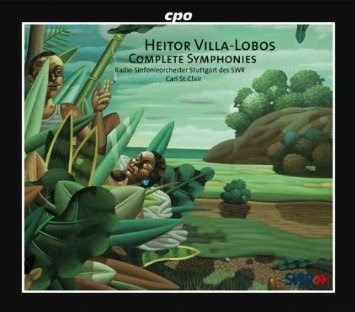
The Complete Villa-Lobos Symphonies were recorded in 1997-2000 by Carl St. Clair and the Radio-Sinfonieorchester Stuttgart des SWR. This ground-breaking set included world recording premieres of Symphonies 1, 3, 7, 8, 9, 11, & 12. Not that there are that many recordings of the others, though - none of the Symphonies is as well-known as works in the great Bachianas Brasileiras or Choros series. But I would place all 11 of these recordings (the score to #5 is lost) at the top, or close to the top, of those available.
Unlike his other two series, though, Villa-Lobos's Symphonic cycle doesn't represent his best work. It's easy to find fault with many of these works, but Villa-Lobos learned to write impressive music for large orchestras early in his career, and was highly praised over the years for his imaginative and colourful orchestration, if not for his grasp of large-scale musical architecture. Each time I listen to these still-unfamiliar works I find something new and interesting, and I'm starting to really appreciate particular symphonies. The neo-classical no. 8 and the uncharacteristically well-structured no. 4 are becoming favourites.
Another stand-out is #10, written for the 400th Anniversary of the City of Sao Paulo, and based in part on the writings of the 16th century missionary Jose de Anchieta. This Symphony has significant rivals - Gisele Ben-Dor's version with the Santa Barbara Symphony on Koch, and Victor Pablo Perez's with the Symphony Orchestra of Tenerife on Harmonia Mundi - but any perceived slight advantage from another version won't reduce the value of this cpo set. The Tenth Symphony has the same pull-out-all-the-stops feeling of the great Choros #10, which many commentators (and I) believe is Villa's greatest work.
The missing fifth star isn't the fault of the admirable St. Clair, the Stuttgart musicians, or the cpo engineers. The music isn't top-drawer Villa-Lobos but it's always really interesting because it always sounds like Villa-Lobos.
It's a golden age for beginning a Villa-Lobos music collection. The cpo Symphonies and superb complete sets of the Choros, Bachianas Brasileiras, String Quartets, and Works for Piano provide a big chunk of Villa-Lobos's legendarily large output at a pretty reasonable total cost. It couldn't happen to a more deserving composer!
Subscribe to:
Posts (Atom)