Reviews and occasional notes on classical music

Reviews and occasional notes on classical music

"Music, both vocall and instrumental, so good, so delectable, so rare, so admirable, so super excellent, that it did even ravish and stupifie all those strangers that never heard the like." - Thomas Coryat, after hearing 3 hours of music at the Scuola di San Rocco in Venice, 1608.

Showing posts with label Bach. Show all posts

Saturday, March 22, 2025

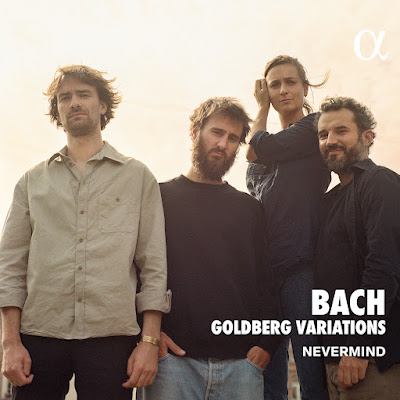
A rich new Goldberg Variations


 Nevermind - Bach Goldberg Variations

If your idea of diversity in the Goldberg Variations universe is to occasionally swap out the 1955 and 1981 recordings of Glenn Gould, you might want to expand your horizons and listen to this new arrangement of Bach's perennial best-seller, by the talented young musicians of Nevermind: Anna Besson, transverse flute; Louis Creac'h, violin; Robin Pharo, viola da gamba; and Jean Rondeau, harpsichord and organ.

You'll find the sounds of Nevermind's four instruments, in various combinations, throughout Bach's works: his sonatas for violin, for viola da gamba, and for flute, and in passages from the Passions and Cantatas. The Paris Quartets of Telemann and Les Nations by François Couperin are among the other models used in this transcription.

The spell that the Goldberg Variations weaves seems to mess with one's internal clock. I can never believe that so much happens in the 38 minutes of Glenn Gould's first version, or that even his more measured 1981 recording is still only 51 minutes. To be sure, Gould isn't generous with repeats, but there is still a feeling of time standing still in many of the variations (and in the 1981 version, of the Aria itself). Here we have the opposite effect; instead of time slowing down, there seems to be a disconnect at the end of the Aria da Capo. Surely, that hasn't been 100 minutes (over two CDs, if you're still listening on physical media)! One is carried along by the internal engine of the music, its logic, and by the often dramatic, even operatic, effect of the instrumental timbres. In his notes to his 1955 recording, Gould called this "... music which observes neither end nor beginning, music with neither real climax nor real resolution." We may have ended up where we began (time being, as we learned from True Detective, a flat circle), but what a rich experience it was!

Listening to the Goldberg Variations in a special performance on the piano or harpsichord can feel like a singular communication with the performer and the composer. This, though, is a more communal experience, not only with the four musicians, but with Bach's European network of performance practices and the traditions of music-making from the 18th century until today. For me, though, it was still a private experience that touched me deeply.

This is a journey well worth taking!

The cover photo is by Clement Vayssieres.


Monday, April 10, 2023

Sunny and dark music for string trio


The string trio is one of my favourite formats; it doesn't have the baggage of the string quartet: that daunting mass of masterworks from Haydn to the present day. The String Trio has, on the one hand, the light serenade side, and on the other the intensity of great string trios by Schoenberg, Villa-Lobos and Schnittke. In the middle is the perfection of Mozart's great string trio from 1788, the Divertimento, K. 563.

The first two works chosen by the exceptional group Leipziger Streichtrio - violinist Adrian Iliescu, violist Atilla Aldemir and cellist Rodin Moldovan - try for that Goldilocks medium attained by Mozart. This is joyful music, but not completely ignoring dark undercurrents. Ernö Dohnányi's Serenade for String Trio, Op 10, is a relatively early work, written in 1902. It takes as its formal model not Mozart's Divertimento, but rather Beethoven's Serenade for String Trio, op. 8, from 1796-97. Jean Françaix's String Trio, from 1933, is a neo-classical gem, which exemplifies the modus operandi of Les Six: slightly sad nostalgia, slightly ironic romps, slightly erudite fugal passages, always having fun with serious matters. 

Jean Sibelius's String Trio, which dates from 1894 is a more serious beast. This is an almost altogether stern work, and though it's only 8 minutes long, it has a symphonic feel to it. When have you ever seen Sibelius smiling in a portrait? *

There are two additional pieces in this interesting program, which one might consider encores. George Enescu's Aubade, from 1899, is a bit of fun, a rustic folkloric piece full of swoops and pizzicati. Andras von Toszeghi's arrangement of J. S. Bach's great Chaconne from the 2nd Partita for Solo Violin is substantial, and interesting. Mozart himself transcribed six Bach Preludes & Fugues for string trio in 1788, K. 404a. I love listening to the Chaconne in any guise - I especially enjoy Brahms' version for piano, and Leopold Stokowski's for full orchestra. But this isn't quite a complete success as an arrangement - the violin gets to keep most of the good bits, and the viola and cello have the leftovers that make the soloist sweat while double-stopping in the original. It's neither fish nor fowl, but tasty anyway! Altogether this makes an exceptional hour of music.

* Here's your answer: Werner Bischof very nearly got a full smile out of Jean Sibelius in this 1948 portrait.


Friday, January 13, 2023

Fresh and Vital Bach and Pärt


Bach: Violin Concertos; Pärt: Fratres, Spiegel Im Spiegel

"The slow movement from Bach’s A Minor Concerto was the reason that, at the age of four, I knew I wanted to play the violin for the rest of my life. Of course, I had no idea at the time what that would really mean — but I was so overwhelmed by the beauty and depth of Bach’s music that there was no question for me: I simply had to become a musician!"

Playing the Guarneri del Gesù ‘Sainton’ violin from 1744, Arabella Steinbacher provides a luscious sound, rich and full, that focuses one's attention completely, almost ignoring the to-and-fro of the orchestral and solo parts, and even of the beautiful melodies that Bach provides. It's remarkable how an instrument made that long ago could be used to play music that's three centuries old and sound so fresh and alive. I've long been a fan of Steinbacher's; I've raved about her playing in a wide variety of repertoire: Bartok, Brahms, and Hindemith and Britten. Here she plays two Bach Violin Concertos: in E major and A minor, and a Bach Concerto for Two Violins in D minor, with another fine violinist, Christian Kontz. Once again Pentatone provides fine accompaniment: the agile and stylish Stuttgarter Kammerorchester.

J. S. Bach's manuscript score of the violin part for
the slow movement of his A minor Concerto

Two Arvo Pärt pieces bookend the three Bach concertos. His Fratres comes in many versions; this one, for violin, string orchestra and percussion, is from 1992. This is a suitable prelude to the meat of the programme: hushed and reverential, but in the end as dramatic a curtain raiser as a Rossini overture. The final piece, Spiegel im Spiegel, in its original 1978 version for violin and piano, acts as a kind of valedictory encore. Once again, Arabella Steinbacher has a fine partner, in pianist Peter von Wienhardt.

The wonderful photo of Steinbacher on the album cover is by Co Merz.

This album will be released on February 10, 2023.

Saturday, July 23, 2022

Stylish and characterful Bach concertos from Japan


 J. S. Bach: Harpsichord Concertos 3, 4, 6 & 7

This is the second release from BIS of Bach Harpsichord Concertos by Masato Suzuki and Bach Collegium Japan - the first was released in 2020. I've long been a lover of the recordings of this orchestra, especially the landmark series of Bach Cantatas under Masato's father, and the group's founder, Mazaaki Suzuki. Though this is a very small subset of musicians - only two violins and a single viola, cello and bass - there is the same nuance and character here as in the Cantatas and Passions. There's also the same warm sound envelope provided by the BIS engineers, producers and editors, and the marvellous, innovative BIS design and marketing, developed over years of collaboration between Japan and Sweden.

Like his father, Masato Suzuki is a very fine harpsichordist, and is fast becoming known around the world as a conductor. He's made the move from the continuo section - Baroque's Special Teams unit - to the podium with style; he's now the Principal Conductor of Bach Collegium Japan. I look forward to more recordings, of Bach, other Baroque composers and beyond, from this excellent musician.


Monday, January 24, 2022

Miraculous recordings from a great master


 Wilhelm Kempff: Bach, Mozart, Schubert & Schumann

This welcome historic release from APR Recordings includes Wilhelm Kempff's complete recordings for Polydor of music by Bach, Mozart, Schubert and Schumann, made in the period 1927 to 1936. We have here nearly 75 minutes of music, which together make for an appealing recital.

Indeed, though I know Kempff primarily through his recordings of Beethoven's Piano Sonatas, I would find almost anything the great pianist plays to be appealing. But there's something special about these recordings, something quite miraculous. In spite of the relatively primitive technology involved in these early electrical recordings, I had no trouble at all forgetting sonic imperfections, and zeroing in on a great master channeling great composers. The French Suite no. 5 of Bach, recorded in 1935, is the highlight of the disc; it's a masterful interpretation. I was in awe of this from the first time I heard it, since I had the strong feeling that Kempff was communicating his own awe, as he so often does with Beethoven, before a great masterwork.

I was quite surprised by Kempff's interpretation of Mozart's Piano Sonata in A major, K. 331, recorded in 1935. It seems much more modern than I would have expected, with crisp, carefully delineated lines, and no hint of the romanticizing prettiness that plagued Mozart music of the period. While not completely Historically Informed, this performance once again demonstrates a real, personal connection between pianist and composer.

There are a number of Kempff transcriptions here, including some Bach pieces that have entered the repertoire of many pianists, and a very clever reworking of Liszt's version of Schubert's "Hark, Hark, the Lark!". The disc ends with a beautiful dream: Schumann's Träumerie, recorded in 1936.

I've characterized the piano playing of Wilhelm Kempff as a miracle, but there's another, albeit smaller, miracle involved in this release. It's quite amazing that one can listen to all of this music with little acoustic worries. That's a testament to the state-of-the-art German engineering behind the recordings themselves, but also, of course to work since then by the Producer and Audio Restoration Engineer for this project, Mark Obert-Thorn. The many years between recording and listening seem simply to vanish.

Stephen Siek's liner essay is first-rate, mixing in technical details, but making sure that storytelling prevails. Learning about Kempff's 1934 trip to Buenos Aires on the Graf Zeppelin adds a great deal to the charm of the entire project.

This disc will be released March 4, 2022.

Thursday, May 13, 2021

Urgent, passionate, transcendent piano music


"Something about this music just seemed to make sense now, when so little else did."

It's fitting, I think, that I come back to reviewing music on this blog after my annus horribilis, when my wife died of Ovarian cancer and I had a major accident, all during the terrible pandemic that we're slowly emerging from. Pianist Andrew Von Oeyen's year was a challenging but productive one, resulting in a shift in his musical priorities, and it brings us a quite remarkable album of music by Bach and Beethoven.

Von Oeyen came to Bach, or perhaps more accurately, Bach came to Von Oeyen, during enforced leisure, with touring, public performance and normal recording activities on hold:
While I had studied many of his keyboard works, I almost never performed them; I was not a specialist. Yet his music was calling, and with a newfound liberty of time to explore repertoire without professional deadlines, I decided to bury my troubles in his contrapuntal canon.
That this was a kind of Saul in Tarsus moment for the pianist is clear from his taught and concentrated performance of the Overture in the French Style, BWV 831. This is just the opposite of the dry Bach that still holds sway over some pianists; Von Oeyen plays with urgency and passion. He comes through these emotions to a calm centre, though he doesn't quite reach the same Olympian serenity of that most urgent and passionate of all pianists, Glenn Gould. Still, this is a superb version of this great work that seems better each time I listen to it.

Von Oeyen's Beethoven is equally stormy, and just as convincing. He found that "the directness, virility, determination, and sheer willpower of Beethoven... aligned with my own growing resolve to transcend this trial." This is Von Oeyen shaking his fist at COVID as Beethoven famously shook his at Fate. The Appassionata Sonata, op. 57, is the perfect work to demonstrate how one person can fight the good fight against the Universe, though of course it also takes enormous control, and self-control, to keep it from sounding melodramatic and histrionic. The slighter Sonata Quasi Una Fantasia, op. 27 no. 1 is pitched at a lower temperature, and to his credit, Von Oeyen doesn't push too hard and destroy the still somewhat naively pre-Romantic feeling of this wonderful piece. This is beautifully balanced, and beautifully played.

Von Oeyen ends a wonderful programme with two Bach arrangements by that great Beethoven pianist, Wilhelm Kempff. I've always thought of Kempff as my Beethoven pianist, since I first heard Beethoven's sonatas played by him. Kempff brings loads of sentiment to these pieces, and in turn Von Oeyen plays both with simple dignity and a feeling of transcendence. Perhaps there is some light ahead.


To be released June 11, 2021.


Tuesday, February 25, 2020

A heroic interpretation of the spirit of Bach


J. S. Bach: The Art of the Fugue

Tatyana Nikolayeva is a legendary pianist with a bit of a cult following, especially for her Bach and Shostakovich (the two were close friends; he wrote the great Preludes & Fugues op. 87 for her). This is a live recording from the Sibelius Academy in Helskini on April 26, 1993, a month before her 69th birthday. Nikolayeva had a huge repertoire: "Sometimes I think I know practically everything that has been written for the piano!", she says, laughing, in a 1991 interview. On top of this, she had the habit of playing by memory. This shows in this recording, not necessarily in the few minor flubs, but because there is a real feeling that there's a well-thought-out, cohesive plan to her interpretation, the result of significant mental as well as physical work. This plan involves the pianist taking full advantage of the capabilities of her Steinway, without any special attention to Historically Informed Practices, but complete and absolute attention to the spirit of the music.

Just over six months later, in November 1993, Nikolayeva was playing the Shostakovich Preludes & Fugues at a recital in San Francisco, when she suffered a stroke. Remarkably, she managed to play until the intermission, but she was dead ten days later. This recording, with its poignant final fugue unfinished at Bach's own death, is a superb memorial.

Photo: Co Broerse, Amsterdam, 1990

This album will be released on March 6, 2020

Saturday, January 4, 2020

A prayerful Passion


Bach: St. Matthew Passion

A new decade is a time for new beginnings, so this release is well-timed: it's a second recording of the St. Matthew Passion from Masaaki Suzuki and the Bach Collegium Japan. The first version, from 2000, was generally well received. Robin Tuttle's Classical Net review pretty well sums up the critical consensus: "Suzuki takes us gently by the hand and shows us Bach not at his most imposing, but at his most humane."

The new album needs only 2 CDs instead of 3, but this isn't because of any speeding up; the new recording is actually a couple of minutes longer. This time around BIS jams everything into two 80-minute plus CDs. The main difference between the two recordings is in the vocal soloists. Gerd Türk followed Suzuki's meditative approach as the Evangelist in the first version, while the equally strong Benjamin Bruns is somewhat, but not a lot, less dramatic this time around. I was especially impressed with the great Nancy Argenta in the first recording; this time around I loved Carolyn Sampson. Suzuki has doubled down in the new recording, with more even more gentle arias and prayerful chorales; the keyword here is definitely "devotional". This might seem to be a small change, but the cumulative effect is awesome, almost breathtaking. 

The new year is fraught with danger and portents of doom; we need the consolation of Johann Sebastian Bach more than ever. The most reliable purveyors of this are, in my opinion, Masaaki Suzuki and the musicians of Bach Collegium Japan.

This album will be released February 7, 2020.

Sunday, July 7, 2019

A brilliant musical partnership


Palimpsest: Music for marimba & clarinet by Bach, McKinley, Piazzolla, Ravel & Zorn

Darius Milhaud introduced the marimba into the classical orchestra with his extraordinary 1947 Concerto for Marimba and Vibraphone, and composers from Leoš Janáček to Steve Reich were quick to introduce the striking colours this marvellous instrument can add to chamber and orchestral works. This new disc from marimbist Mike Stoltzman and her husband, clarinettist Richard Stoltzman, provides a great overview of various styles ("from Bach to Zorn" is a great way to talk about a wide range of music!)

Mika Stoltzman's own adaptation of Bach's perfectly adaptable Chaconne, from his D minor Partita for Solo Violin, shows the musical and emotional range of the instrument, as well as her own brilliant playing. Ravel's Pavane pour une infante défunte is another work that's made its way into many, many arrangements, and Richard Stoltzman's version for marimba & clarinet sounds exotic and familiar at the same time, in other words, just right for this kind of music.

For me the highlight of the album was the John Zorn piece which provides the title of the project. Richard Stoltzman describes the work in the liner notes:
Mika begins by playing quite tonal music, and then the clarinet jumps in with something abstract and arrhythmic, with crazy leaping intervals, almost as if Ornette Coleman had stepped into the room, and it keeps in conflict with the steady metre of the “old manuscript” underneath Mika’s part. It’s really fun to play, and it has been a surprise hit with audiences.
So many of the pieces here (including the Bach arrangements) are jazz- and blues- inflected. The Piazzolla works seem so natural, partly because the great composer from Argentina worked in his own jazz/classical idiom, but also because of the groove that the Stoltzmans and bandoneonist Pedro Giraudo are in throughout.

Mika and Richard Stoltzman play John Zorn's Palimpsest

Thursday, September 13, 2018

The spot-lit miracle


Das Neugeborne Kindelein: Christmas Cantatas by Buxtehude, Telemann and J. S. Bach
Although we are deeply indebted to the light, because by means of it we can find our way, ply our tasks, read, distinguish one another; and yet for all that the vision of the light itself is more excellent and more beautiful than all these various uses of it. The contemplation of things as they are, without error or confusion, without substitution or imposture, is in itself a nobler thing than a whole harvest of invention.
 - Francis Bacon *
Old Master paintings on the covers of classical music discs can be a bit of cliché, but occasionally an especially relevant one is chosen, and that's definitely the case with this new Accent disc of Christmas cantatas from Baroque Germany, performed by Sigiswald Kuijken and La Petite Bande. The Adoration of the Shepherds by Gerrit van Honthorst, painted in 1622, and now in the Wallraf-Richartz-Museum in Cologne, is an amazing presentation of the nativity. It's a Caravaggesque interpretation of John 1:9, "The true light that gives light to everyone was coming into the world." Sigiswald Kuijken has made that connection as well, in his excellent liner notes, which emphasize the  intimate atmosphere, but which, he says, "by no means excludes theatrical effects!" Of the beautiful Buxtehude In dulci jubilo he says:
... the fourth verse shines (as if under a halo) in a completely new glow, in that the two violins suddenly express the joy of the angels (“gaudia”) with their “ringing bells” in a frenzy of rapid movements.
Even in the early 18th century Christmas was a time to mix traditional music with newer, forward-looking sounds. I love Georg Philipp Telemann's archaic-sounding cantata Ein Kindelein so löbelich, TWV 9:5, from around 1720, but sounding at least a century older, at least until an Amen that sprouts Baroque curlicues around the more severe contrapuntal sounds of the stile antico. This is virtuoso composition that plays with styles in a kind of Enlightenment Post-Modernism. J. S. Bach's gorgeous cantata Ich freue mich in dir, BWV 133, from 1724, is a perfect example of how the great composer turned music into sounds of pure joy. Kuijken and La Petite Bande provide a joyful interpretation of the theatrical intimacy in this music, as apt an illustration of the show-stopping, spot-lit miracle that was the Nativity as the great painting of Gerrit van Honthorst.


* The quote from Francis Bacon, which is more or less contemporaneous to van Honthorst's painting and a century of more before the music on this disc, is from Temporis Masculus Partus, 'The Masculine Birth of Time', from 1605. It's well-known today, as you'll quickly see from a Google search, because the great photographer Dorothea Lange had the last sentence posted on her darkroom wall.

Dorothea Lange, Migrant Mother, Oklahoma, 1936

This disc will be released on October 19, 2018.

Sunday, July 1, 2018

Greatness in musical partnership


Mravinsky Edition, volume 3: works by Tchaikovsky, Bach, Weber, Wagner, Scriabin, Kalinnikov, Bruckner, Shostakovich

I've come to historic recordings fairly late, but I've had such good luck with recent releases that I'm beginning to search them out. This 6 CD set, the 3rd volume in Profil's Mravinsky Edition, is a superb example of well-documented remastered recordings of special significance. It's easy enough to filter out sonic shortcomings when the performances are so vital. Mravinsky had a lifelong relationship with the Leningrad Philharmonic Orchestra, and it's fascinating to hear the development of their musical partnership from 1938 to 1961. The obvious highlights in this package are the Tchaikovsky Symphonies #4 and (especially) #5 and a blistering performance of the Shostakovich 8th Symphony. But I was completely bowled over by Mravinsky's take on Bruckner's 8th Symphony, which I've been listening to a lot lately. In my review of Mariss Jansson's recent recording, I talked about the balance in Bruckner 8 between what Vincent Van Gogh referred to as "Tranquility of Touch" and "Intensity of Thought". It's no surprise that Mravinsky comes down on the intense side. Shostakovich biographer David Fanning describes just this intensity:
The Leningrad Philharmonic play like a wild stallion, only just held in check by the willpower of its master. Every smallest movement is placed with fierce pride; at any moment it may break into such a frenzied gallop that you hardly know whether to feel exhilarated or terrified.
An outstanding production all around.

The Mravinsky Edition covers feature a monochrome detail of his portrait by Lev Russov. Here it is in colour:

Thursday, February 22, 2018

Fun for four hands and a piano keyboard


Bach's Brandenburg Concertos arranged for piano duet

Back in 2003 Sony released a great Bach album, one of my all-time favourites, by Murray Perahia. It included an electrifying performance of the 5th Brandenburg Concerto:


That's great piano playing in the cadenza, but I love the piano/orchestra textures throughout the concerto. It points the way to this new arrangement of the Brandenburg Concertos for piano duet. I know I was ready for this! Eleonor Bindman's arrangement is outstanding, at once freer and closer to the spirit of the original music, and with more interesting textures than the one by Max Reger. Bindman and Jenny Lin (who was so great in this year's release of Philip Glass Etudes) really lean in to this freedom, swinging when Bach allows, and never staid or boring when things get more thoughtful or academic.

Here's a short taste of the music, and some interesting comments about the arrangement by Bindman. Though she may have started with purely pedagogical reasons for bringing this music to four hands and a piano keyboard, which I'm sure are very close to Max Reger's own, Bindman and Lin are obviously having too much fun here for it to be just that. And that makes it even more pleasurable for us to listen to.

THE BRANDENBURG DUETS: Bach’s Brandenburg Concertos arranged for piano duet by Eleonor Bindman from Grand Piano Records on Vimeo.

Eleonor Bindman has a fabulous section on her website exploring this project more fully. I highly recommend checking it out!

The Brandenburg Duets disc will be released on March 9, 2018.

Sunday, February 18, 2018

With Love from Stewart Goodyear


Stewart Goodyear: piano works by Gibbons, Sweelinck, Bach, Brahms, Berg

On January 11, 1955 Glenn Gould made his New York debut (what he called his "Debutown") at Town Hall, and on the following day he signed a recording contract with Columbia Records. His 27 years in the recording studio before his untimely death in 1982 made him a legend around the world, but here in Canada he is especially admired and loved. One of those hero-worshippers is Stewart Goodyear, born and raised in Toronto, and an alumnus, like Gould, of the Royal Conservatory of Music. Goodyear has recently been playing in concert many of the works from Gould's audacious programme in New York, and in his American debut earlier that year in Washington DC.

Glenn Gould's debut concert at Town Hall, January 11, 1955. Library & Archives Canada
Now we have this new Sono Luminus disc with many of those pieces: music by Gibbons, Bach (Sinfonias from the 3-Part Inventions and the 5th Partita) and Berg (his Piano Sonata op.1). He's also included two Brahms Intermezzi and to close, the ultimate Gould tribute, the Aria from The Goldberg Variations. I love Gould's Brahms; those who think of him as a capricious and detached artist should listen to his 1961 recording of 10 Intermezzi, which he referred to as "the sexiest interpretation of Brahms’s Intermezzi you’ve ever heard". He also said it was "perhaps the best piano playing I have done." Goodyear's own Intermezzo in A major, op. 118 no. 2 is as rapturous and full-blooded as Gould's, full of a deep understanding of Brahms and a fitting tribute to Gould in the bargain.


It was surprising to notice how slow some of Glenn Gould's tempi were in his recordings of the early English masters. His 1971 recording of Orlando Gibbons' "Lord of Salisbury" Pavan and Galliard runs about the same length as Goodyear's in spite of the fact that the latter includes repeats that Gould doesn't. Goodyear's zippier version makes more musical sense, I think. Though I do love Gould's whole album A Consort of Musicke bye William Byrde and Orlando Gibbons, it's a bit out in left field even by the standards of its day, much less when looked at through any modern historically informed practice lens. 

Thank goodness we're finally beyond looking at Glenn Gould as the mere sum of his eccentricities. We have a much better idea of the whole person: his emotional responses to people as well as pianos, and the full measure of his mastery in so many dimensions of great artists like Bach and Brahms. It's this response to the complete artist that makes Goodyear's tribute so important; it's based on a study of the deep roots of Gould's art, and not the externalities. As well, it's obviously heartfelt. The best expression of this love is the last piece on the disc, the Aria from the Goldberg Variations. Goodyear's moving performance takes the middle ground between the bright, almost coltish first version Gould made at the beginning of his recording journey, and the solemn, heart-breaking one he made close to the end. What a marvellous way to celebrate our Glenn!

This disc will be released on March 23, 2018.

Wednesday, September 20, 2017

A superb Christmas sampler


Choral Music for Christmas: works by J.S. Bach, Zelenka, Mendelssohn, Reger, Saint-Saens, Handel & others

Summer is winding down; autumn officially arrives tomorrow, so what is coming up Real Soon Now? That's right, the Holiday Season! At Christmas, we're always looking out for new music we've never heard, but not forgetting all the same works we love to hear every year. The Sampler Disc is a great chance to do this, and we have an especially good one here from Carus. You may not know Heinichen's Te Deum laudamus, but I plan on putting it in my regular Xmas playlist rotation; the same for Zelenka's Laudate pueri Dominum. These are very fine performances, with stylish playing, and good recent recordings (2004 and 2012). Then you get a really nice Hallelujah Chorus from Handel's Messiah, from Kammerchor Stuttgart & Barokorchester Stuttgart. This to-ing and fro-ing between evergreens and surprisingly lovely unfamiliar works goes on through the whole disc, with a focus on very high quality choral singing and fine orchestral support, all at a reasonable price. I'll let you choose your own favourites, but I have to single out another amazing song. It's Philip Lawson's arrangement of Hark, the Herald Angels Sing, sung by the Calmus Ensemble; it was included in their 2009 disc Calmus Christmas Carols. Pour yourself an eggnog and listen:


I recommend this disc very highly. Merry Christmas!

Here are the details of the works included:


This disc will be released on October 6, 2017.

Monday, June 5, 2017

Style and grace; warmth and humanity


Gloria in Excelsis Deo, Celebrating the completion of the recording of Bach's sacred cantatas.

In 2013 Masaaki Suzuki and his Bach Collegium Japan finished a massive 18-year project: the recording of all of J.S. Bach's sacred cantatas. All 55 SACDs are now available in a special box-set from BIS.


To mark the end of the project this film was made at the Shoin Chapel in Kobe, where all of the recordings had been made over a period of 18 years. It includes performances of three complete cantatas, BWV 30, 69 and 191, interspersed with interviews with the musicians and various interested parties. The very fine HD video and superb surround sound give you a vivid picture of how this awesome music went from Bach's mind to Maestro Suzuki's, and then to Super-Audio Compact Discs. More than just musical skills are on display here. You see the style and grace of the vocal soloists as they move from soloist roles back into the superbly integrated choral sound. The three virtuoso trumpeters, holding their instruments with one hand with their other hand on their waists, swaying to the music with the proud look of Samurai warriors. Perhaps most importantly you see the warmth and humanity of the great leader, Masaaki Suzuki, whose faith is as important as his scholarship and musicianship.

Here is an excerpt, the Dona Nobis Pacem from the B minor Mass, a coda which ends the disc.

Wednesday, April 5, 2017

Bach and Villa-Lobos for Saxophone


Here's an impressive new release from a young artist with a bright future in the classical music world, saxophonist Asya Fateyeva. My primary interest here is the music by Villa-Lobos, but the Bach arrangements, by Fateyeva herself, are musical and show off the capabilities both of her instrument and herself. She receives solid support from the Württembergisches Kammerorchester Heilbronn under Ruben Gazarian. The saxophone's natural singing tone is used to good effect, but the subtle colour effects that Fateyeva provides as an arranger and a performer keep things fresh, while Gazarian's brisk tempi make sure things don't get bogged down in sentimentality. The celebrated Aria from the Fifth Bachianas Brasileiras is arranged with due respect to the composer's original version where the voice has support from 8 cellos (or, rather, a solo cello and seven others), and not with a more generic "strings" accompaniment that is often used. This performance of the Fantasia for Saxophone should help provide some traction for a work that I've always felt should be much better known than it currently is. It's been turning up fairly regularly on programs around the world since it was the center-piece of Branford Marsalis's Marsalis Brasilianos tour back in 2012, and young saxophonists like Asya Fateyeva are right to play it often. A highly recommended disc!

Saturday, January 21, 2017

An urgent new St. Matthew Passion from John Eliot Gardiner


John Eliot Gardiner's ground-breaking Archiv recording of the St. Matthew Passion was made in 1988 at Snape Maltings, with the English Baroque Soloists and the Monteverdi Choir. Twenty-eight years later he took those same musicians on tour in Europe, and in their stop at Pisa on September 21-22, 2016 SDG recorded this live version.

At the time of the original recording everyone noted how brisk Gardiner's tempi were. The total time was just over 157 minutes. While SDG manages to fit the work on only two CDs rather than the original three, Gardiner has relaxed just a tiny bit, with a new total time of 161 minutes. This music still has the same drive, the same dancing quality. Gardiner's vision was always more dramatic than devotional, and the urgency of the first version remains in the new one. "You feel you are being taken by the scruff of the neck," Gardiner says of his experience of the work, "and required to confront big issues - the nature of kingship, of identity, or of what happens when truth faces falsehood." That quote is from Gardiner's 2013 book Bach: Music in the Castle of Heaven, which is for me the New Testament of Bach scholarship. In the new version The Monteverdi Choir is just as tight and disciplined as in the original, with new levels of subtlety and often more dramatic shading this time around. The strong group of soloists, led by James Gilchrist as The Evangelist and Stephan Loges as Jesus, tell their stories in a thrilling way, and Bach provides many ways for his audience to reflect on their meaning. "Without any concession to theatrical gimmickry," says Gardiner in his book, "Bach provides his audience with a magnificent display of dramatic re-enaction." He says, further, that Bach approached his task "with the flair of the born dramatist." This flair the great composer shares with Sir John Eliot Gardiner today.

Sheila Rock's 1998 photograph of John Eliot Gardiner, in the National Portrait Gallery


Tuesday, November 29, 2016

A charming Baroque compilation from Sweden


The new Telemann Corelli Bach album by the new Swedish group Höör Barock is full of special touches, with a background of stylish, historically-informed performance. Corelli's Christmas Concerto op. 6 no. 8, for example, includes two solo recorder parts, played here by Emilie Roos and group leader Dan Laurin. Along with oboes and bassoon in the tutti, and the special appearance of a baroque harp in the final movement, this charmingly rustic pastoral scene is a nice change from the strings-only version we hear many times every Holiday Season. There's a similar familiar/unfamiliar situation with Bach's Harpsichord Concerto in F major, the composer's own arrangement of his Fourth Brandenburg Concerto. This is run through in brisk fashion, with splendid playing by Anna Paradiso at the keyboard. The harpsichord sound works well in this odd mixture of solo and continuo instrument; the BIS engineers have struck the right balance, I think, between blending in and sticking out. Of the rest of the music, the stand-out work is Telemann's splendid Ouverture-Suite ‘Hamburger Ebb und Fluth’, with its energetic and graceful dances. This new recording tends to be rather light and frothy, with its considerable charm more on the surface. I still prefer the classic, more dignified version by Musica Antiqua Köln under Reinhard Goebel. But I'm glad to have heard this excellent compilation from one of Sweden's greatest exports: BIS.  The record drops January 6, 2017.

Monday, October 31, 2016

Fine Christmas music from Montreal


The Montreal-based Arion Orchestre Baroque, led by Alexander Weimann provides an authentic 18th century German Christmas celebration in this excellent new disc from ATMA Classique (due November 4, 2016). With a relatively small (26 player) orchestra and five vocal soloists doubling as the choir, you'd expect a small-scale, intimate performance, but there's also plenty of pomp and exultation to go with the quiet, personal story of a young girl and an angel. Here's the scene at the spectacular Notre-Dame Basilica in Montreal at Arion's December 5, 2015 concert (from the album booklet; photograph by Jean Guimond). The album was recorded a few days later at  Église Saint-Augustin, Mirabel.


There are two other things special about this recording. The first is the inclusion of the four laudes, Christmas hymns interpolated into an earlier version of the Magnificat that are rarely included in performance or recordings. The second is the marvellous Christmas Day Cantata by Johann Kuhlau, which is really quite beautiful, and which deserves much more attention in people's Christmas playlists. This disc will certainly feature in mine!

Tuesday, May 24, 2016

Beautiful, striking and thought-provoking


One of the highlights of my Christmas last year was the moving Bach Christmas Oratorio choreographed by John Neumeier and danced by Hamburg Ballett. That Blu-ray disc will be lined up with all our other favourites in 2016: Father Christmas, A Wish for Wings that Work, Desk Set and A Muppet Christmas Carol. This Blu-ray disc of the St. Matthew Passion by the same dancers, instrumentalists and singers has all the advantages of the previous disc, with an additional major plus. This music is even greater than the cantatas that make up the Christmas Oratorio. It's more dramatic - in John Elliot Gardiner's words, "Bach's was essentially dramatic music: music intended to appeal to - even occasionally assault - the senses of his listeners." Thus the Passion lends itself more naturally to interpretation through dance. This will give you an idea of the variety of effects Neumeier comes up with to match (again quoting Gardiner) Bach's "stark new juxtapositions of texture and sonority."


As beautiful and striking and thought-provoking as this is - and it's all of those things at a consistently high level for 3-1/2 hours - I wonder if this is somehow less than what Peter Sellars and Simon Rattle achieved in their ground-breaking 2010 production in Berlin. This small bit of that performance perhaps gives you an idea of a more personal, more human, more intimate Bach.


As good as the orchestra and choirs conducted by Gunter Jena in the Hamburg Ballett recording are - for the record they're the St.-Michaelis-Orchester und -Chor, Knabenchor Hannover and Knabenchor St. Michaelis - they're not in the same league as Sir Simon Rattle and the Berlin Philharmonic, Rundfunkchor Berlin, and a lineup of star soloists headlined by Mark Padmore as the Evangelist. But a greater difference is that we are necessarily a passive audience for a ballet - these fit good-looking young people are a different species from the people sitting in the seats at the Festspielhaus Baden-Baden, not to mention those of us on the couch at home. But when Peter Sellars puts the camera - i.e. the audience - amongst the singers and instrumentalists, he involves us more fully in the action. When the choir are active participants in the ebb and flow of that performance, we are closer as well, since choir members are our proxies. Indeed, the congregation would have sung along with the Chorales they knew, like at a midnight showing of the Rocky Horror Picture Show. Again, Gardiner provides insight:
Bach took his cue from Luther, who, knowing from direct experience what it was like to be persecuted, insisted that Christ's Passion 'should not be acted out in words or appearances, but in one's own life'. That is exactly what Bach does - by addressing us directly and very personally, by finding new ways to draw us in and towards acting it out in our own lives: we become participants in the re-enactment of a story which, however familiar, is told in ways calculated to bring us up short, to jolt us out of our complacency, while throwing us a lifeline of remorse, faith and, ultimately, a path to salvation. *
Now I know that Sellars and Rattle touch me more directly in their production than Neumeier and Jena do in theirs, but this is very much a personal view. I'm still very enthusiastic about this version after my first run-through, and I expect I'll find it resonating with me even more when I watch again.


* John Elliott Gardiner, Music in the Castle of Heaven, p. 429.