Reviews and occasional notes on classical music "Music, both vocall and instrumental, so good, so delectable, so rare, so admirable, so super excellent, that it did even ravish and stupifie all those strangers that never heard the like." - Thomas Coryat, after hearing 3 hours of music at the Scuola di San Rocco in Venice, 1608.
Handel may not have planned this grouping of concertos himself, but the collection we know as Opus 3 is so appealing, so full of invention, so stylish, that it's hard to be too harsh about this result of the oddities of 18th century norms of Intellectual Property. Handel had a most wonderful model for these works - Arcangelo Corelli - and if he borrowed a few melodies, rhythms and harmonies along the way, that's fine, considering the fluidity of authorship at the time. A publisher may have rounded up Handel works willy-nilly into a publishable state, but in spite of this the results are surprising, full of depth and meaning. Umberto Eco's great essay on the movie Casablanca is, I think, relevant:
When all the archetypes burst in shamelessly, we reach Homeric depths. Two clichés make us laugh. A hundred clichés move us. For we sense dimly that the clichés are talking among themselves, and celebrating a reunion.
Handel's op. 3 collection is a test for any group: staying true to the letter & spirit of the score, while keeping the music sounding fresh and alive. Martin Gester and his Tasmanian group Van Diemen's Band have done exactly that, in this wonderful new album from BIS. There's plenty of fire burning here, but it's within the context of impressive musical discipline and lightly-worn Historically Informed Performance scholarship. BIS provides the kind of direct and transparent sound that allows Early Instruments to flourish. This is a highly recommended release!
This is the second of three Handel albums from the Akademie für Alte Musik Berlin under Bernhard Forck. I loved the first, which included the Concerti grossi op. 6, no. 1-6, and very much look forward to the op. 3 album, hopefully coming soon, which will complete the set. This is a group that has Handel figured out like Van Gogh figured out sunflowers; these marvellous concertos have never sounded better. They've hewn to a middle road between refinement (the Academy of Ancient Music under Andrew Manze) and full-out drama (Il Giardino Armonico under Giovanni Antonini). The latter had always been my preferred version, but I find myself more inclined to choose this new release for my Desert Island Handel.
This fine portrait of the Akademie für Alte Musik Berlin by Uwe Arens shows the full richness and joy you can expect from these Handel discs from Pentatone.
"Never before had naturalism transfigured itself by such a conception and execution. Never before had a painter so charnally envisaged divinity nor so brutally dipped his brush into the wounds and running sores and bleeding nail holes of the Saviour. Grünewald had passed all measure. He was the most uncompromising of realists, but his morgue Redeemer, his sewer Deity, let the observer know that realism could be truly transcendent. A divine light played about that ulcerated head, a superhuman expression illuminated the fermenting skin of the epileptic features. This crucified corpse was a very God, and, without aureole, without nimbus, with none of the stock accoutrements except the blood-sprinkled crown of thorns, Jesus appeared in His celestial super-essence, between the stunned, grief-torn Virgin and a Saint John whose calcined eyes were beyond the shedding of tears."
- J. K. Huysmans, on Matthias Grünewald's Crucifixion at Cassel, from the first chapter of his novel Là-Bas
Even today Matthias Grünewald's Large Crucifixion has the power to shock us. The work was painted in 1523-24 (it's now in the Staatliche Kunsthalle Karlsruhe), and having looked at it through the intense lens of J. K. Huysmans, one realizes that one cannot understand life without looking closely, without flinching, at pain and suffering. And it's especially those rare artists like Grünewald that help us to a deeper understanding through their transcendent art.
Two hundred years later, in 1712, Barthold Heinrich Brockes published a passion libretto nearly as naturalistic and graphic as Grünewald's painting. Coming as it did in the midst of the Enlightenment, it was perhaps even more shocking. Many of the critics found it objectionable, or at the least in poor taste. "Viewer discretion is advised", or the 18th Century equivalent. But it was a big hit with three great artists who understood its emotional power, and were anxious to bring their best music to the task. Georg Philipp Telemann set the Passion in 1716, Georg Frideric Handel wrote his some time before 1719, and Johann Sebastian Bach used a number of Brockes' texts in his St. John Passion of 1727. Bach also performed the Telemann and Handel Passions in Leipzig.
This recording by the Academy of Ancient Music, under Richard Egarr, is intensely emotional and darkly coloured by pain and suffering. It provides an almost cinematic experience; I'm thinking of here of artists such as Andrei Tarkovsky, Francis Ford Coppola and Carl Theodor Dreyer. For that, we can thank Egarr, his choir, solo singers and instrumentalists, and the sound engineers of AAM's own label, but also Handel and Brockes.
This is also a major scholarly release, based on a new edition of the work. The third disc provides alternative readings, but you needn't worry about untangling versions. Handel's endless invention provides passionate arguments, profound sorrow and pity, and redemptive uplift that always somehow entertains, as only the greatest of opera composers - Mozart, Verdi, Wagner - can. And to do all this while working in the bailiwick of the greatest of Passion composers, J. S. Bach, well, that's really some accomplishment!
After a disappointing recent Handel album from another Berlin band, it's great to have this new disc, with the promise of two more real soon, from the Akademie für Alte Musik Berlin, under Bernhard Forck. This is some of the greatest music of the 18th century: on the same level as Bach's Brandenburgs and Vivaldi's best concertos, and it's performed in as stylish and musical way possible. Forck highlights the myriad felicities that Handel has woven into these six concertos, but without interrupting the rushing mountain streams of the fast movements, or the stately court dances of the slow ones.
Handel wrote the first six Concerti Grossi published as op. 6 in just over two weeks, from September 29 to October 15, 1739 (the final six were completed before Hallowe'en). You can hear the rush of inspiration in these works in a way that few pieces of music can match. I think of Mozart's piano concertos from the spring of 1785, and Schubert's composition of Winterreise in February and October of 1827. Handel's orchestral music sounds robust when it's played like this, but I've heard more than a few versions of both op. 3 and op. 6 that were crippled by poor musical choices or stylistic axe-grinding, on both sides of the Historically Informed Practices divide. Bernhard Forck and his very fine Berlin musicians, supported by Pentatone's fine engineers, let Handel's inspiration flow unimpeded.
"The fetish of the 'original instrument' has had its day," says conductor Reinhard Goebel, "but not the profoundly trained professional who guides an orchestra into the deeper dimensions of the composition." I certainly don't buy the premise of the first part of his quote, and can only agree to the rest with the proviso that style is as important as musicianship when bridging the gap between the 18th century and the 21st. Unfortunately, Goebel's Handel is often less than stylish, his tempi sometimes sluggish and his point of view more Romantic than Baroque. I'm certainly on-board with Goebel's augmentation of the orchestra, which is well-documented; having recently read Jane Glover's Handel in London, it's clear that the composer was completely focussed on the most impressive display his music could create in the moment, regardless of his original conceptions. But I miss the verve and bite of the best original instruments performances: I recommend Marc Minkowski and Les Musiciens du Louvre, or Richard Egarr and the Academy of Ancient Music, but not, unfortunately, this new disc.
Early in the 18th century a group of writers came together in one of London's newly-popular coffee-houses, and began a long satirical collaboration that would eventually result in interesting products in the literary, political and, as we shall see, the musical fields. The members of the Scriblerus Club, who included such big names as Alexander Pope, Jonathan Swift and John Gay, pitched ideas and jokes to each other like a roomful of sitcom writers, with their creation Martinus Scriblerus an early version of Alan Brady or Tracy Jordan. As I learned from a fascinating episode of BBC Radio 4's In Our Time, the death of Queen Anne in 1814 and the fall from power of the Tory Ministers in 1815 scattered the Scriblerus Club members. But they would soon be back.
Meanwhile, Georg Frederic Handel's fortunes as a composer showed peaks and valleys after he settled permanently in Britain in 1712, though always trending more or less up. In 1710 he had been named Kappelmeister to the Elector of Hanover, who became King George I on the death of Queen Anne. A falling-out with the new Sovereign was bad, but things looked much better when he became the fashionable operatic composer in London. Even better, in 1717 his Water Music for George I's barge was a big hit, but fashions turn quickly, and he all at once found himself without a hit in London's operatic world. So he turned from the fickleness of both city and court to a lavish country house that included its own orchestra and singers: James Brydges' (later Duke of Chandos') Cannons, built at a cost of £200,000, worth tens of millions today. There Handel fell in with a group of Scriblerians, themselves looking for a more congenial home after their political/artistic exiles.
The librettists were John Gay, Alexander Pope and John Hughes; the subject was one that Handel had used for an earlier Neapolitan opera, Acis and Galatea, from the story told in Ovid's Metamorphoses. Everything now had an English slant; the project was more like an English masque than an Italian opera. The songs - to very cleverly crafted English words - were sung by English singers. And the Englishness continues to this recording, recorded, by mainly British musicians, I'm sure, at the Church of St Jude-on-the-Hill, Hampstead Garden Suburb in November of 2017. And all for Chaconne, the Early Music marque of Chandos, the label named for the Duke who built Cannons and help bring about some of Handel's greatest music. Acis and Galatea was apparently Handel's most popular work during his lifetime. The clever libretto must surely have played a part here, though Handel's tunes are often sublime, his rhythms infectious, his sad arias heart-breaking and his happy ones uplifting. The opera has most effective advocates here: the two leads, soprano Lucy Crowe as Galatea, and tenor Allan Clayton as Acis, are outstanding, as is the choir. The musicians of the Early Opera Company, led by Christian Curnyn, have a special quality about their playing that one might almost call rustic. It looks back to the masques of Henry Purcell, and ahead to a future collaboration of John Gay with another German composer who settled in England, Johann Christoph Pepusch, The Beggar's Opera from 1728. I had a great deal of fun researching this review - it's what retired librarians do - but even more listening to this music!
This disc will be released on June 1, 2018. Here's the official trailer:
Hervé Niquet has opted to record the 1754 version of Messiah, which has five soloists rather than four. I know this version well because of the now classic 1991 recording by Christopher Hogwood and the Academy of Ancient Music, which featured the divine Emma Kirkby. We had that on cassette, so it was the soundtrack (along with Yogi Yorgesson's I Yust Go Nuts at Christmas - the kids were little!) for many a holiday trip in Alberta's cold Decembers.
However, that's not the key to this new version by Le Concert Spirituel under the direction of Hervé Niquet. Rather, it's his statement that "I’ve opted here for an operatic interpretation, taking its cue from the drama inherent in this account of the life of Christ." Niquet plays up the drama throughout, and he has the players and singers to follow through on all of his concepts. I think nearly every idea is at least plausible. It's a brisk run-through; listen to the swinging Sinfonia:
But this is about more than just tempo. Niquet's version is positively bouncy; if it were in the Hundred Acre Wood it would be Tigger. As far as I'm concerned that's great; I've heard too many Eeyore Messiahs.
Summer is winding down; autumn officially arrives tomorrow, so what is coming up Real Soon Now? That's right, the Holiday Season! At Christmas, we're always looking out for new music we've never heard, but not forgetting all the same works we love to hear every year. The Sampler Disc is a great chance to do this, and we have an especially good one here from Carus. You may not know Heinichen's Te Deum laudamus, but I plan on putting it in my regular Xmas playlist rotation; the same for Zelenka's Laudate pueri Dominum. These are very fine performances, with stylish playing, and good recent recordings (2004 and 2012). Then you get a really nice Hallelujah Chorus from Handel's Messiah, from Kammerchor Stuttgart & Barokorchester Stuttgart. This to-ing and fro-ing between evergreens and surprisingly lovely unfamiliar works goes on through the whole disc, with a focus on very high quality choral singing and fine orchestral support, all at a reasonable price. I'll let you choose your own favourites, but I have to single out another amazing song. It's Philip Lawson's arrangement of Hark, the Herald Angels Sing, sung by the Calmus Ensemble; it was included in their 2009 disc Calmus Christmas Carols. Pour yourself an eggnog and listen:
I recommend this disc very highly. Merry Christmas!
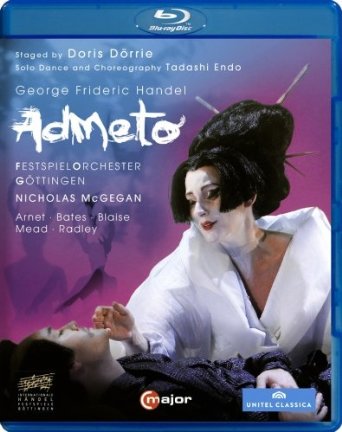
The orchestral playing and solo singing in the musical side of this production from the Internationale Handel-Festspiele Gottingen, from May of 2009, is under the capable direction of Nicholas McGegan. It's great to see him wedged sideways with his Festspiel Orchestra into the tiny pit of the Deutsches Theater; you have complete confidence that he'll keep things moving in a Historically Informed and dramatically appropriate way. Even though this is 7 years old now, the C Major Blu-ray is from a very fine HD source, and the surround sound is outstanding.
But it's naturally the theatrical concept of Doris Dorrie that causes the most discussion, since it adds an additional layer of abstraction to the already formalized conventions of Baroque opera. This layer, the transposition of the ancient Greek source materials from 18th century Europe to the Samurai culture - also 18th century - of Japan, didn't convince me at first. But then a set-piece of outstanding beauty justified the entire project for me, Ercole the Hero dressed as a Sumo wrestler included. This was Alceste's recitative 'Non lagrimate, o miei seguaci' and her aria 'Faro cosi piu bella', in which the heroine tells her entourage that she plans to kill herself to save her husband Admeto. Beginning as shadows behind a screen - another layer of abstraction - Alceste and her maids form a tableau vivante, and though they emerge in three dimensions, the formalized beauty remains and they seem no more flesh and blood than before. Indeed, with their pastel robes and faces painted white, they're more like faded early Renaissance frescoes than actual people. When Alceste returns behind the screen and the deed is done, again in a scene that could be a painting, it's sad, but sadder still because all the time Alceste (Marie Arnet) is singing an aria of exquisite beauty.
There are other highlights in the staging, and each is lamp-shaded to ensure we're very much aware of the conventions being flouted and new conventions being inserted. This is the very acme of self-aware stage-craft. The talented members of the Mamu Dance Theatre are variously ghosts, sheep, demons and deer, each time in set-pieces that I'm sure are no more artificial than the original ballets from Handel's time. This is highly imaginative stage-craft, nearly as imaginative as Handel's music. What it isn't is subtle, and of course Handel is a master of subtle effects, musical and dramatic.
Singing honours go to Marie Arnet, of course, but also to Tim Mead as Admeto and to Kirsten Blaise as Antigona. All are fine actors as well as excellent singers, and remind us of the humanity underneath the 18th century European and Japanese conventions and the 21st century International operatic emphasis on whimsy, irony and self-reference. The more opera tries to subvert itself, the more like traditional opera it seems, and that's largely to the good, when musicianship and stagecraft and technology together can create something as beautiful as this.
This new Blu-ray disc reissue of the production of Handel's opera-oratorio Hercules filmed in the Palais Garnier in 2004 is very much welcome. The HD picture and DTS 5.1 sound are both outstanding, and there is an amazing feeling of presence when you sit down in front of your screen. Most important, of course, is the music and the acting and the production: I loved everything about all of it, nearly unreservedly.
The music Handel wrote for Hercules is amazing. Its beauty is obvious, and in the late Luc Bondy's production, with the modernizing translation/adaptation of playwright Martin Crimp, its psychological depth is apparent as well. Naturally, that only happens with great acting by the principals and chorus (who play a very important role), and fine singing as well. William Christie provides impeccable Historically-Informed Performance credentials for the music, and most importantly keeps the nearly unbroken intense mood on stage from swamping the musical sense Handel brings to this project.
But as good as everyone is in the pit and on the stage, this is Joyce DiDonato's show. A great, great performance!
I'm in the middle of a #MessiahMarathon: listening to as many different versions of Handel's masterpiece as I can comfortably manage during the month of December. I'm holding up fairly well; it's amazing how listenable this music is!
Number 7 was a real eye-opener: the 1959 recording that Sir Thomas Beecham made with the Royal Philharmonic Orchestra. After listening to mainly nimble, light, vibrato-less HIP versions, the slow, frankly Romantic, overblown phrasing of Beecham and the odd excrescences of arranger Eugene Goossens really jump out at one. Goossens isn't afraid to add harps and cymbal crashes. "As rescored by Goossens," said Beecham after it was all done, "Handel's music glowed, boomed and tinkled unprecedentedly." But the whole thing is oddly compelling, and in the end just as musical as Mozart's version (which I love). It's just that it tends to make me giggle.
I happen to be reading producer John Culshaw's Putting the Record Straight, which goes into some detail about this project. Decca and RCA were at the time involved in a distribution partnership, and one of their executives decided that Joan Sutherland, who was at the time turning into a big star, should be added to the cast. Culshaw takes up the story:
"The first crisis occurred within a day or two of the start of Messiah, for Beecham decided he could not abide Sutherland. For her part, she was only too ready to leave; she was inclined to agree with Beecham that Messiah (or, rather, Messiah in the Beecham manner) was unsuitable for her."
So Sutherland was replaced with Jennifer Vyvyan. The soloists, by the way, all have strong voices with strongly-etched dramatic shading, and Beecham gives them plenty of room to emote. Even back in 1959 there were calls to make Messiah more authentic, so Beecham was going a bit against the grain with pretty much everything he did. The great conductor insisted, though, that Handel would have liked it his way:
"He would have used every damn thing he could get his hands on. Hundreds of people. Thousands of people. But not that Australian woman!"
In the end Beecham had the last laugh. The recording (on three LPs - Beecham was in no hurry) was a big money-maker for RCA at the time, and again when it was released on CD in 1992. Even today there are people who just love this, though I'm afraid we're entering Culture War territory here. From reading some of the comments at Amazon, there are those who think that Historically-Informed Performance is just another part of the War on Christmas. The damn leftist atheist musicologists are after my rum-and-eggnog, my Merry Christmas! Starbucks cup, and all the vibrato in my big orchestras.