Reviews and occasional notes on classical music
"Music, both vocall and instrumental, so good, so delectable, so rare, so admirable, so super excellent, that it did even ravish and stupifie all those strangers that never heard the like." - Thomas Coryat, after hearing 3 hours of music at the Scuola di San Rocco in Venice, 1608.
Showing posts with label Britten. Show all posts
Sunday, September 10, 2017
Dynamic music in exile
Benjamin Britten & Paul Hindemith: Violin Concertos
It's looking like Paul Hindemith's reputation might have turned a corner; there have been some really first-class releases of his music in the last few years. I've recently reviewed the Amar Quartet's excellent Complete String Quartets on Naxos and another fine album of chamber music with clarinet from Brilliant Classics. Slightly older, but quite spectacular, was an outstanding all-Hindemith disc from Midori and Christoph Eschenbach. Now we have a fine new recording of the Hindemith Violin Concerto from Arabella Steinbacher and the Berlin Radio Symphony Orchestra under Vladimir Jurowski. It's coupled with an equally beautifully-played Britten Concerto.
These two works were both written in 1939, when each of these composers was in exile from his native land; Britten in America and Hindemith in Switzerland, and later America as well. "Only the misfortune of exile," says Stefan Zweig, "can provide the in-depth understanding and the overview into the realities of the world." There's some nostalgic sadness in each work, as there was in Zweig's own work about exile, The World of Yesterday, written in Brazil in the early 1940s. But, typically of both composers, this music is very much forward-looking, dynamic and really rather optimistic. Steinbacher plays with verve and great virtuosity, while Jurowski and his musicians provide the requisite big sound for these two 19th century-style concertos, the dramatic and lively Britten, and the lyrical, stirring Hindemith. Very highly recommended.
This album will be released on October 20, 2017.
Thursday, April 6, 2017
A marathon of great music and great performance
The great cellist Mstislav Rostropovich was in his prime, about to turn 40, when he arrived in New York with the London Symphony Orchestra for eight concerts at Carnegie Hall between February 23 and March 12, 1967. The excitement surrounding this project is easy to hear; there's a real sense of occasion in this music, and though the applause for each piece is cut quite short, what's left is (rightly) very enthusiastic. For this six-CD set Doremi has chosen 22 concertos from the 30 performed. It seems a bit churlish to complain, with all the amazing riches included, about what isn't here. But what a shame to have the greatest of 20th century cello concertos, the Elgar, to lead off the set, without the greatest 19th century concerto, the Dvorak, to go with it. I also regret not having the Schumann concerto, and the two Haydn concertos. But let's accentuate the positive, beginning with the Elgar Cello Concerto. Comparing it with the classic performance by Jacqueline du Pre (with the same LSO), it seems much cooler at first than du Pre's more emotional attack, but Rostropovich soon turns on the afterburners, and provides just as satisfying an experience when the piece is over. Other highlights include Prokofiev's Concertino, a work that is much more substantial and interesting than the diminutive title would suggest, and the Britten Symphony for Cello and Orchestra, which was written for Rostropovich in 1964. I also much enjoyed the Hindemith Concerto, and the two American world premieres, by Foss and Piston. Ottorino Respighi's Adagio con variazioni is a really remarkable piece of music, which Rostropovich sinks his teeth into. It's marvellous to have it available in such a strong performance.
Unfortunately, my enjoyment in this music is not completely unalloyed. The baroque music, concertos by Vivaldi and Tartini, does not match the level of the rest of the program. I was perfectly willing to put aside my love for the historically informed style in vogue today, even indulging in a bit of guilty pleasure. But I got no pleasure from these lumpish, unformed performances. There was precious little charm here, and no real feeling that Rostropovich was engaged in this music. These are the exceptions, though, rather than the rule, and I can enthusiastically recommend this marathon of great music and great performance.
Friday, October 14, 2016
A modern masterpiece brought to post-modern life
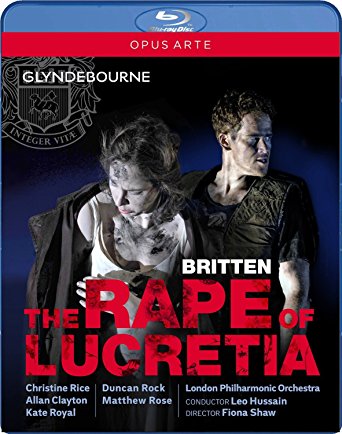
This new Opus Arte Blu-ray disc of last year's Glyndbourne production of Britten's The Rape of Lucretia is a very welcome record of the highly praised opera directed by Fiona Shaw. Shaw's concept adds new layers to the cleverly designed original concept of Britten and his librettist Ronald Duncan. There's an intended pun there, since the Male and Female Choruses act as if they were post-war British archaeologists uncovering the tragic story of Lucretia and her rape by Tarquinius, prince of Rome. We dig into the story through layers of dirt, and the set and lighting and costume design all focus our attention on Britten's perennial theme, the corruption of innocence.
I watched this with the equally sordid American election swirling in the background, which seemed pertinent in a way, but unfortunate in others. There's lots in the story as told by Shaw that's vile, but it also has dignity and gravitas, and the violence of the central act is never gratuitous. That's helped immensely by the amazing acting and singing of the cast, and especially Christine Rice as Lucretia and Duncan Rock as Tarquinius. Musically as well we have the best possible players - thirteen musicians from the London Philharmonic Orchestra and their leader, Leo Hussain - who, as Fiona Shaw herself says, "have [the work] in their fingers, in their bodies." The HD sound and picture are outstanding; much more impressive than a video clip can put across. This is a modern masterpiece brought to post-modern life.
Tuesday, April 26, 2016
Rule Britannia
It's British Music week here at Music for Several Instruments. I'm listening to three new Chandos discs: a 2-CD re-issue of British Cello Concertos with Raphael Wallfisch, volume 2 in the Overtures from the British Isles series from Rumon Gamba and the BBC National Orchestra of Wales, and another volume 2, in Tasmin Little & Piers Lane's British Violin Sonatas series. Before we get started, then, just a reminder of what went before, or as they say on TV,
Previously, on British Music from Chandos....
The first disc in the Tasmin Little/Piers Lane series, released in June of 2013, is marvellous, and this model bodes well for the new disc, due to be released in June 2016. The full-blown pastoral yumminess of Howard Ferguson's Violin Sonata is presented to its best advantage, without sentimental flourishes or ironic winks. Benjamin Britten flexes his muscles in his early Suite for Violin and Piano; grown-up music from a 21-year-old. This is definitely a Continental side-trip for Little and Lane - it was chosen for a Barcelona Contemporary Music festival by Anton Webern and Ernest Ansermet - and they provide the requisite sophistication here. The William Walton pieces are a bit in both camps, looking back with nostalgia and ahead with spikes out, but again the shift in tone is handled very well, with sensitivity to this more introverted, cerebral music.
The first of the Rumon Gamba Overtures discs, from January 2014, was also a real success, and with some quite obscure music:
This disc got rave reviews from Britain - I'm not sure it was heard much anywhere else. These are well-crafted late Victorian overtures, and together they conjure a time when classical music, of the lighter variety, to be sure, was truly popular. We're all off to the concert!
Friday, November 27, 2015
Masterpieces of British choral music
I first came across Marcus Creed’s SWR Vokalensemble Stuttgart when they released an outstanding 2011 CD of choral works by Heitor Villa-Lobos. It’s part of an impressive series of recordings of music from around the world in uniform editions with simple but attractive standard design, published by Haenssler Classics from 2008 until last year’s America album. The latest recording is a joint production of Naxos Deutschland Musik and SWR Media Services, so I presume the Haenssler connection is gone, but this CD is definitely another winner. The programme is well chosen to represent relatively recent British choral composers, from Benjamin Britten, who died in 1976, to two still-living composers and another two only recently passed.
The Alleluia for 13-part a cappella choir by James Macmillan was written for the Oregon Bach Festival to commemorate the 80th birthday of conductor Helmuth Rilling, and it’s fittingly full of Bach references. This is complex music with gorgeous textures, and it shows off the versatility of the Vokalensemble and the beauty of their voices, as well as the excellence of the engineering. This was recorded in the reverberant acoustic of the Christuskirche Ganscheide in Stuttgart, as was the Schuon Hymnen of John Tavener, another piece of great beauty and a mystical vibe written to sacred texts. The rest of the album comes from the more restricted acoustic of the SWR studio. Both Jonathan Harvey’s boisterous How could the soul not take flight and Peter Maxwell Davies’ irreverent Corpus Christi with Cat and Mouse are full of complex sounds that would be lost in a cathedral acoustic. The eight short hymns and carols that make up Britten’s Sacred and Profane, op. 91, are distinguished by their beauty or ingenuity: of vocal line, rhythm or harmony. Creed’s singers have the measure of this music. This is a highly accomplished and beautifully presented programme that compares well with any UK choral recording I’ve heard in this century.
Monday, November 2, 2015
A Golden Disc
From October 3, 2015:
This is the first disc from a fine new choir, Cappella SF, led by Ragnar Bohlin, Director of the San Francisco Symphony Chorus. The program chosen is, I think, the best kind for a Christmas CD: a mixture of old favourites and unfamiliar pieces or arrangements. As well, there’s a variety of musical textures, a mix of soloists and featured parts, and the important contribution of harp and organ on some of the tracks. Most importantly, the singing is of a very high standard. The title track, Eric Whitacre’s Lux Aurumque, calls for “absolute vocal clarity and pinpoint accuracy of intonation,” as Lindsay Koob writes in her excellent liner notes. Bohlin and his singers deliver just that. Though I’ve always preferred the pure sound of an alto in the Britten carols, soprano soloist Alexandra Sessler is very impressive in Balulalow. Of the less familiar carols on the disc, I especially enjoyed Fredrik Sixten’s simple but profound The Song of the Star, and the very beautiful Jul, Jul, Stralande Jul, by Gustaf Nordqvist. The disc ends with Barlow Bradford’s great arrangement of my favourite, and what I think is the best, of all the secular Christmas songs, Hugh Martin’s Have Yourself a Merry Little Christmas.
Saturday, October 31, 2015
In the beginning is the night
From November 10, 2011:
Sandrine Piau's new collection of songs on Naive, entitled "Après un rêve", gathers a fascinating group of pieces by a wide range of composers that all share the subjects of dreams, sleeping, and waking. "In the beginning is the night," Piau says in the introductory note included in the uncommonly full and interesting liner notes, "the cradle of our childhood terrors, peopled with creatures as fearsome as they are fascinating..."
With more than capable support from pianist Susan Manoff, Piau is outstanding in the French songs - Faure, Chausson, Poulenc - and more than capable in the three by Richard Strauss. The song set "Galgenlieder" by Vincent Bouchot was new to me, and certainly fit the mood set by the rest of the pieces chosen for this recital. I was especially pleased with the three folk song arrangements of Benjamin Britten which finish the disc. They add a final childish twist to a sometimes spooky and always disorienting hour of music that's beautifully presented.
Sandrine Piau's new collection of songs on Naive, entitled "Après un rêve", gathers a fascinating group of pieces by a wide range of composers that all share the subjects of dreams, sleeping, and waking. "In the beginning is the night," Piau says in the introductory note included in the uncommonly full and interesting liner notes, "the cradle of our childhood terrors, peopled with creatures as fearsome as they are fascinating..."
With more than capable support from pianist Susan Manoff, Piau is outstanding in the French songs - Faure, Chausson, Poulenc - and more than capable in the three by Richard Strauss. The song set "Galgenlieder" by Vincent Bouchot was new to me, and certainly fit the mood set by the rest of the pieces chosen for this recital. I was especially pleased with the three folk song arrangements of Benjamin Britten which finish the disc. They add a final childish twist to a sometimes spooky and always disorienting hour of music that's beautifully presented.
Subscribe to:
Posts (Atom)