Reviews and occasional notes on classical music

Reviews and occasional notes on classical music

"Music, both vocall and instrumental, so good, so delectable, so rare, so admirable, so super excellent, that it did even ravish and stupifie all those strangers that never heard the like." - Thomas Coryat, after hearing 3 hours of music at the Scuola di San Rocco in Venice, 1608.

Showing posts with label Steinway. Show all posts

Sunday, November 19, 2017

Lovely Christmas jazz, spare and sad


'Tasteful jazz arrangements', it says on the back cover, but these are much more sophisticated arrangements than you're likely to find at the lounge at the local Sheraton or Marriott Hotel. In a letter to his father Mozart praises a pianist's "taste, feeling, and a brilliant style of playing", and this is the territory we're in here with pianist Simon Mulligan, who gets a fine piano to play on, in a great venue, with first-class engineering and presentation for this lovely disc from Steinway & Sons. The Christmas jazz antecedents here are Oscar Peterson, whose Christmas album is first-class, but quite a bit livelier than this one; Bill Evans, whose Santa Claus is Coming to Town is a treat, full of wit and good humour; and of course Vince Guaraldi, who brought jazz Christmas music to the masses with the debut of A Charlie Brown Christmas on CBS on December 9, 1965. Mulligan has major classical bona fides (Chopin, Beethoven, Shostakovich) and a thorough grounding in the American Songbook to go with what seems to be an encyclopedic knowledge of jazz piano styles. Listen for bits of Art Tatum, George Shearing, Dave Brubeck, but in these arrangements each song has its mood and its story to tell, so none of them feels like a pastiche.

One of my favourite tracks is the first one on the disc, a Hark The Herald Angels Sing that keeps taking completely unexpected turns into surprising places: here to Chopin, there to Scott Joplin, over to Gershwin. There's also a very spare version of Have Yourself a Merry Little Christmas that's a real stand-out, but I especially loved the final song, a Silent Night with a real valedictory feel to it. It has the peace and beauty of falling snow at night, but also all of the melancholy we've come to expect from Christmas songs in a minor key, bringing some solace, but also, as Orhan Pamuk remarks in another context, "adding depth to our sorrow".


Wednesday, November 8, 2017

Organic, powerful Glass


Here we are again. Two releases of Philip Glass's great cycle of Etudes for Piano in November 2017: this Steinway & Sons album by Jenny Lin follows Jeroen Van Veen's for Brilliant Classics, which was released earlier this month. These two discs emphasize the stature of this composer and the importance of this music. Though the earliest Etudes began as studies to help Glass improve his technique as a pianist, the set as a whole now represents a landmark in 21st century music.

Lin's version is significantly faster than Van Veen's, cooler and lighter and more mercurial. This cuts against Glass's own focus on the emotional content of his music, but I find Lin's reading totally convincing. In Van Veen's more romantic approach, the emotion sweeps us up, while Lin's grows slowly in subtle shifts. As Glass says about his music from the late 60s and early 70s, "It was not meant to be mindless, but to be organic and powerful, and mindful, too."
The trick of that music was that it allowed the attention to form around a series of successive events that became almost unnoticeable - around the function of listening to something that seemed as if it were not changing, but was actually changing all the time. (Words Without Music)
Jenny Lin has been involved in the one-evening events where a number of pianists including Glass himself play all 20 Etudes. She'll join Glass, Aaron Diehl, Jason Moran and Blood Orange’s Dev Hynes in this program at the Kennedy Center in Washington DC in March of 2018.

This album will be released on November 17, 2017.

Friday, August 25, 2017

Filling in details of Lenny's life and works


Leonard Bernstein: the complete solo piano works

I'm writing this review on Leonard Bernstein's 99th birthday. It's time to begin the Lenny Centennial celebrations, and what a good way to begin: listening (though not all at once) to the music he wrote for solo piano, for two and four hands. There aren't too many substantial works here, with most of the 56 tracks on two discs running two minutes or less. Bernstein wrote mainly miniatures, character pieces which quite often made reference to friends and professional colleagues. Even his Piano Sonata, an early piece written in 1938, is hardly a big work; the two movements add up to only 11 minutes. Pianist Leann Osterkamp helps to provide a more organic view of Bernstein's piano oeuvre by organizing the pieces more or less chronologically, but grouping pieces which share a connection with larger works together. She also includes a number of unpublished pieces and works that have never been recorded. Most importantly, Osterkamp plays this music with the perfect balance of respect for the composer and an awareness of the nature of circumstances of the work's composition. She has a lightness of touch that works well with Bernstein's often ironic point of view, recognizing mock seriousness or sentimentality but playing other works in a more straightforward way when required. Though the piano music represents nothing as profound or important as Bernstein's orchestral music or his works for the stage or the musical theatre, this delightful music fills in much detail of his character and his life. Michael Barrett provides an extra two hands in Bernstein's Bridal Suite, which is full of lovely melodies, ingenious touches and out and out jokes.

Bernstein at the piano during rehearsals for On the Town, 1953, via NYPL digital collection
One thing that these works illustrate is how social a person Leonard Bernstein was. He obviously gained energy from his huge network of close friends and colleagues in musical, theatrical and other artistic circles. Nothing could be further from the old stereotype of the composer wrestling with his Muse in his lonely attic. In the picture above he works with Roz Russell, Betty Comden, Adolph Green, George Abbott, Lehman Engel on the songs for Wonderful Town. It's a great picture, and it goes so well with the pictures he draws of both Comden and Green in two separate pieces included in this album. Bring on more music - and performance - of this calibre in the next 12 months!

To be released on September 15, 2017.

Monday, April 18, 2016

Intensity in concert, and in the studio

http://amzn.to/29GogUu

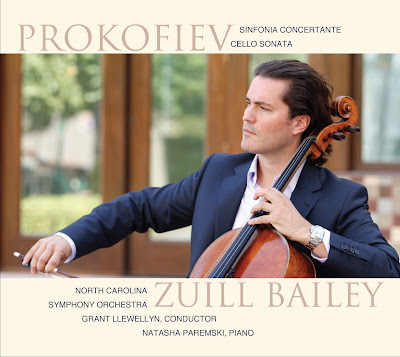
Cellist Zuill Bailey repeats almost exactly the formula that won raves from the critics in his 2014 Telarc recording of cello music by Benjamin Britten. That included the Symphony-Concerto and a Cello Sonata, as does this new Steinway disc of music by Sergei Prokofiev, due to be released on April 29, 2016. Bailey has the same supporting cast as well: the North Carolina Symphony conducted by Grant Llewellyn, and in the Sonata, pianist Natasha Paremski. The concerted works of both discs were recorded live at the Meymandi Concert Hall in Raleigh, while the sonatas come from the studio.

Way back in 2002 Bailey gave a wide-ranging interview with Tim Janof of the Internet Cello Society, in which he talked about the cello recordings that he especially loved. I'm not surprised with his choice of Rostropovich's famous recording of the Sinfonia Concertante with the Royal Philharmonic Orchestra and Sir Malcolm Sargent. Bailey and Llewellyn follow the great Russian/English team in terms of tempi, which tend to be a bit brisker than other recordings (especially Ma's, with Maazel in Pittsburgh). The cello is brought quite far forward, front and centre, in the recording, though, putting the emphasis more on the Concertante than the Sinfonia.  It's an especially fine live recording, though, with that electric feeling you sometimes get in the concert hall. There's no sign of the audience, even at the end, which is different from the nine minutes of applause included in the latest recording from Atlanta.

This great work is extremely well served on disc. I listened to bits of a dozen versions, and all of the Rostropovich, Ma, Harrell, and Wallfisch, and marvelled at the way great and modest cellists could differ in small and large ways while still sounding so musical. The lovely tone of Bailey's venerable instrument - the 1693 Goffriller played by Mischa Schneider for three decades in the Budapest String Quartet - and Bailey's confident mastery of the work, puts this recording in the same league as those masters, with the very fine orchestral playing of the Carolinians very nearly up to the Royal Philharmonic, Pittsburgh or Liverpool orchestras.

I shouldn't forget the 1949 Sonata, which is fine indeed. Prokofiev, who had recently been charged with formalism in music, did not know if he'd ever have his music performed again, or worse. So he forgets about impressive effects to wow the audience; this is more like a personal working out of things in his brain. And what a brain! Bailey and Paremski (again, an equal musical partner) keep their eyes down and the feeling intense, eschewing obvious effects in favour of the work's bleak architecture.

In the world of the recording star you're always moving on to the next project. I follow Bailey on Twitter (as should you), and on April 16, 2016 he tweeted about the latest live recording project with the North Carolina Symphony, conductor Grant Llewellyn, and violinist Philippe Quint: the Brahms Double Concerto. I'm looking forward to this recording!

Bailey, Llewellyn & Quint with the NC Symphony, from Bailey's Facebook page.

Sunday, November 1, 2015

A welcome program of romantic music from Argentina

From July 12, 2012:


I haven't heard much this year about the 2012 Centennial of Carlos Guastavino, who died in 2000. It's nice, then, to see his 10 Cantos Populares at the centre of this new disc of Piano Music of Argentina, from the Argentine-American pianist Mirian Conti.

Conti's 2010 Chopin Mazurkas recording, one of the first releases from the new Steinway & Sons label, was very well received. I know Conti best from her South American discs on Koch International & Troy, and it's nice to have her back with music from her homeland. That's especially the case because so many of the composers included on the disc will be new to most, because the pieces Conti has chosen are so full of character and so varied, and because they're all so beautifully played and recorded on an impressive Steinway piano.

Conti brings three generations of Argentine composers together with a nostalgia theme explained in a fascinating liner-notes essay. The music is informed by the dual folkloric traditions of Argentina, urban tangos and the dances of the gauchos, and coloured by the music of the French and Spanish modernists who had such an impact on South American composers from Villa-Lobos & Ginastera to Tom Jobim & Piazzolla. It's all very romantically sad, and often very simply beautiful. It's Guastavino's melodies, harmonies & subtle rhythms that stand out, but the whole package is charming, and definitely worth a listen!

Saturday, October 31, 2015

Mysticism and Modernism

From June 1, 2011:


Adventurous programmes and amazing technique are the hallmarks of Jenny Lin's recordings over the past decade. I really sat up and took notice when Hannsler Classics released her Shostakovich Preludes and Fugues in 2009. This was a fresh take on some of my favourite music; an outstanding disc with depth as well as fireworks.

So I was really pleased to see her new disc of Federico Mompou's Musica Callada - Silent Music - an important work from the 1960s. This music is without fireworks of any kind, but it requires a skilled pianist to put across this deceptively simple music. The third piece of the first book, "Placide" is an excellent example. It is indeed placid, and simple, almost child-like. It reminds one of some of Schumann's Kinderszenen, or the folk-like tunes of Villa-Lobos's Guia Pratico. It has a nostalgic sadness, and Lin plays it with restraint, almost reverence.

Musica Callada is Mompou's late masterpiece, written under the twin influences of mysticism and modernism. His literary inspiration was the 16th century Spanish poet St. John of the Cross, who provides Mompou's title. But the composer also makes reference to the French Symbolist poet Paul Valery, when he quotes the poem Le pas at the top of the score to the second piece in Book I, Lent.

Mompou's musical influences are Spanish and and French modernists. The great Catalan composers Albeniz and Granados share Mompou's interest in Ravel and Debussy, but I wonder if all three are channeling their own regional folk music as well. Mompou is especially interested in Erik Satie, though the pieces on this disc partake only of Satie's understatement and not his humour. This music is spare, but hardly light!

This disc is the first I've seen from the brand new Steinway & Sons label. The sound is lifelike, open, and resonant. Guess what kind of piano Lin is playing?