Reviews and occasional notes on classical music

Reviews and occasional notes on classical music

"Music, both vocall and instrumental, so good, so delectable, so rare, so admirable, so super excellent, that it did even ravish and stupifie all those strangers that never heard the like." - Thomas Coryat, after hearing 3 hours of music at the Scuola di San Rocco in Venice, 1608.

Saturday, July 23, 2022

Stylish and characterful Bach concertos from Japan


 J. S. Bach: Harpsichord Concertos 3, 4, 6 & 7

This is the second release from BIS of Bach Harpsichord Concertos by Masato Suzuki and Bach Collegium Japan - the first was released in 2020. I've long been a lover of the recordings of this orchestra, especially the landmark series of Bach Cantatas under Masato's father, and the group's founder, Mazaaki Suzuki. Though this is a very small subset of musicians - only two violins and a single viola, cello and bass - there is the same nuance and character here as in the Cantatas and Passions. There's also the same warm sound envelope provided by the BIS engineers, producers and editors, and the marvellous, innovative BIS design and marketing, developed over years of collaboration between Japan and Sweden.

Like his father, Masato Suzuki is a very fine harpsichordist, and is fast becoming known around the world as a conductor. He's made the move from the continuo section - Baroque's Special Teams unit - to the podium with style; he's now the Principal Conductor of Bach Collegium Japan. I look forward to more recordings, of Bach, other Baroque composers and beyond, from this excellent musician.


Thursday, July 21, 2022

An intense ending to a wonderful series


 Allan Pettersson: Symphony 15; Viola Concerto

This is the final release in the BIS series of Allan Pettersson's Symphonies, with Christian Lindberg conducting the Norrköping Symphony Orchestra. It's been such a fascinating and revealing journey, shining a light on one of the most remarkable series of works by any 20th century artist. This is now the undisputed champion of Pettersson Symphony cycles on disc, though the recordings by Sergiu Comissiona and Alun Francis have their positive qualities as well. 

The 15th Symphony, from 1978, is a late work; only one more remained before the composer died in 1980 (there were fragments of the 17th Symphony as well, which is included in this series). Symphony 15 exhibits Pettersson's usual dense textures, intense emotions and carefully contrived segments put together into an impressive architecture. This is by now second nature to Lindberg and his fine musicians, though there is no hint of routine; this is a fresh sounding performance that is well served by the always accomplished BIS engineers.

Pettersson's Viola Concerto came at the very end of his life, and wasn't performed until 1988. Like the 2nd Violin Concerto and the 16th Symphony, written in the same period, this work has very much of an orchestral rather than a concerto texture, with little attention paid to the usual solo pyrotechnics. Pettersson referred to the Violin Concerto as a Symphony, and the Symphony as a Saxophone Concerto, while his widow Gudrun called this work a "Viola Symphony". As with the 2nd Violin Concerto, it's tempting to think of the solo instrument here as a representation of the composer himself, commenting as an individual estranged from but deeply connected to the world of the orchestra. The viola was Pettersson's instrument, so I don't think it's too far-fetched. If that's the case, it's perhaps ironic that the composer should represent his own alienation from the world, a result of both his temperament and his severe, chronic rheumatoid arthritis, by integrating the solo part so closely with the whole orchestra.

Violist Ellen Nisbeth gets a beautiful sound from her Nicolò Amati instrument, from 1714. This is a great way to cap off a wonderful series.

Tuesday, July 19, 2022

Orchestral music of a major Brazilian composer


César Guerra-Peixe was born and died about 30 years after Heitor Villa-Lobos, and though he initially took a completely different tack, in the end he came to much the same musical place: a mix of folkloric and erudite strains, of indigenous Brazilian, African and European traditions. Like Villa, his mix of European avant garde and popular music sounds especially Brazilian. This character is brilliantly illustrated by the wonderful painting on the album cover: J. Borges's Forró Sertanejo, which shows a colourful, multi-ethnic mix of traditions of dance and instrumental music.

In the 1920s Villa-Lobos brought Brazilian music into the modernist world, but he later rejected serialism, which came to Brazil with Hans-Joachim Koellreutter, a student of Paul Hindemith and a refugee from Naziism. Guerra-Peixe studied with Koellreutter, and was a member of the "Musica Viva" group that promoted atonality. As with Villa-Lobos, the folkloric strain in Guerra-Peixe's music runs deep. But the progressive European strain - modernism for Villa, serialism for Guerra-Peixe - is never completely submerged. Both composers continue to blend both in their later music.

The two Symphonic Suites recorded here in this new release in the essential "Music of Brazil" series are both from 1955. The Symphonic Suite No. 1 ‘Paulista’ begins with an insistent phrase reminiscent of the beginning of Villa-Lobos's Bachianas Brasileiras No. 1, from 1930. The work is full of dance rhythms gathered from folk tunes of São Paulo and the surrounding countryside. Guerra-Peixe has put together an appealing mix of mainly tonal dance tunes with the odd atonal passage for spice. The 2nd movement, Jongo, is an Afro-Brazilian dance that often reminds one of the music from the following decade written by Steve Reich, Terry Riley and Philip Glass. The remarkable fourth movement, Tambu, is a moving liturgical procession that contrasts the brass and drums with intersessions from the strings. I was reminded of the Vorspeil: Concert of Angels from Mathis der Maler, written in 1932 by Guerra-Peixe's teacher's teacher Paul Hindemith.

By the way, in 1954, the year before Guerra-Peixe's first Symphonic Suite, Villa-Lobos had written his own symphonic tribute to São Paulo: his massive 10th Symphony, "Amerindia", for the 400th anniversary of the city's founding. However, I'm thinking that any similarities between the two works are more likely to come from a common source: Villa's own Bachianas Brasileiras suites from the 1930s and 40s. These are the source for so much of Brazil's music - both classical and popular - from then until today.

Guerra-Peixe's 2nd Symphonic Suite, "Pernambucana", uses the music of his second home, Recife and the surrounding area of Pernambuco. The music encapsulates the Carnaval de Pernambuco, with the dances of the North-East colourfully presented by a large orchestra with a large percussion component. The folkloric content has a sophisticated envelope: besides the large-scale Choros of Villa-Lobos, especially no. 6, completed in 1942, I hear echoes of Gershwin and Aaron Copland, as well as a host of Hollywood film composers. Guerra-Peixe was himself an active film-scorer; he has 19 composer credits at IMDb. Guerra-Peixe was much more open to jazz influences than Villa-Lobos ever was; the 2nd Symphonic Suite often has the sound of the American big band, and this music anticipates the Henry Mancini's music of the 60s.

The third work on the program is Roda de amigos, from 1979. The Roda is a group of musicians playing together in a circle; the amigos in this case are Guerra-Peixe's own friends. The composer creates pictures of each friend playing a woodwind instrument featured in the four movements: grumpy bassoon, stubborn clarinet, melancholy oboe and mischievous flute. So the work is a clever combination of Peter and the Wolf and the Enigma Variations.

These are all works designed for a large orchestra of virtuoso soloists and a conductor who can keep many plates spinning, mastering complex rhythms along the way. Neil Thomson manages everything with aplomb, and the Goias Philharmonic Orchestra is very much up to the task here. This is the tenth release in the Naxos Music of Brazil series, and it's providing yet another example of the many fine composers who have been in the Villa-Lobos shadow for too long.
 

Wednesday, July 13, 2022

Haydn Symphonies "Les Jeux et Les Plaisirs"


Under the direction of Giovanni Antonini, the Kammerorchester Basel performs three middle-period Haydn Symphonies - numbers 61, 66 and 69 - with a special bonus for the youngsters out there. This is the 12th release in the wonderful Haydn 2032 series from Alpha; only 10 more years of these records until the project is complete and we can break out the cake with 300 candles for Papa Haydn!

This is a fun disc from start to finish. To be sure, in these symphonies Joseph Haydn makes use of the common tropes of the international galant style, but he always puts his own stamp on his symphonies. At this point in his career Haydn does not stray far from the galant schemata, but he conceals within them a complex and cunningly wrought art that seems effortless.

Giovanni Antonini is taking the long view of this immense series of symphonies; he has planned each album's program with care, taking into account the long arc of a great musical career as well as each hour and twenty minute segment. He's plucked three joyful works from 1775-76 to contrast with the more dramatic and erudite group in the 11th disc (which I reviewed here). The sense of fun is palpable in these performances; Antonini and his band are obviously enjoying playing this music, & that's immediately communicated to the listener.

Joseph Haydn's younger brother Michael has written a small kitsch masterpiece in his Toy Symphony, and it receives a spirited performance here. There are parts written for various toy instruments, from trumpet, drum and triangle to ratchet, quail, organ hens and cuckoo. The result is a splendid noise:


I was curious about the bird sounds, so I ran the symphony through the Merlin Bird ID app from The Cornell Lab of Ornithology. I was pleased to see that there was no fooling the Merlin algorithm; it heard no actual birds. As Susan Sontag says in her "Notes on Camp", 
"All camp objects, and persons, contain a large element of artifice. Nothing in nature can be campy."


As with every disc in the Haydn 2032 series, this release is matched with a Magnum photographer; in this case it's the fabulous Spanish photographer Cristina García Rodero. I was thrilled to see these photos, since I only knew her black and white pictures (which are stunning). A number included here are from García Rodero's 2020 exhibition "Holi, the celebration of love".  Holi is an Indian festival of colour, where young people throw colored powders to desire love, fortune and vitality, while they dance and sing in the streets and temples. What a follow-up to a lifetime of amazing black and white photography!


Wednesday, February 2, 2022

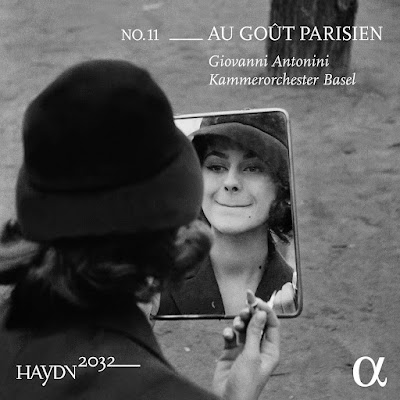
Great Haydn Symphonies "Au Goût Parisien"


Haydn: Symphonies 2, 24, 82, 87

Alpha's Haydn 2032 project continues with this album, the 11th release in the series. In about half the recordings Giovanni Antonini conducts his ensemble Il Giardino Armonico, but here he returns to the Kammerorchester Basel for four Haydn Symphonies with a Parisian connection: 2, 24, 82 and 87. 

Though the Basel orchestra is considerably larger than Il Giardino Armonico - the string complement is ten Violin I, seven Violin II, five Viola, three Double Bass - this is a nimble group that Antonioni takes through the twists and turns of Haydn's music as if he were driving a Ferrari. I've always loved the six Paris Symphonies commissioned by the Chevalier de Saint-Georges in 1788; two are included here. Number 82 is subtitled "L'Ours", for the comical, slightly grumpy features of its finale, complete with the drone of a folk instrument, perhaps a kind of bagpipe. Though it doesn't come with a cute title, Symphony 87 is a perfect mature Haydn symphony, an on-ramp for the Beethoven Symphony Freeway to come. The 24th Symphony is from 1764, a period when Haydn brought a bit of mystery and drama to the gallant symphonies of the time. It's bracketed by two stone-cold masterpieces - number 22, "The Philospher", and number 26, "Lamentatione" - but number 24 has its own positive qualities. I find it at once unsettling and exciting. There's something a little bit dangerous in this performance!

The Paris connection for Symphony 24 is that it was performed there - to great acclaim - in 1773. The 2nd Symphony, written in the late 1750s, was actually published in Paris in 1764. At under 10 minutes, it's the shortest of his symphonies, but there's plenty of incident packed in here. It's slight in stature, but not in style; the Little Symphony That Could.

Antonini brings great energy to all four symphonies here - great and small. Though this series doesn't replace my all-time choice for the complete Haydn symphonies, Adam Fischer's version on 37 CDs with the Austro-Hungarian Haydn Orchestra, I'm beginning to see that we now have a very close challenger, not quite a third of the way to 2032. 

Each of the Haydn 2032 releases features a Magnum photographer in the album liner booklet, and this time it's the turn of the great Elliot Erwitt, a great choice considering the theme: "Au Goût Parisien". He took so many great photos of the City of Light; I'll post one here that he took in 1989; for some reason it isn't included in the booklet.


Charming music from a great eccentric

Lord Berners: Ballet Music, Les Sirènes, Cupid and Psyche
 

Gerald Hugh Tyrwhitt-Wilson, 14th Baron Berners, aka Lord Berners is one of the great English eccentrics. He wrote his own epitaph, for example, which appears on his gravestone:

Here lies Lord Berners
One of the learners
His great love of learning
May earn him a burning
But, Praise the Lord!
He seldom was bored.

Though he hung out with such forward-looking artists as Igor Stravinsky, Salvador Dali and Gertrude Stein, his music (except for some early works) isn't especially avant garde or modernist. Rather, it is accessible, tuneful and light.

Lord Berners by Bill Brandt, 1945

Lord Berners by Bill Brandt, 1945
"I wonder if by any chance you are free to dine tomorrow night? 
It is only a tiny party for Winston [Churchill] and GBS [George Bernard Shaw].
There will be no one else except for Toscanini and myself."

Indeed, the music often sounds much like superior English Light Music, in the style of Eric Coates or Percy Grainger. The charming 30-second Fanfare, though, hearkens back to Façade, by William Walton & Edith Sitwell, while the Habanero from Les Sirènes is awfully similar to Darius Milhaud's Le Boeuf Sur Le Toit. So progressive to a degree, though his models were 20 to 30 years in the past.

The key word here is "charm". It doesn't require any deep thought, but as ballet music (with choreography in both ballets by Frederick Ashton) it shouldn't. More than an hour of uninterrupted charm is a true gift.

The wonderful cover painting is Edward Burne-Jones's "Cupid Delivering Psyche", from 1867.

This album will be released on March 11, 2022.

Monday, January 24, 2022

Miraculous recordings from a great master


 Wilhelm Kempff: Bach, Mozart, Schubert & Schumann

This welcome historic release from APR Recordings includes Wilhelm Kempff's complete recordings for Polydor of music by Bach, Mozart, Schubert and Schumann, made in the period 1927 to 1936. We have here nearly 75 minutes of music, which together make for an appealing recital.

Indeed, though I know Kempff primarily through his recordings of Beethoven's Piano Sonatas, I would find almost anything the great pianist plays to be appealing. But there's something special about these recordings, something quite miraculous. In spite of the relatively primitive technology involved in these early electrical recordings, I had no trouble at all forgetting sonic imperfections, and zeroing in on a great master channeling great composers. The French Suite no. 5 of Bach, recorded in 1935, is the highlight of the disc; it's a masterful interpretation. I was in awe of this from the first time I heard it, since I had the strong feeling that Kempff was communicating his own awe, as he so often does with Beethoven, before a great masterwork.

I was quite surprised by Kempff's interpretation of Mozart's Piano Sonata in A major, K. 331, recorded in 1935. It seems much more modern than I would have expected, with crisp, carefully delineated lines, and no hint of the romanticizing prettiness that plagued Mozart music of the period. While not completely Historically Informed, this performance once again demonstrates a real, personal connection between pianist and composer.

There are a number of Kempff transcriptions here, including some Bach pieces that have entered the repertoire of many pianists, and a very clever reworking of Liszt's version of Schubert's "Hark, Hark, the Lark!". The disc ends with a beautiful dream: Schumann's Träumerie, recorded in 1936.

I've characterized the piano playing of Wilhelm Kempff as a miracle, but there's another, albeit smaller, miracle involved in this release. It's quite amazing that one can listen to all of this music with little acoustic worries. That's a testament to the state-of-the-art German engineering behind the recordings themselves, but also, of course to work since then by the Producer and Audio Restoration Engineer for this project, Mark Obert-Thorn. The many years between recording and listening seem simply to vanish.

Stephen Siek's liner essay is first-rate, mixing in technical details, but making sure that storytelling prevails. Learning about Kempff's 1934 trip to Buenos Aires on the Graf Zeppelin adds a great deal to the charm of the entire project.

This disc will be released March 4, 2022.