Reviews and occasional notes on classical music

Reviews and occasional notes on classical music

"Music, both vocall and instrumental, so good, so delectable, so rare, so admirable, so super excellent, that it did even ravish and stupifie all those strangers that never heard the like." - Thomas Coryat, after hearing 3 hours of music at the Scuola di San Rocco in Venice, 1608.

Tuesday, April 22, 2025

A worthwhile Shostakovich grab-bag


Shostakovich: Chamber Symphony, String Quartets, Piano Music

This new 4-CD set coming on June 6, 2025 consists of recordings made by Capriccio and BR Klassik in the period 2004-06. There's a lot of music here - about four hours altogether - and it's definitely a worthwhile purchase, at a bargain price.

Here are the complete contents of the set:


The first CD includes some works from this 2004 CD from Capriccio, namely Rudolph Barshai's version of the 8th String Quartet for String Orchestra, the Prelude and Scherzo, op. 11, and Alfred Schnittke's Prelude in Memory of Dimitri Shostakovich. These are all marvellous works, and good performances. The Schnittke piece is especially moving, and a valuable addendum to such a large compendium of Shostakovich's music.

As well, the first disc includes Lena Auerbach's arrangement of the Poems of Marina Tsvetaeva, op. 143, from a 2006 CD. These are poignant poems sung by soprano Zoryana Kushpler, with comments from a string quartet, here the Petersen String Quartet of Berlin, sometimes pithy, sometimes full of compassion.

Here's the original Capriccio BR Klassik album cover for the Piano Quintet and two String Quartets on CD 2, from 2005:

There's a lot of music to review here, and I've only listened all the way through once. But I like what I've heard so far. Of course, with the String Quartets, the bar is set very high, by groups like the Borodin Quartet, the Fitzwilliam Quartet, the Brodsky Quartet, and my favourite, the Pacifica Quartet. The Petersen Quartet don't give us the total experience that these intense readings provide, but these are more than passable interpretations. Their relaxed approach is perhaps better matched to Shostakovich's fraught 4th Quartet than to the spring-like First, which flags at times rather than flowing freely.

The Piano Quintet is most probably the greatest work in this set, with the most daunting recording competition. There are 70 recordings on Apple Classical; my favourites are Sviatoslav Richter with the Borodin Quartet, Marc-André Hamelin with the Takács Quartet, and Martha Argerich with Maisky, Margulis, Capuçon & Chen. Ewa Kupiec and the Petersen Quartet provide a fine performance here, though perhaps not in the same league as these.

CDs 3 and 4 are filled with music for one and two pianos, played by Margarete Babinsky and Holger Busch, originally released on this 2-CD set from 2006:


I love Shostakovich's music for solo piano, most especially his great set of Preludes and Fugues, op. 87, from 1950/51. His 24 Preludes, op. 34, recorded here by Margarete Babinsky, are from 1932, and are as indebted to Chopin as his Preludes & Fugues are to Bach. The composer's shifting moods and his use of mock heroism, sarcasm and parody give the performer lots of room for interpretation, and I generally like Babinsky's choices here. Of course she doesn't bring the same authenticity to Shostakovich's piano music that Tatiana Nikolayeva does, but there is no single right way to play this music. And Babinsky has considerable technique, though her 36-second version of the Fifth Prelude doesn't go quite as hard or as fast as some I've heard. Andrey Gugnin's 2019 recording on Hyperion probably wins that particular competition, though I don't condone drag races on piano keyboards. (19 seconds, but who's counting?)

I was likewise impressed with both of Babinsky's versions of the two Piano Sonatas, the 1st from 1926-27, and the 2nd from 1943.  The First provides a portrayal of the October Revolution of 1917 unfiltered by the Soviet Realism of Shostakovich's October Symphony, his no. 2. It's powerful music, capably communicated by Babinsky. The Second is also impressive, especially the remarkable theme and variations of the third movement, which the pianist builds with Hitchcockian suspense.

Shostakovich wrote his Concertino for Two Pianos for his teenage son Maxim to play with a fellow student, and there's a very pleasant family feeling to the piece. Margarete Babinsky and Holger Busch don't make too big a meal of this work; there's lots of drama here, but I don't think the stakes are especially high. A fun piece!

So this has been a pretty rapid tour of a big chunk of the much, much bigger chunk of music Shostakovich wrote in almost every genre, over a working life of five decades. Though none of these performances is in the top rank, they're all better than average, and some considerably better. Thanks to Capriccio and BR Klassik for this compilation!


Saturday, April 5, 2025

A serial beginning; a neo-romantic future


Guerra-Peixe: Symphonies no. 1 and 2; Nonet

Here's a welcome release in the "Music of Brazil" series from Naxos, a must for everyone interested in the classical music of that great country. It's their version of Mostly Mozart: Not Just Villa-Lobos. A few years ago I reviewed an earlier disc in the series that included music by César Guerra-Peixe, performed by the same forces on this album: The Goiás Philharmonic Orchestra under Neil Thomson, though this time we have two choirs added: the Goiânia Symphony Choir and the Goiás Youth Symphony Choir.

Guerra-Peixe was born, and died, about 30 years after Heitor Villa-Lobos; his music represents a major shift in the classical music of Brazil. After World War II, serialism came to the country in the person of Hans-Joachim Koellreutter, a pupil of Paul Hindemith. Guerra-Peixe and a number of his colleagues formed the forward-looking Música Viva group under Koellreutter's guidance.

By the 1940s Villa-Lobos, once the firebrand revolutionary who established new music in his home country - he was the only composer represented in the Semana de Arte Moderna in São Paulo in 1922 - now represented the musical establishment. Villa had moved away from modernism towards an idiom heavily inspired by Johann Sebastian Bach, tinged with folkloric content, a merger of African, European and Indigenous folk musics. Villa was firmly opposed to serialism, and never even dabbled in it, unlike modernist colleagues like Igor Stravinsky and Aaron Copland.

There are two works on this disc that represent Guerra-Peixe's serial period: the First Symphony, from 1945-46, and the Nonet, from 1945. The Symphony is a fine example of a serial work, severe and spiky; but still, this is quite accessible music. The Nonet is written for flute, clarinet, bassoon, trumpet, trombone, violin, viola, cello and piano. Guerra-Peixe must have known Villa's Nonetto, written during his peak modernist phase in 1923, but the two works have little in common. That's partly a question of scope: Villa's interpretation of the number "9" was stretched to include a complete mixed choir (for up to 12 separate voices!), a large battery of percussion instruments, and the doubling of the flute with a piccolo, and the alto saxophone with a baritone sax. And the contrast in style is also clear: Guerra-Peixe's work is austere and inward-looking, but Villa's is, in a word sprawling. Villa's Nonetto is a great work, perhaps his greatest; Guerra-Peixe's Nonet is remarkable, a masterpiece, perhaps, but it seems like it was time for the young composer to move on.

Considering the controversy of Música Viva's reaction against Villa-Lobos in the 40s and 50s, it's a surprise that in the late 50s Guerra-Peixe should have made the same move that Villa made in the late 1930s, from modernism (Villa) or serialism (Guerra-Peixe) to nationalism through popular and folkloric music. It's perhaps no coincidence that Villa-Lobos died in 1959, and Guerra-Peixe's new tonal style came to fruition in his Symphony no. 2, "Brasilia".

The Brasilia Symphony is an out-and-out romantic work, fiercely nationalistic, and quite beautiful. The choral passages are stirring. With its modern new capital, Brazil was moving ahead, and it had a new generation of musicians leading the way: Santoro, Guarnieri, Mendes, Guerra-Peixe, as well as another Koellreuter pupil: Tom Jobim.

The wonderful cover art is Sol nascente, by Pablo Borges.

This album will be released on May 15, 2025.
 

Thursday, April 3, 2025

My music growing fainter


"Mozart’s corpus of piano concertos remains one of the most perfect achievements in all of Western music, on a par with Bach’s cantatas. That’s the miracle of this music." 
     - Andreas Staier

"Goodness is nothing in the furnace of art."
     - Peter Shaffer, Amadeus 

Peter Shaffer's play Amadeus, made into a wonderful film by Miloš Forman in 1984, has given us a very particular, and not at all accurate, picture of Mozart's rival, Antonio Salieri. It's a tribute to Shaffer and Forman, and most especially F. Murray Abraham, who played Salieri in the film, that this portrayal is the first thing I thought of when I came across this new disc of Salieri Piano Concertos. Chances are you did as well.

F. Murray Abraham as Salieri. Photo by Phil Bray, 1984

What this means is that even before we listen to this record for the first time, we've lined up Mozart's Piano Concertos on one side - pieces that everyone, most especially including Abraham/Shaffer's Salieri, agrees are miraculous works of art. On the other side is the unfortunate Salieri, the second-rater who came up against Mozart, who he feels is God's Beloved. 
"He killed Mozart and kept me alive to torture! 32 years of torture! 32 years of slowly watching myself become extinct. My music growing fainter, all the fainter till no one plays it at all, and his..."  

Back to the real world: The two Salieri piano concertos recorded here were written in 1773, when he was only 23. They're both confident, melodious and written in the latest galant style. The composer must have been proud of both of them; think of the smug performance of F. Murray Abraham early in the film. He had every right to be smug: he was at the top of his game, soon to be the maestro di cappella of the Imperial Court. 

One thing that's clear from listening to these two piano concertos, and those of composers like Joseph Haydn and Bach's sons, is that the 18th century galant piano concerto is a marvellous creation, providing operatic drama, tunefulness and opportunities to wow the musical cognoscenti of the time. They're just fun to listen to, and from the evidence of this recording, to play as well.

These are fine performances: conductor Giulio Arnolfi keeps things moving briskly, and gets stylish playing from the excellent musicians of the Accademia d'Archi Arrigoni. Pianist Constantino Catena provides elegant, assured, singing tones from his piano. He and Arnolfi are in synch, and together give us a pretty fair picture of Salieri at his best. By the way, both conductor and pianist get their chance to shine alone: in the Sinfonia in D Major "La Veneziana", a short work that shows how much at home Salieri was in the opera world. And for solo piano, a Sonata in C Major that sounds an awful lot like Scarlatti or Haydn, which is high praise. Wonderful stuff!

Both the C major and B-flat Major Piano Concertos have many felicities: some up front and obvious, especially both slow movements, which are lyrical without being overly sentimental. Though there aren't any really memorable themes in either opening movement, these are well-constructed, dramatically successful musical journeys, largely skirting the banal.

When I first heard the Menuetto of the B-flat Major Concerto I thought it was clunky, but in fact Salieri is doing this deliberately; he immediately provides relief with witty passagework for the solo piano. And he keeps us on our toes throughout, with mock-heroic themes, operatic pauses and flourishes, along with more elaborate passagework. In this movement the composer is closest to C.P.E. Bach or Haydn, the composer as magician.

So in the year 1773 things are looking pretty good for Salieri on the piano concerto front. And then, in December, disaster strikes. Wolfgang Amadeus Mozart, who's only just turned 17 (he's six years younger than Salieri), writes his first real piano concerto, in D major, K. 175. No contest. Game over. No más!

Okay, so Salieri wrote some perfectly fine piano concertos, but he was blindingly eclipsed by a teenager on his first try. He still had much more fame and acclaim in his life than Wolfie, who died a largely unappreciated pauper. In his Book of Friends, Hugo von Hofmannsthal tells this story:

When someone mentioned to Kapellmeister Schwanenberg, a friend of Salieri’s, the rumor that Mozart had been poisoned by the Italian, Schwanenberg replied: “Non ha fatto nulla, per meritar tal onore. [He did nothing to merit such an honor.]”

I come away from this fine new recording, and the research I've put into this review, with a new appreciation for Salieri the composer. He isn't the mediocrity that I've lazily assumed him to be. And yet, somehow, the next time I see a new recording by Salieri (and it won't be for a while, I expect), I'll be right back where I started, with F. Murray Abraham's powerful performance overwriting everything we've learned about the unfortunate Salieri.

Ransom Stoddard: You’re not going to use the story, Mr. Scott?
Maxwell Scott: No, sir. This is the West, sir. When the legend becomes fact, print the legend.
     - from John Ford's 1962 film The Man Who Shot Liberty Valence 


Tuesday, March 25, 2025

The Certain and Uncertain Symphony


 Molécule - Symphonie no. 1, "Quantique"

"This symphony is an imaginary and symbolic representation made up of probabilities, intuitions, certainties and uncertainties. It is an artistic adventure charged with encounters, openness, benevolence and learning; its cardinal point is love for sound and its vibrations."
- Romain De La Haye-Serafini, aka Molécule

"All the good music has already been written by people with wigs and stuff."
- Frank Zappa 

This fascinating new symphony by the electronic musician Molécule was made in remarkable way. The composer attended rehearsals of the Orchestre National de Lille over a period of two years, recording everything: 

"... the sliding of strings, harmony, the cracking of instruments, silences, melodies, musicians’ breaths, the inaudible frequencies of a double bass... I wasn’t looking for perfect notes, but for a collection of sounds that would give me enough material to start composing."

This gave Molécule his sound palette. He took those sounds, manipulated them, and then recombined them into the standard four-movement symphonic format we all know and love. After he had created his soundscape, it was transcribed by Sinan Asiyan into standard orchestral notation, and played by the 83 musicians of the orchestra, led by its conductor Alexandre Bloch.

Molécule's earlier works involved a more adventurous sound recording stage; he gathered sounds in Arctic Greenland, and at the legendary huge waves of Nazaré in Portugal. But as he says in this video, the project with the Lille orchestra had its own artistic risks:


Molécule's sound-gathering is the most interesting and innovative part of both his earlier work and the Symphonie project. It might be analogous to Bartok or Villa-Lobos's ethnomusical forays into the Hungarian countryside and the Amazon rainforest. Meanwhile, the classical sound collage has been a staple of post World War II avant garde music: Mauricio Kagel's Ludwig Van, from 1969, is a good example:


But as cool as the process is, the proof of this particular pudding is in the music itself. There are certainly some impressive moments in the finished works, and I was swept up in some peak passages throughout. The problem with this kind of pastiche is also its strength: the best-sounding bits are the least original. There are plenty of modernist clichés and avant garde clichés and movie soundtrack clichés in this work. But of course, the parts that sound the most like John Williams or Howard Shore also sound like those composers' (acknowledged) forebears: Gustav Holst and Richard Wagner and Richard Strauss. Though Molécule actually samples particular works - for example, Debussy's La Mer and Holst's The Planets in Mouvement II, No. 3: 335 398 400 - most of the source material has been massaged so that only echoes of the original music can be heard.

Symphonie no. 1, in the end, can stand on its own as a success of outstanding process and workmanlike structure. Listen for yourself:


Saturday, March 22, 2025

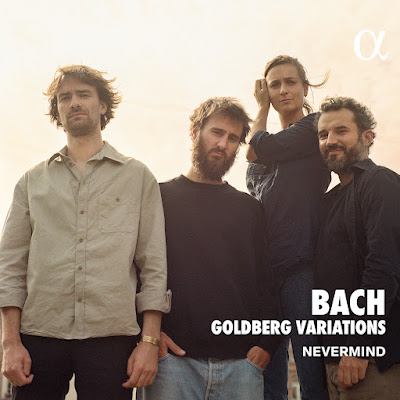
A rich new Goldberg Variations


 Nevermind - Bach Goldberg Variations

If your idea of diversity in the Goldberg Variations universe is to occasionally swap out the 1955 and 1981 recordings of Glenn Gould, you might want to expand your horizons and listen to this new arrangement of Bach's perennial best-seller, by the talented young musicians of Nevermind: Anna Besson, transverse flute; Louis Creac'h, violin; Robin Pharo, viola da gamba; and Jean Rondeau, harpsichord and organ.

You'll find the sounds of Nevermind's four instruments, in various combinations, throughout Bach's works: his sonatas for violin, for viola da gamba, and for flute, and in passages from the Passions and Cantatas. The Paris Quartets of Telemann and Les Nations by François Couperin are among the other models used in this transcription.

The spell that the Goldberg Variations weaves seems to mess with one's internal clock. I can never believe that so much happens in the 38 minutes of Glenn Gould's first version, or that even his more measured 1981 recording is still only 51 minutes. To be sure, Gould isn't generous with repeats, but there is still a feeling of time standing still in many of the variations (and in the 1981 version, of the Aria itself). Here we have the opposite effect; instead of time slowing down, there seems to be a disconnect at the end of the Aria da Capo. Surely, that hasn't been 100 minutes (over two CDs, if you're still listening on physical media)! One is carried along by the internal engine of the music, its logic, and by the often dramatic, even operatic, effect of the instrumental timbres. In his notes to his 1955 recording, Gould called this "... music which observes neither end nor beginning, music with neither real climax nor real resolution." We may have ended up where we began (time being, as we learned from True Detective, a flat circle), but what a rich experience it was!

Listening to the Goldberg Variations in a special performance on the piano or harpsichord can feel like a singular communication with the performer and the composer. This, though, is a more communal experience, not only with the four musicians, but with Bach's European network of performance practices and the traditions of music-making from the 18th century until today. For me, though, it was still a private experience that touched me deeply.

This is a journey well worth taking!

The cover photo is by Clement Vayssieres.


Wednesday, March 19, 2025

A vivid picture of a 15th century composer


 Alexander Agricola: Masses

Alexander Agricola was a Netherlandish Renaissance composer who lived and worked in France, Italy and the Low Countries from the 1470s until his death in 1506. This makes him a contemporary of Josquin des Prez, though his earliest music was written under the influence of Johannes Ockeghem, who was 30-40 years older than Agricola and Josquin.

Agricola's eccentric mixture of dense polyphony, "athletic" voice parts, rhythmic virtuosity and an often playful shifting of the musical norms of the day places him in the category of musical innovators/oddballs that includes De Lasso, Gesualdo, Biber, CPE Bach, Satie & Ives. At the same time, this is music of strange beauty and obvious religious feeling, written at a time when the religious stakes in Europe were very high indeed.

It also makes for a good match with Beauty Farm, the excellent group of six male singers who have presented, on the Fra Bernardo label, so many fine albums of Netherlandish and French Renaissance music: by Ockeghem, Gombert and Obrecht, among others. Agricola's masses on this album, the Missa Malheur me bat and the Missa in myne zyn, make for two well-filled CDs of music from a little-known master.

"Malheur me bat" is a three-part rondeau by an unknown composer; it's an example of the Phrygian mode, one of the eight church modes, which is known for its emotional character. Agricola was not the only composer to make use of this source material; there are works by Obrecht, Ockeghem and Josquin based on the same rondeau tune. But it's clear that Agricola has made a very personal work out of this common source.

Missa in myne zyn, Agricola's final mass, is based on a popular Dutch tune. I know this work from the 2010 recording on Ricecar with Capilla Flamenca under Dirk Snellings, which is also a wonderful recording. But Beauty Farm brings out a touch more character and individuality in their version, There's no holding back in the weird, and weirdly beautiful, Agnus Dei III.

There are many gaps in our knowledge of Agricola. We don't have a clear idea of when all of his major works were written, or even where he was in Europe at any given time. But the music on this disc speaks so eloquently we have a vivid facsimile of what kind of person he was. That's a tribute to both the artistry and the scholarship of Beauty Farm.

The wonderful cover image is by Muntean/Rosenblum, the collaborative artist duo of Markus Muntean and Adi Rosenblum. See more of their artwork here.


Tuesday, March 18, 2025

Let's Dance!


Unexpected America: music by Paul Schoenfield, William Bolcolm, Camargo Guarnieri, Aaron Copland, Mike Mower

Put on your dancing shoes for a well-chosen mix of South and North American music for violin and piano, from violinist Oscar Bohórquez and pianist Frank Braley.

The programme begins with a suite of Four Souvenirs for Violin and Piano, by the Detroit-born composer Paul Schoenfield, written in 1990. An opening Samba, with a slow interlude at its centre, is followed by a sultry Tango. As often happens at a dance, when a slow song comes up, things get steamy! The ghost of George Gershwin is then brought out for Tin Pan Alley. This is top rank pastiche; I definitely use that word in a positive sense! Schoenfield's finale is Square Dance, one of the most lively bits on this album. It's sad to learn that Schoenfield died just under a year ago, in April 2024, at 77 years of age. This wonderful performance makes for an elegy and remembrance of a fine composer.

William Bolcolm's lovely ragtime "Graceful Ghost" is a standout. Bolcolm really shows as well as tells; this is as graceful as any piece I've heard. The themes are so lovely, which is important in this form. With so many repetitions in a ragtime,  each of the tunes must be embraced on its return. Bolcolm's six minute piece never wears out its welcome; this is salon music of the highest level.

Mozart Camargo Guarnieri's Violin Sonata no. 4 is a substantial work in a standard classical music form, but even here one feels the built-in rhythms of the choros, the urban popular music of Brazil. Written in 1956, while his (and every other Brazilian composers') master, Heitor Villa-Lobos, was still alive, Guarnieri's Sonata looks back to Villa's three violin sonatas of the early 1920s, which made such a stir at the Semana de Arte Moderna in Sao Paulo in 1922. The typically Brazilian version of nostalgia - saudade - is evident in the lovely Intimo slow movement, though Guarnieri really lets loose in the raucous Allegro appassionato finale, which has Villa's fingerprints all over it. By the way, Mozart was really Guarnieri's given name; his brothers were Bellini, Verdi and Rossine. A tough act to follow, on top of the Villa-Lobosian elephant in the room, but Guarnieri never seems to have lacked for self-confidence. His music always displays complete self-assurance and equanimity.

Aaron Copland's Nocturne, from 1926, is another slow dance in a modernist idiom. Perhaps it's the context of this programme, but this American music heard through a Parisian lens, with Nadia Boulanger's fingerprints this time, very much feels at home in South America as well. Copland made many personal and professional connections among Latin American musicians through his involvement in Nelson Rockefeller's Good Neighbor initiative of the WWII years, but that was still in the future.

The last work on the disc is the beguiling Bossa Merengova from the British composer Mike Mower's Sonata Latino, from 1994. This clever mix of the Brazilian bossa nova and the Cuban merengue shows the underlying connections between the various dance traditions of Latin America. Again with a wistful element to go with the sprightly rhythms, this is a wonderful way to end a wonderful programme.

Bohórquez plays a Guarneri del Gesù violin on which he produces a beautiful tone; his familiarity with the various musical traditions of Latin America results in completely idiomatic performances. He and pianist Frank Braley really swing this music when required; it's important to stress the folkloric component of this music, especially in a work like the Guarnieri Violin Sonata, with its erudite, academic, component.