Reviews and occasional notes on classical music

Reviews and occasional notes on classical music

"Music, both vocall and instrumental, so good, so delectable, so rare, so admirable, so super excellent, that it did even ravish and stupifie all those strangers that never heard the like." - Thomas Coryat, after hearing 3 hours of music at the Scuola di San Rocco in Venice, 1608.

Thursday, September 27, 2018

Fresh and lively Schubert


Now that Historically Informed Practices are closer to the mainstream of classical music one is less likely to come across a surprisingly different performance, even of early 19th century works, but here we are with a completely re-thought album of Schubert's symphonies. René Jacobs and the B'Rock Orchestra present the freshest and most lively Schubert I've heard in a long time; the cobwebs are gone, the light is let in, and one can hear the most interesting musical connections to different genres of operatic, orchestral and popular music, and especially to the carnival traditions of Vienna. Jacobs provides a long essay that breaks down each movement in the two symphonies, the First from 1813, and the Sixth from 1817-18. Reading it is like watching an expert restorer of Old Master paintings. He shows more than musicological expertise, though; he makes a convincing case for presenting the finale of the Sixth Symphony as Schubert's musical depiction of a procession from the Carnival.

Rudoph Ackermann. Characters in the Grand Fancy Ball Given by the British Ambassador Sir Henry Wellesley
at Vienna, at the Conclusion of the Carnival 1826
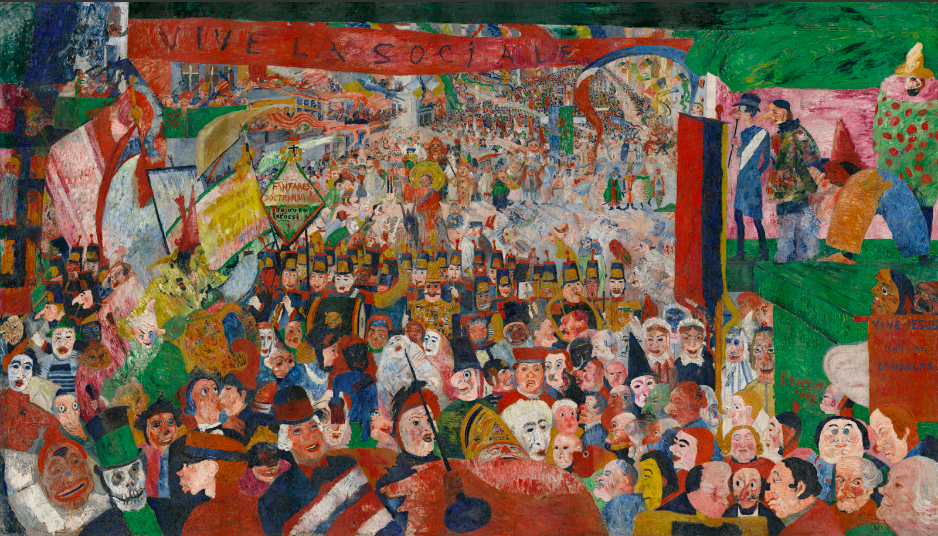
In an extraordinary passage, Jacobs illustrates the music by referring to a great painting, now in the J. Paul Getty Museum, by the Belgian James Ensor (René Jacobs and the B'Rock Orchestra hail from Ghent):
James Ensor’s monumental 1888 painting ‘The Entry of Christ into Brussels’ comes very close to the “meaning” of this final movement as I see it: Christ, although placed at the centre of the huge picture, is a small, lonely, sad figure, almost drowning in a sea of ugly masks and guises. It’s carnival time, and the little Christ is Ensor himself... I wonder if behind the many exuberant notes of this movement, a small, lonely and sad Franz Schubert is hiding.

All the musical and cultural insights into this music are impressive indeed. That along with the outstanding performance of the players of the B'Rock Orchestra makes this a special release indeed.

This album will be released on November 2, 2018.

Tuesday, September 25, 2018

Sad stories about death and dying


Shostakovich: String Quartet no. 8; Schubert: String Quartet no. 14

A picture lives by companionship, expanding and quickening in the eyes of the sensitive observer. It dies by the same token.
 - Mark Rothko
Masterpieces meet at Sothebys: Rothko's Untitled (Yellow & Blue), 1954 and Van Gogh's L'Allee des Alyscamps, 1888
📷 Mary Turner, 2015

Matching two or more works from different eras is a tried-and-true programming trick for concerts or recordings, which works often enough that I would never want to see it fall out of favour. A stellar example is the Aris Quartett's new disc, with sparks flying back and forth between Shostakovich and Schubert, both of whom show an intensity of feeling belied by the often calm surfaces of their string quartets. The one work calls to the other, like a Rothko and a Van Gogh hung together, yellows reflecting off each other, and blues pulling each together. The concept works best, of course, with two masterpieces masterfully played. The Aris players, quite correctly, I think, play the Shostakovich first. It's a harrowing mash-up of all sorts of horrors: historical (it's dedicated to the "victims of fascism and the war"), political (coming after the composer's humiliating forced membership in the Communist party), and personal (he had recently experienced the first symptoms of what was eventually diagnosed as ALS). In spite of all of this the 8th Quartet is one of Shostakovich's best known and popular works, both in its original form and in Rudolf Barshai's transcription for string orchestra as the Chamber Symphony op. 110a. The 14th Quartet of Schubert, named for his song "Death and the Maiden" was also written in response to a health crisis, and Schubert's own knowledge of his impending death, and it too contains music of surpassing beauty.

The intense feelings of both of these works create both tensions and release, within each piece and between the two. Set in this frame, these fine musicians tell us incredibly sad stories about death and dying in the 19th and the 20th centuries. I felt privileged to hear these stories again and again as I listened to this album, every time hearing new facets of sadness, anger and the comforts of beauty and love. This is a significant achievement for Genuin and the Aris Quartett.


Saturday, September 22, 2018

Except in his own town


Rued Langgaard: Symphonies no. 2 & 6; Jacob Gade: Tango Jalousie

Here's a common problem among artists and Messiahs:
Jesus said to them, 'A prophet is not without honor except in his own town, among his relatives and in his own home.' - Mark 6:4
Rued Langgaard had not inconsiderable success in Germany and Austria, but his music never caught on at home in Denmark. So it's good to have this very fine disc from Europe's musical heartland, with Sakari Oramo conducting the Vienna Philharmonic Orchestra, though I hasten to point out that the recording is published by DaCapo, "the Danish national label". So in that sense, Rued, you can go home again.

These are beautifully crafted symphonies, full of appealing melodies and interesting side-trips away from the main themes. "Digression is the sunshine of narrative," says Lawrence Stern, and further, Adam Phillips calls it "secular revelation." While you can hear some strains of the Great Dane Carl Nielsen in this music, and somewhat more Sibelius, it's Richard Strauss who comes most to mind, especially in the very fine 2nd Symphony, written in 1912-14. All three of those composers were born in the 1860s, while Langgaard is 30 years younger. It's no surprise that this relatively conservative but very appealing music, more or less untouched by modernism, was such a hit in central Europe before the Great War.

A lot of things were different after that conflict, of course, but Rued Langgaard's music kept to a certain path, and his somewhat prickly and difficult temperament kept him on the outs with the musical establishment at home. He set himself up in opposition to Carl Nielsen, but unlike in the great Jack Benny-Fred Allen feud to come, there seemed to be no benefit to either composer. This is really a marketing issue, though, since you can hear Langgaard's 6th Symphony from 1920 as a kind of response to Nielsen's 4th Symphony, written in 1916. The serious nature of this symphony speaks more to Langgaard's musical evolution, though, rather than any polemical agenda, as much as he aggressively promoted one or another for most of his life.

Both of these symphonies have moments of transfiguration, in the Richard Strauss tradition, but they're relatively short on light, and nearly devoid of real joy. This is serious music from a dour man, and I can't help comparing Rued Langgaard with a near contemporary prophet who also had problems at home, Heitor Villa-Lobos. In spite of many personal and artistic trials, Villa-Lobos was a true optimist whose music nearly always expresses the same joyful spirit of music itself, which he felt was embodied in, and expressed most perfectly through, Johann Sebastian Bach.

Perhaps in response to this dour hour, Sakari Oramo adds a delightful coda: the Tango Jalousie of another Danish composer, Jacob Gade. With their own light music always right at their finger-tips, the Viennese musicians provide us with an up-beat finale to a thoughtful but severe concert.

Thursday, September 20, 2018

Salt-pepper-chromatic sidesteps


Brahms: Symphony no. 3, Segerstam: Symphony no. 294
getting ahaa extasy moments from shiverings in an octavepusspasm in either major or minor directions into complextonal myceliums taking salt-pepper-chromatic sidesteps allowed in between... in the wonders of experiencephenomenologic dualisms: Love-Hate, Life-Death, richness-poorness, lightness-darkness, humidity-dryness, warmth-coldness, quicknessslowness, acceleration- retardation, fractalic straightlines-aerodynamic parables etc.
This is a small bit of the liner notes essay written by Leif Segerstam for the third episode in the Brahms/Segerstam Symphonies series from Alba. I like to think of it as just a thousand or so words plucked at random from a multi-volume Finnegans Wake-style tome explaining Segerstam's odd, and oddly appealing, musical world. So much can be divined by carefully parsing Segerstam's interpretation of the four great orchestral works by Johannes Brahms, and there is more information imbedded in the symphonies from Segerstam's own late works. But there are plenty of blank areas left on the map to puzzle over.

The first album exploring the musical worlds of what Segerstam calls "the beardy brothers" matched Brahms' First Symphony with Segerstam's Symphony 288. The second had the Second Symphony and the 289th. This release has the sunny Third Symphony to go with Segerstam's 294. Not that the Finnish composer is using Brahms as a model. Rather, it's Sibelius's 7th Symphony that provides the scope and structure, while the musical language is rather more like Penderecki or Rautavaara. As to the Brahms, we once again have things slowed down to a surprising extent. It's like Segerstam has stopped everything, and he's picked up the Symphony and is turning it around in his hands, examining it closely. The orchestral playing is gorgeous, but all the tension and life is gone; it's like we're driving a car with most of the air let out of the tires.

I can't help thinking that Segerstam is up to something other than just recording a well-known and well-loved symphony. Is this a case of everyone else playing checkers while Segerstam is playing chess? Let me ponder that for a while...

Sunday, September 16, 2018

The shape-shifting composer


Lars-Erik Larsson: Symphony no. 3, Three Orchestral Pieces, Adagio, Musica permutatio

That Lars-Erik Larsson withdrew all three of his symphonies after they were first performed shows a certain lack of confidence in his own abilities as a symphonist. On the evidence of three successive CPO recordings with Andrew Manze conducting the Helsingborg Symphony Orchestra this seems more a sign of imposter syndrome than any compositional weaknesses, though to be fair Larsson was working in the shadow of a daunting range of Nordic symphonies, from Stenhammar, Nielsen and Sibelius to contemporaries such as Holmboe and Pettersson, and in between, Atterberg. Larsson is best known for his rhapsodic, pastoral orchestral pieces and suites, but the Third Symphony, premiered in 1946, is especially full of the same appealing melodies and dynamic pacing one finds in his better known works, though not developed quite as freely. We have in this symphony, perhaps, just a bit of what some athletes call 'the yips', a tightening-up with a resultant loss of fluency.

In his Gramophone review of the first disc in this series, Guy Rickards calls Larsson "a musical magpie", and that continues here. Right from the beginning he makes reference to the insistent rhythms of the Scherzo to Schubert's 9th Symphony. Christoph Schlüren, in his detailed and informative liner essay, mentions both Beethoven's 5th Symphony and Borodin's 2nd in the same context. By the way, the impressive waltz-like second theme of the 1st movement was "borrowed" by George Duning for the jaunty main theme for his Bell, Book and Candle film score from 1958, though he adds bongos. I expect this is just a coincidence, since it's very unlikely this music had made it to Hollywood then. It's a fun game to track down these quotes, in both directions, and I don't believe his homages diminish Larsson's music especially. In the end the performance of Manze and his players won me over.

Rickards also mentions that Larsson "flitted between styles throughout his life," and we have two surprising pieces here - the 3 Orchestral Pieces, op. 49, and the Adagio, op. 48, that show his experiments with what Schlüren terms a "free twelve-tone style." These manage to compress the usual Larsson material into a much tighter construction and a darker than usual mood, but still with more than a bit of the Larsson charm. I found the Adagio especially appealing, though it's striking how optimistic Larsson sounds here, in what one might consider Allan Pettersson territory.

There's a further stylistic shift with the final work on the disc, the Musica permutatio, which was also the final work of Larsson's life. Freer harmonically, it's very much a learned work, with impressive contrapuntal passages. It was premiered in 1982, four years before Larsson's death.

This disc will be released on October 5, 2018.

Thursday, September 13, 2018

A fascinating concert of 20th century masterworks


40 Years of Contemporary Music: Chamber works by Villa-Lobos, Ginastera, Webern, Terzian, Berio, Boulez, Schreker

Alicia Terzian begins a fascinating program of contemporary chamber music with one of the great works of Brazilian modernism, the Seventh Choros of Heitor Villa-Lobos, written in 1924. The 37-year-old composer spent most of that year in Paris, rubbing shoulders with Ravel, Cocteau, Stravinsky, Prokofiev and others, though he also brought with him his own strongly modernist works he'd written in Brazil. 1924 was a banner year for modernism on both sides of the Atlantic, by the way, with the publication of both Oswald de Andrade's Manifesto da Poesia Pau-Brasil and André Breton's Manifeste du surréalisme (though as Desmond Morris notes in his recent Lives of the Surrealists, the tone-deaf Breton wasn't interested in adding musicians to his group). It's refreshing to see Villa-Lobos in this modernist company, rather than the parrots-and-jungle exoticism that usually surrounds him. This is a marvellous version of this work, as well. It's subtitled "Settimino" (which means "Septet"), and it's written for flute, oboe, cello, clarinet, alto saxophone, bassoon, tam-tam and violin. I counted twice, and both times I got 8 instead of 7. I figure the tam-tam isn't counted, like when Ringo plays the tambourine. They're still the Fab Four.


Alberto Ginastera's Pampeana no. 2 for cello & piano comes from 1950, and thus is written in what he called his Subjective Nationalism style, a transition between with folkloric Objective Nationalism of his early years and the avant-garde Neo-Expressionism he worked in after 1958. This is an appealing piece, with Latin rhythms becoming insistently astringent and abstract. It's a fine bridge between the Latin American works and those of the Europeans later in the program.

The 8 Early Songs, a work without opus number by Anton Webern, is the earliest on this program. It's from 1901-04, and shows the strong influence of Wagner, Mahler, Richard Strauss and Hugo Wolf. Soprano Marta Blanco and pianist Claudio Espector are effective advocates for these marvellous, slightly naive but always characterful songs. I hadn't heard this music before, and I'm so grateful that it was included on this disc.

Marta Blanco is also featured in the version for voice and five instruments of Luciano Berio's O King, written in response to Martin Luther King Jr.'s assassination in 1968. I recently reviewed a fine recording from Seattle of O King in its extended version for eight voices and orchestra, and it's fascinating to hear a kind of essential distillation of this landmark work, which is all kinds of bleak, but ultimately somewhat hopeful.

Dérive by Pierre Boulez is the same kind of puzzle music that Bach and Mozart delighted in. He shifts and shuffles around a six-note chord among six instruments, and by changing the intervals derives new chords (hence the name). After five derivations, the original chord returns, and then fades into silence. At the highest level of sophistication one can hear and follow along these changes; if not one can puzzle them out while following along with the score. The rest of us might be content with the general idea that there are basic transformations happening, while enjoying the ornate decorations

Alicia Terzian contributes two works to the program. Yagua Ya Yuca for percussion is five minutes of ingenious sounds, alternately wistful and intense. Les Yeux Fertiles for voice and five instruments, is a setting of fragments of poems by Paul Eluard, serious mood pieces all.

Franz Schreker's Der Wind was written in 1909 as a ballet, though it was never performed in his lifetime. It's an occasionally jolly but ultimately sadly nostalgic piece, untroubled by the more experimental modernism of his contemporary Arnold Schoenberg. This work is a fine ending to a fascinating concert of twentieth century masterworks.


The spot-lit miracle


Das Neugeborne Kindelein: Christmas Cantatas by Buxtehude, Telemann and J. S. Bach
Although we are deeply indebted to the light, because by means of it we can find our way, ply our tasks, read, distinguish one another; and yet for all that the vision of the light itself is more excellent and more beautiful than all these various uses of it. The contemplation of things as they are, without error or confusion, without substitution or imposture, is in itself a nobler thing than a whole harvest of invention.
 - Francis Bacon *
Old Master paintings on the covers of classical music discs can be a bit of cliché, but occasionally an especially relevant one is chosen, and that's definitely the case with this new Accent disc of Christmas cantatas from Baroque Germany, performed by Sigiswald Kuijken and La Petite Bande. The Adoration of the Shepherds by Gerrit van Honthorst, painted in 1622, and now in the Wallraf-Richartz-Museum in Cologne, is an amazing presentation of the nativity. It's a Caravaggesque interpretation of John 1:9, "The true light that gives light to everyone was coming into the world." Sigiswald Kuijken has made that connection as well, in his excellent liner notes, which emphasize the  intimate atmosphere, but which, he says, "by no means excludes theatrical effects!" Of the beautiful Buxtehude In dulci jubilo he says:
... the fourth verse shines (as if under a halo) in a completely new glow, in that the two violins suddenly express the joy of the angels (“gaudia”) with their “ringing bells” in a frenzy of rapid movements.
Even in the early 18th century Christmas was a time to mix traditional music with newer, forward-looking sounds. I love Georg Philipp Telemann's archaic-sounding cantata Ein Kindelein so löbelich, TWV 9:5, from around 1720, but sounding at least a century older, at least until an Amen that sprouts Baroque curlicues around the more severe contrapuntal sounds of the stile antico. This is virtuoso composition that plays with styles in a kind of Enlightenment Post-Modernism. J. S. Bach's gorgeous cantata Ich freue mich in dir, BWV 133, from 1724, is a perfect example of how the great composer turned music into sounds of pure joy. Kuijken and La Petite Bande provide a joyful interpretation of the theatrical intimacy in this music, as apt an illustration of the show-stopping, spot-lit miracle that was the Nativity as the great painting of Gerrit van Honthorst.


* The quote from Francis Bacon, which is more or less contemporaneous to van Honthorst's painting and a century of more before the music on this disc, is from Temporis Masculus Partus, 'The Masculine Birth of Time', from 1605. It's well-known today, as you'll quickly see from a Google search, because the great photographer Dorothea Lange had the last sentence posted on her darkroom wall.

Dorothea Lange, Migrant Mother, Oklahoma, 1936

This disc will be released on October 19, 2018.